





We’re living through a moment that will be studied in textbooks.
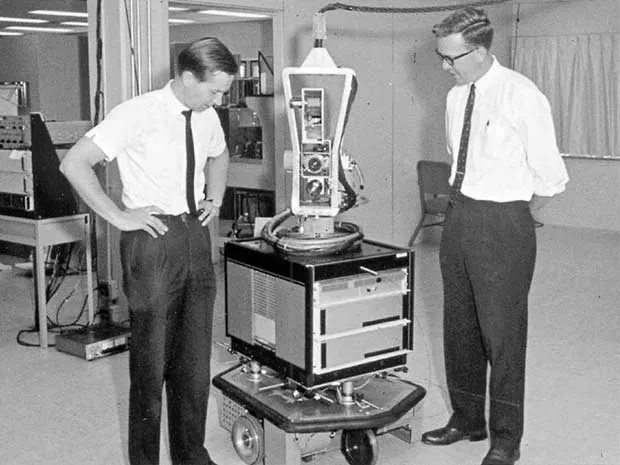 Shakey, the first intelligent robot (SRI International, 1966). Source: The New Stack
When Andrej Karpathy coined the term vibe coding to describe a new way of building software by collaborating with AI rather than typing every line by hand, it felt like a playful provocation. Months later, Collins Dictionary named it Word of the Year. What started as an experiment became a paradigm. And then it went further. We entered the agentic era: AI that doesn’t just generate snippets but reads your codebase, forms a plan, makes changes, runs tests, sees what fails, and adjusts, showing intelligence and unexpected capabilities, using tools the way humans do.
In early 2025, a single engineer at Cloudflare rebuilt the entire Next.js framework on top of Vite in about a week. Not a team of twenty, not over months of sprints: one person, empowered by AI. Then Cloudflare took it further: they used AI agents to build a WordPress-compatible CMS from scratch, rewritten in TypeScript on Astro, with sandboxed plugins and native AI integrations including an MCP server. Simon Willison, co-creator of the Django framework, built a complete macOS application in Swift in 45 minutes, a language he’d never written in before.
These aren’t anecdotes from a distant future. They’re happening right now.
A pattern as old as innovation itself

The architects in this photo don’t know their drafting tables are about to disappear. We’ve seen this pattern repeat. When calculators arrived in classrooms, teachers worried students would forget arithmetic. When AutoCAD entered architecture firms, drafters feared they’d become button-pushers. In 1492, Johannes Trithemius, a German abbot, wrote In Praise of Scribes, a passionate defense of manual copying in an age when Gutenberg’s press was making it obsolete. The irony? His book was printed. Trithemius wasn’t wrong about the value of craftsmanship. He was wrong about what would happen to that value in a world of new tools.
In every case, the tool didn’t eliminate expertise: it raised the floor, accelerated the work, and freed professionals to focus on what truly required human judgment.
The question isn’t whether AI will change how we build software. It already has. The question is whether we’ll approach this change with curiosity and intentionality, or resist it out of attachment to how things used to work.
Our position is clear
At SparkFabrik, we have chosen to embrace AI fully and deliberately. Not because it’s fashionable, but because we believe it amplifies what has always mattered most: the ability to understand complex problems, design thoughtful solutions, and deliver real value.
We are already integrating agentic development into our workflows: from analysis and design to coding, review, testing, and delivery, within our DevOps and Cloud Native practices. Some of these bets are already in production: in key company functions, tools built with an AI-first approach are concretely changing the way we work every day.
We see AI not as a replacement for our expertise, but as a multiplier of it.
This doesn’t mean we’re naive about the challenges. Adopting AI well requires new skills, new habits, and a willingness to rethink processes that have served us for years. It means being honest about what AI does well and where human judgment remains irreplaceable. It means building a culture where experimentation is exciting, not frightening.
We believe this shift extends beyond engineering. It involves everyone: developers, designers, project managers, cloud engineers, each contributing to how AI is understood and applied across our work.
Human relations at the center
SparkFabrik was founded on the conviction that the best technology comes from the harmony between deep technical skills and strong human relationships. AI doesn’t change that conviction: it reinforces it.
The companies that will thrive in this new era won’t be the ones with the most sophisticated tools. They’ll be the ones whose people know how to wield those tools with purpose, creativity, and care for the people they serve.
That’s who we intend to be.


