





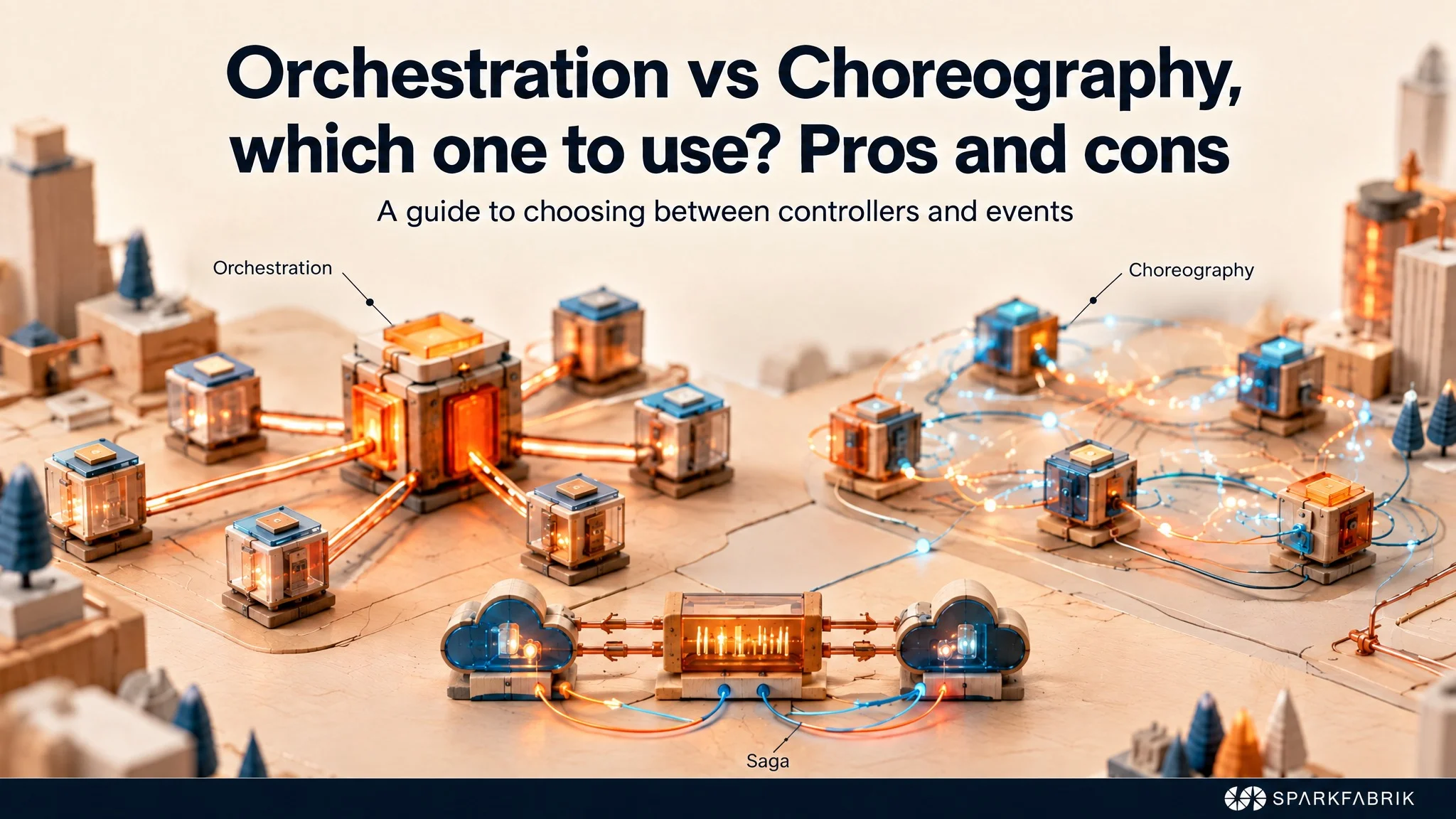
Cloud native refers to a way of building applications as a collection of independent microservices, deployed in containers and managed on cloud platforms. In this model, the central challenge is not writing individual services, but coordinating their interactions, and the two main approaches are orchestration and choreography. Neither wins outright: what matters is the number of services involved in a flow, who must own the business logic, and how many failures you are willing to handle manually. We analyze how orchestration, choreography, and hybrid approaches work, along with their pros and cons.
Before diving into the details, it is useful to position the two approaches across the three architectures encountered in migration projects: monolithic, cloud enabled, and cloud native. Orchestration and choreography only become a real choice in the last column; in the first two, coordination remains hidden within the code.
| Feature | Monolithic | Cloud Enabled | Cloud Native |
|---|---|---|---|
| Structure | Single deployable, tightly coupled modules | Monolith or few large services moved to cloud VMs or containers | Independent microservices, each with its own release cycle |
| Component communication | In-process calls | Mostly synchronous (REST, RPC), often to a shared database | Synchronous or event-driven, with message brokers and explicit API contracts |
| Scalability | Whole application | Horizontal, by replicating the entire block | Per single service |
| Flow coordination | In code, single transaction | In code, with some external queues | Orchestration (coordinator service) or choreography (events) |
| Failure management | Transactional rollback | Manual retries, shared state | Saga, compensations, idempotency |
| When it makes sense | Small domain, single team | Lift-and-shift migration without rewriting | Large domain, multiple teams, frequent releases |
Cloud native refers to applications designed from the start for the cloud: independent services running in containers, deployed and scaled individually. A microservices application built this way differs from a monolithic architecture for a practical reason: a monolith calls its functions in memory, whereas microservices must communicate across the network. Who decides who calls whom, in what order, and what happens when a service does not respond? Two different approaches answer this question: Orchestration vs Choreography.
Before comparing them, it helps to distinguish genuine cloud native architecture from what is often marketed as such, because the challenge of service coordination only arises in the final column of this table.
| Approach | Application structure | Deployment and scalability | Component communication | Orchestration or choreography? |
|---|---|---|---|---|
| Monolithic | Single codebase and single process | Released and scaled all together, even if the bottleneck is a single module | In-memory function calls, transactions on a single database | Not needed: the flow is in the code |
| Cloud Enabled | Monolith migrated to cloud infrastructure, often in a VM or large container | Benefits from infrastructure elasticity, but remains a single block to release | Unchanged compared to the monolith | Not needed: where it runs changes, not how it is built |
| Cloud Native | Independent microservices, each with its own lifecycle and data | Each service is released and scaled independently, typically on Kubernetes | Synchronous network calls (REST, gRPC) or asynchronous events (Kafka, RabbitMQ) | Essential: you must choose how services cooperate |
In this in-depth guide, we will first take a step back to clearly define the context. We will then examine in detail how both approaches are structured: orchestration and choreography. Finally, we will look at how they can be combined, in which situations they can be applied, and their respective limitations.
Orchestration vs choreography: how to coordinate microservices in a cloud native architecture
Cloud Native applications are almost always built as a set of microservices running in containers (Docker being the most common case), released and updated through CI/CD (Continuous Integration/Continuous Deployment) pipelines and DevOps practices. For a complete overview of principles, tools, and architectural patterns, see our complete guide to cloud native applications.
There are several possibilities. One possible model is “serverless”, offered for example by AWS Lambda, which executes code blocks in response to specific events and automatically manages the underlying compute resources.
Returning to microservice architecture, the advantage lies in breaking down the application into a series of composable and reusable services. Small, lightweight, easy-to-implement services lead to lower development and modification costs and make scaling fast and simple.
To make this system work, you need a coordination method that enables microservices to work together. There are essentially two approaches: orchestration and choreography, terms drawn from the performing arts that reflect their respective dynamics.
While no analogy is perfect, this one captures the core distinction between the two approaches. An orchestra has a conductor who directs the musicians moment by moment. Choreography, on the other hand, is designed beforehand by a choreographer, and the dancers move freely during the performance. They are not controlled in real time; instead, they decide what to do at each moment based on the choreography they learned and the music that is playing.
What orchestration is and how it works
As mentioned and as the name suggests, orchestration is based on the idea of a central system that controls all interactions between the various elements of the system, namely the microservices.

In this approach, the key word is “supervision”: ensuring compliance with individual instructions. In orchestration, a service acts as a controller and manages communications between individual microservices, ensuring that each service executes its assigned role.
The controller is a true middleware, software that provides common functionality and services to applications. In general, middleware acts as the connective tissue between different application layers. In the specific case of orchestration, the middleware component serves as the supervisor controlling interactions between microservices.
Orchestration covers a wide range of tasks. For example, Kubernetes allows declarative management of orchestrated resources by abstracting the underlying physical layer: different nodes and machines are treated as a single pool of compute resources.
Declarative configuration management operates via a control loop. Just like a thermostat in a room: once the desired state is defined, the thermostat checks the current state and acts to bring it as close to the desired state as possible. In the case of Kubernetes, controllers watch the cluster and make or request changes to the current state when necessary.
In short, the orchestrated approach is based on building a centralized, well-organized Business Process Management (BPM) system capable of providing application stability and making its state easily measurable and modifiable.
Orchestrating containers is not orchestrating processes
Kubernetes and a process orchestrator like Temporal or Camunda share a name, but operate at two levels that do not touch. Kubernetes coordinates the compute layer: it decides which node runs a pod, restarts it if it crashes, increases replicas when CPU exceeds a threshold, and exposes a service to others. It does not know that the payment pod must be called after the orders pod and before the inventory pod, nor what to do if payment fails. To Kubernetes, there are only healthy or unhealthy containers, not paid or refunded orders.
A workflow orchestrator, on the other hand, operates at the application level. Temporal, Camunda, Netflix Conductor, or AWS Step Functions persist the state of every process instance, manage retries, timeouts, and compensations, and know exactly which step every single business transaction is in. Their code, incidentally, almost always runs inside Kubernetes pods: the two layers overlap physically precisely because they are logically independent.
| Layer | What it coordinates | State it manages | Examples | Failure it resolves |
|---|---|---|---|---|
| Infrastructure | Containers, pods, nodes, network | Desired vs active replicas, process health | Kubernetes, Docker Swarm, Nomad | A pod crashes and is recreated |
| Application | Business process steps | Workflow instances, outcome of each step, compensations | Temporal, Camunda, Conductor, Step Functions | Payment fails and the order is cancelled |
Confusing the two leads to a practical issue we often encounter during assessments: “we use Kubernetes, so our architecture is orchestrated.” That is false. We heard this from an e-commerce platform whose checkout was distributed across roughly ten services choreographed via Kafka, without any application controller: when the payment gateway timed out, the order remained confirmed in the warehouse but was never charged, because no component handled compensation. The Kubernetes control loop described above is a good example of an orchestrator, but it operates on containers, just as a monolith on a single VM can contain a BPMN engine. The choice between orchestration and choreography belongs to the application level and must be made regardless of how pods are scheduled, as we show in our guide to cloud native applications.
Tools for orchestration
Orchestration tools operate on two levels. For containers, Kubernetes is the de facto standard and the best-known example of an orchestrator: it schedules pods, restarts them, and scales them. For business processes, workflow orchestrators like Temporal, Camunda, and AWS Step Functions persist the state of each instance and manage retries and compensations.
The Cloud Native Computing Foundation (CNCF), which hosts the Kubernetes project, also supports other orchestrators at varying levels of maturity. Crossplane completed the incubation process and achieved graduated project status in 2025, reaching the same maturity level as Kubernetes1, making it the benchmark for control plane management. Five other orchestrators remain in intermediate CNCF stages (sandbox or incubation): Fluid, Karmada, Open Cluster Management, Volcano, and wasmCloud.
Read also: What container orchestration is and how to do it with Kubernetes
Limitations of orchestration
Here is a summary of the disadvantages of the orchestration approach.
Latency and service availability issues
In orchestration, the controller must communicate directly with each service to instruct it on what to do. It must therefore wait for communication to be established and for the service to respond.
When an architecture consists of hundreds or thousands of microservices, this can create service availability issues or excessive latency.
The limitation is not a fixed number of microservices, but the fan-out of the controller: if the orchestrator calls eight services in series with a network latency of 30-50 ms each to complete a transaction, the worst-case response time is the sum of all eight calls, not just the slowest one. A checkout that responds in 80 ms in isolation ends up with a p95 over 400 ms, and every service added to the chain pushes that percentile up by tens of milliseconds. When the controller coordinates more than a dozen synchronous dependencies for a single operation, and modifying any of them requires updating the controller logic as well, you have effectively rebuilt a monolith inside a distributed environment: a single point of deployment, failure, and latency, with added network overhead between steps.
Excessive dependency between microservices
Orchestration creates a strong dependency between individual services, especially when they operate synchronously. One service must explicitly respond to requests from another.
When relationships involve such tight coupling, any break in the chain can halt the entire process. In an enterprise environment, with thousands of microservices supporting a single business function, the one-to-one approach cannot scale.
RESTful APIs and scalability challenges
Regarding scalability, the third challenge of the orchestration approach is the use of RESTful APIs, which are themselves tightly connected services. RESTful APIs are defined by a set of architectural constraints for distributed systems. They communicate over HTTP in a stateless manner for uniform resource sharing, using a universal syntax and global identifiers.
From our perspective, using RESTful APIs tightens service coupling even further within the architecture, increasing the cost and impact on APIs whenever functionality is added or removed. Here too, the ultimate issue is scalability.
The choreography approach: what it is and how it works
Choreography takes a completely different, fundamentally decentralized approach. Extending the dance troupe metaphor, service choreographies are not executed; they are enacted.
This means enactment occurs when participants carry out their roles autonomously. No component follows an explicit order; instead, each knows a set of actions it must perform in relation to the other components it interacts with.
The choreographic approach is based on the idea that a central control element, the orchestrator (middleware like Kubernetes), is redundant. Individual components, the microservices, must be capable of self-management without external intervention, coupled loosely rather than tightly.

This means loosely coupled microservices must be able to deliver maximum business value on their own, without directly impacting other components. This reduces complexity because there is no central controller to program and manage. Furthermore, there is no single node that could become a critical bottleneck for the entire infrastructure in the event of issues.
How do microservices exchange messages without middleware?
In choreography, this is handled by a component called an “event broker” (or message broker). Coordination follows a sequence of steps. Each microservice that completes an action publishes a message to specific channels. Other microservices subscribed to that channel receive the message and determine their own next steps, as they are designed to respond automatically to specific events (event-driven).
Communication is asynchronous. Returning to the dance analogy, dancers (microservices) listen to the music (the event broker) to move.
Adopting loose service coupling makes it possible to modify microservices (adding or removing them as needed) without rendering the underlying logic unusable or requiring rewrites.
Tools for choreography
As with orchestration, several solutions are available in this space.
The heart of a choreographic architecture is the event broker mentioned earlier: it ensures genuine decoupling between microservices, because the publisher of an event does not know and does not need to know who will consume it. The most common examples are Kafka, a distributed log that persists events and allows replaying them, and RabbitMQ, an AMQP broker that routes them via exchanges and queues. In AWS environments, this role is fulfilled by Amazon SQS, which AWS highlights alongside SNS and EventBridge in its event-driven architecture overview.
In addition, an event-driven architecture integrates well with two tools serving distinct purposes: a service mesh like Istio, which governs network traffic between services (mTLS, retries, routing), and Dapr (Distributed Application Runtime), a graduated CNCF project since 2024 operating at the application layer to provide ready-made building blocks for pub/sub, state management, and workflows while abstracting the underlying message broker.
Limitations of the choreography approach
Choreography automates asynchronous message exchange among microservices using distributed, event-driven control logic designed to execute processes spanning multiple domains. The benefits are twofold: it eliminates single points of failure and enables scaling without performance loss. It also allows modifying processes without compromising the application logic defined by individual microservices.
However, the choreography-based approach also introduces several challenges:
A mindset shift is a prerequisite
The need to change mindset and rethink how microservices operate is a prerequisite. In this sense, it can be considered a limitation: not every team is ready to apply choreography effectively.
Managing the end-to-end process is harder
With choreography, the business process is literally scattered across various microservices, each possessing greater autonomy because it is loosely coupled to the others. This makes it harder to maintain an overarching view of the overall process and manage it effectively.
High complexity
Finally, the primary limitation of choreography in microservices is complexity. Each service identifies its own relevant logic and reacts independently based on incoming messages from the channels it monitors. The risk of failing to operate this architecture properly is high.
The third way: the hybrid approach
A third approach to managing microservices is a hybrid model combining synchronous and asynchronous elements.
The hybrid approach uses a centralized, orchestration-based model for individual services and a choreographed model for communication between services.
This approach lets you leverage an orchestrator for better visibility and control over microservices, while using choreography to allow individual service workflows to execute separately and autonomously.
The Saga pattern: orchestration and choreography tested by distributed transactions
The clearest test for comparing both approaches is data consistency. In a monolith, a checkout flow that creates an order, charges payment, and deducts inventory runs within a single ACID transaction: if payment fails, the database rolls everything back. With three microservices and three separate databases, that single transaction no longer exists. The Saga pattern replaces it with a sequence of local transactions, each accompanied by a compensating transaction that undoes the preceding step (refunding payment, restoring inventory, cancelling the order).
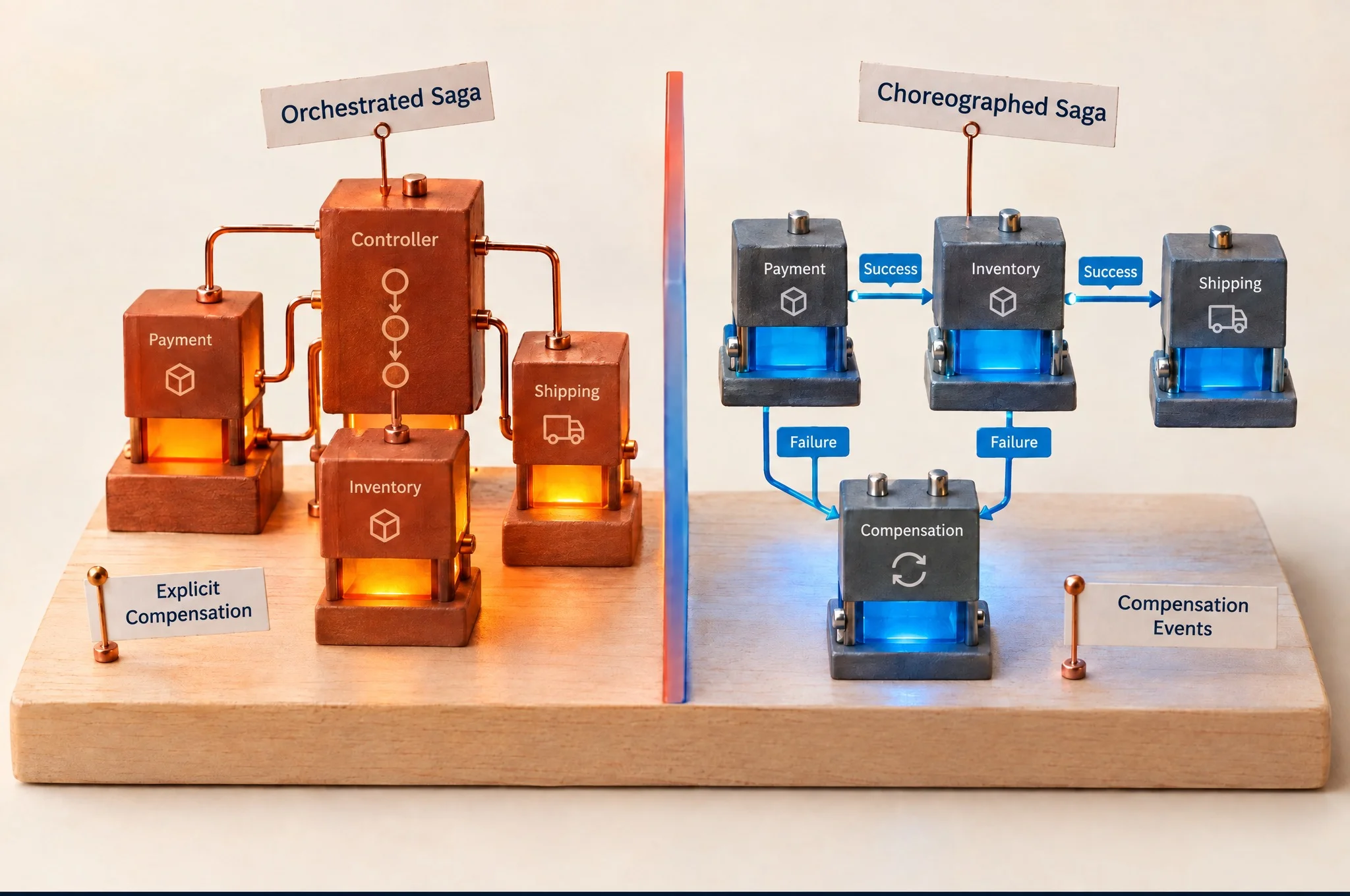
The pattern comes in two variants that mirror the exact distinction explored in this article.
In an orchestrated saga, a dedicated component, the saga orchestrator, sends a command to each service, waits for the outcome, and, upon the first failure, executes compensations in reverse order. Tools like Temporal, Camunda, or AWS Step Functions are designed for this: saga state is persisted centrally, making it easy to see the status of every single order. The tradeoff is a component that knows all services, which, if left unchecked, risks turning into a “god service” that centralizes business logic for half the system.
In a choreographed saga, there is no coordinator: the orders service publishes OrderCreated, the payment service consumes it and publishes PaymentCompleted or PaymentFailed, inventory reacts to the former, and orders reacts to the latter by cancelling the order. Compensation is not defined in any single place; it emerges from reactions to failure events. This works well for up to four or five steps. Beyond that, the flow becomes difficult to trace, and circular dependencies can emerge between services listening to each other.
| Criterion | Orchestrated Saga | Choreographed Saga |
|---|---|---|
| Where flow logic lives | In the saga orchestrator | Distributed across participating services |
| Compensation management | Explicit, in reverse order | Implicit, by reacting to failure events |
| State observability | Immediate, state is centrally persisted | Requires distributed tracing and correlation IDs |
| Coupling | Services coupled to the orchestrator | Services coupled to the event contract |
| Main risk | Orchestrator centralizing too much logic | Circular dependencies and unreadable flow |
| Best suited for | Long flows with complex compliance and rollbacks | Short flows, domains with autonomous teams |
In both variants, two requirements remain essential: every step must be idempotent, because messages will be redelivered, and every event must carry a correlation ID, otherwise compensation cannot identify which order to cancel. The hybrid approach described above is the one we implemented in a cloud native project for a luxury fashion brand: the order flow (covering validation, payment, inventory reservation, and shipping) runs as an orchestrated saga within the sales bounded context, where every compensation must be tracked and audited. Propagation to the catalog, CRM, and logistics occurs via choreographed events, allowing a team to release or pause its service without blocking checkout for others. The rule of thumb is straightforward: use orchestration where the flow is long and must be explainable to auditors, and choreography between contexts where team autonomy and fault tolerance are paramount.
Limitations of the hybrid approach
As with orchestration, the limitations of the hybrid approach stem from the fact that the orchestrator remains tightly coupled to microservices.
If the coordination system experiences an issue, the impact reverberates across the entire system. Additionally, making logic changes, modifications, additions, or deletions of microservices requires more effort.
Orchestration vs choreography: which one should you use?
When it comes to systems architecture, the answer to which approach to choose is always “it depends”. Orchestration offers several advantages and some disadvantages, as does choreography.
Which one should you choose?
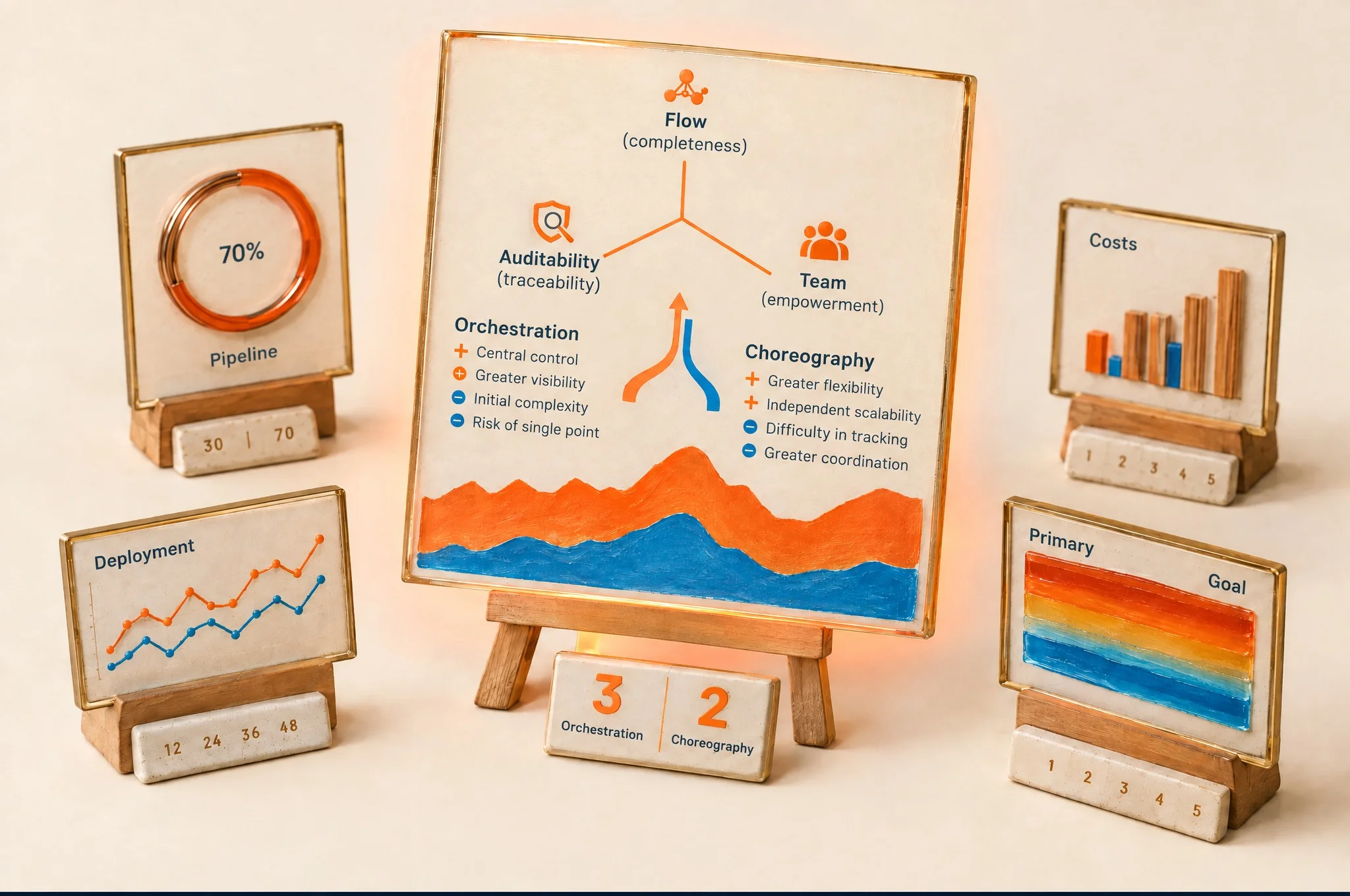
Given the benefits and limitations discussed, the decision must be made based on several factors. The project type, business needs, target goals, team structure, and available resources will all influence the choice. Three criteria in particular tip the scale:
- Flow complexity: if the process is a long sequence with intermediate states, rollbacks, and compensations (such as checkout with payment, inventory reservation, and shipping), orchestration keeps the logic readable in a single place. If services react to a few independent events (profile update, sending notifications, reindexing), choreography avoids a controller that would have nothing to coordinate.
- Auditability requirements: when compliance or auditing requires reconstructing who did what and in what order, an orchestrator exposes process state in one place. With choreography, that same reconstruction requires distributed tracing and correlation IDs on every event, a cost that must be budgeted from sprint one.
- Team coupling: a single team owning the entire flow can easily manage a central orchestrator. Multiple autonomous teams, each responsible for its own domain, work better with events published to a broker, since no team has to wait on changes to a controller owned by another team to release.
As a general rule, if the priority is scalability and you are prepared to manage high complexity, choreography is a strong candidate.
Conversely, if the priority is controlling flows to stabilize the application and keep it measurable and modifiable without modifying every service, orchestration or a hybrid approach is the better choice. Before deciding, a practical exercise our team performs during assessments is mapping business flows along three axes: number of steps, audit requirements, and frequency of rule changes. Short flows that change frequently fit choreography well; long flows requiring strict traceability call for an orchestrator. In practice, the map almost always shows that both coexist within the same system.
To frame this choice within the broader design of a microservices architecture, our complete guide to cloud native covers communication patterns, the role of message brokers, and domain decomposition criteria. To discuss your specific case, from extracting initial services from a monolith to selecting an orchestration tool, feel free to contact us through our Cloud Native services.
The table summarizes the criteria used in this article to choose between the two approaches:
| Criterion | Orchestration | Choreography |
|---|---|---|
| Coupling | Every service is coupled to the central controller; adding a step requires modifying the orchestrator | Services coupled only to the event contract; a new consumer subscribes to the broker without touching publishers |
| Traceability | Process state persisted in a single place; easy to inspect the current step of any transaction | Reconstructed after the fact with distributed tracing and correlation IDs on every event, planned from sprint one |
| Operational complexity | Concentrated in the controller: a component to design, version, and guard against becoming a “god service” | Distributed across services and the broker: no single point to manage, but the overall flow is not written in any single place |
| Latency | Serial synchronous calls: response time is the sum of steps, growing with each added dependency | Asynchronous communication: the publisher responds immediately, work proceeds in parallel with eventual consistency |
| Error handling | Retries, timeouts, and compensations explicit in the orchestrator, executed in reverse order on failure | Implicit compensations triggered by failure events; beyond four or five steps, the flow becomes hard to trace |
| Best suited for | Long flows with complex rollbacks, audit requirements, single team owning the entire process | Short flows that change frequently, multiple autonomous teams, domains that must tolerate service downtime |
Notes and sources
Note e fonti
completed the incubation process and achieved graduated project status in 2025: “Crossplane is now a graduated CNCF project and is available for production use today.” (source: https://www.cncf.io/announcements/2025/11/06/cloud-native-computing-foundation-announces-graduation-of-crossplane/) ↩︎