



If you are familiar with the DevOps philosophy, you have certainly heard of DevSecOps. It is an approach to security that is gaining momentum, aligned with the growing awareness among large enterprises of security threats. We recently discussed how to introduce DevSecOps. In this article, we will examine the concept of Cloud DevSecOps, focusing on its benefits and useful tools. Let us start with a definition.
What is Cloud DevSecOps?
Cloud DevSecOps is the native integration of security practices into the software development lifecycle within cloud environments. This approach automates security checks in CI/CD pipelines, transforming security from a final bottleneck into a shared requirement right from the early design and release phases.
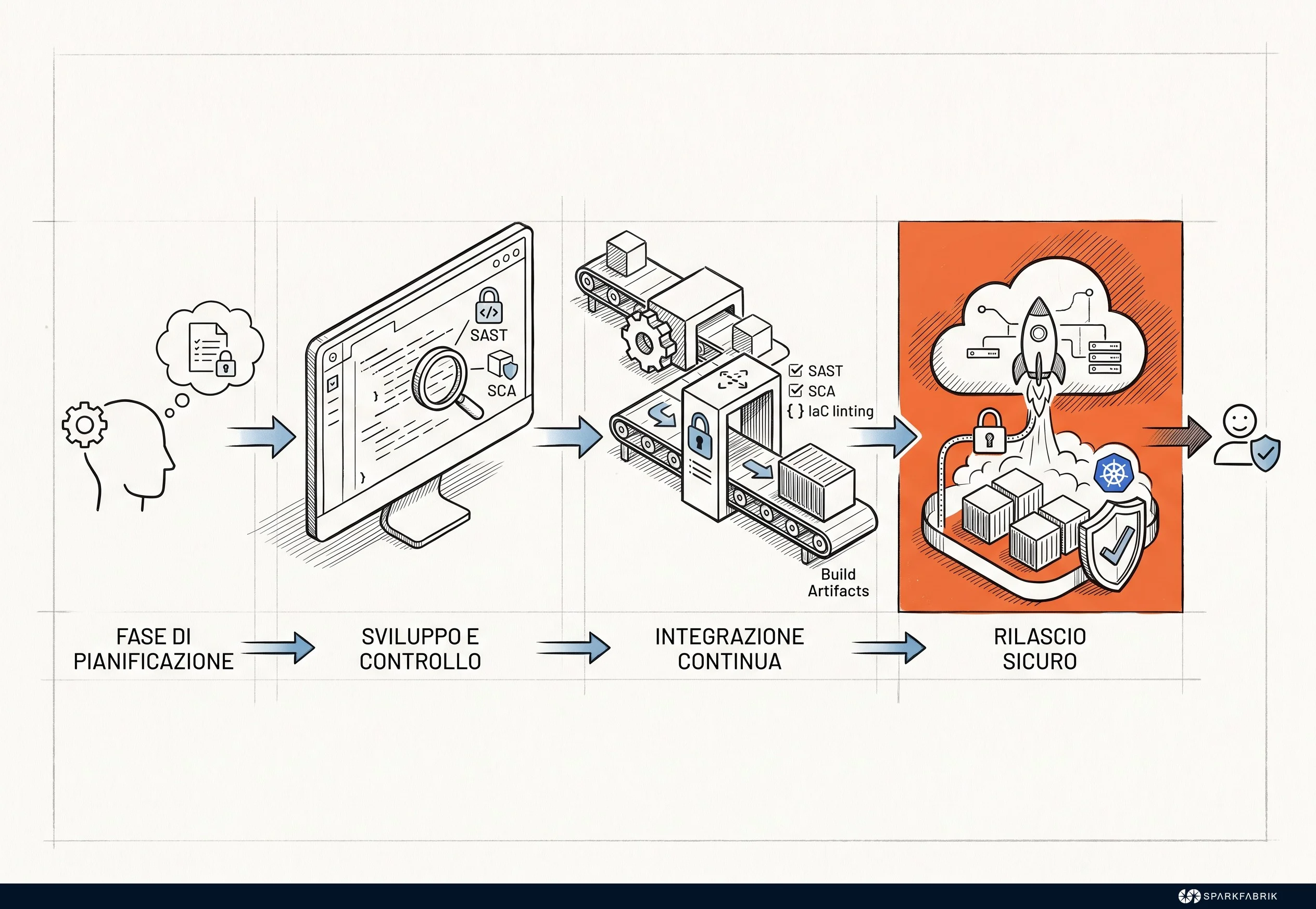
DevSecOps is the result of integrating security into the DevOps methodology, applied specifically to the Cloud context. This approach seeks to bring security practices as close as possible to the delivery phase, rather than isolating them into a separate phase that follows each software release cycle.
The main benefit of the DevSecOps model is that it makes security a requirement known to all stakeholders, not just industry specialists and a dedicated team. If everyone is, to varying degrees, responsible for security, the reliability and quality of the software produced will inevitably improve.
The benefits of DevSecOps
The main benefits of a DevSecOps model are the speed with which you can iterate on software produced and the speed with which you can improve the resulting application security score. (Whether dealing with Cloud Native applications or not.) These two benefits, however, are not triggered at a specific stage, but are rather the consequence of practices that bring noticeable advantages throughout the development process. Let us examine them below.
Fast and cost-effective software delivery
When software is developed in an environment outside DevSecOps principles, security issues can lead to massive delays. Shifting feedback aimed at verifying the code security posture left to the coding phase reduces the overhead of late resolution.
Improved security and greater proactivity
The “shift left” approach increases the proactivity of DevOps teams. By seeing security metrics immediately, development teams are progressively encouraged to resolve potential issues before considering code to be “ready”.
Accelerated security vulnerability patching
Continuous and proactive scanning makes it possible to identify and fix vulnerabilities or CVEs at a significantly faster pace compared to a scheduled analysis mechanism.
Automation compatible with modern development
All major tools can be integrated into Continuous Delivery and Continuous Integration pipelines: a SAST job running on every pull request, SCA dependency scanning during build, an IaC linter (like Checkov or tfsec) before applying with Terraform. With GitHub Actions or GitLab CI, these checks run in parallel with unit tests and become explicit quality gates, blocking the merge when a critical CVE or a publicly configured bucket emerges.
Solid DevOps and Platform Engineering consulting allows you to introduce and orchestrate these checks seamlessly.
A repeatable and adaptive process
The extensibility of tools and the determinism guaranteed by market solutions allow you to optimize tool sensitivity to the most critical alerts according to organizational standards and policies. This ensures that the same piece of code, analyzed at different times, is classified in the exact same way.
DevSecOps vs SecDevOps: what is the difference?
The value of an application lifecycle management strategy that includes DevSecOps is now beyond doubt. However, within the IT industry, a new perspective is emerging that questions the priority with which “security” concepts take root in a product lifecycle.
The term SecDevOps takes shift-left to the extreme, defining an application delivery methodology that asks how much a given choice impacts security before any other consideration (technological, design, or methodical). The difference, therefore, lies not so much in the quality of the software produced, but rather in the path taken to reach a decision.
To simplify, we can say that in the DevSecOps model the emphasis is on automation, while in SecDevOps the emphasis is on development planning.
Cloud DevSecOps best practices
Just as with DevOps best practices, there are guidelines for DevSecOps that simplify its adoption and increase its benefits for all stakeholders involved. We have detailed six of these guidelines in the article DevSecOps: 6 principles to introduce it into your company. The same principles apply to the specific context of Cloud DevSecOps and are:
- Code Analysis
- Automated Testing
- Change Management
- Compliance Monitoring
- Threat Investigation
- Staff Training
We recommend reading the above-mentioned article for more details on each point.
In cloud contexts, Cloud Security Automation remains central, meaning the automation of governance and monitoring of workloads running on the cloud. Alongside this, Software Supply Chain Security has become crucial today: generating an SBOM with every build, verifying container signatures with Sigstore/cosign before cluster admission, and continuously scanning open-source dependencies.
Another key practice is resource “tagging”, which is assigning custom metadata (automatically via tools and scripts) to active application or infrastructure workload instances. These tags can then be used as indicators or filters for auditing activities during security reviews.
The following table summarizes essential Software Supply Chain Security practices.
| Practice | Objective | Typical tools |
|---|---|---|
| Generate SBOM with every build | Track all software components and dependencies | Syft, CycloneDX |
| Container signing and verification | Ensure image integrity and provenance before deployment | Sigstore, Cosign |
| Continuous open-source dependency scanning | Identify known vulnerabilities and outdated components | Dependabot, Trivy, Snyk |
| Admission control policies | Block deployment of non-compliant or unsigned artifacts | OPA/Gatekeeper, Kyverno |
From resource tags to SBOM: tracking what software is made of
Tagging answers the question “what workloads am I running”. The more uncomfortable question remains: “what are they made of”. The majority of code that ends up in production is not written by the team releasing it, but comes from transitive open-source dependencies pulled in by a package.json, a go.mod, or a requirements.txt.
Log4Shell (CVE-2021-44228) and the backdoor in xz-utils (CVE-2024-3094) exposed the same weakness: at the time of disclosure, most organizations were unable to answer within a few hours whether that library was inside any of their artifacts.
The SBOM (Software Bill of Materials) serves exactly this purpose: a machine-readable inventory of components, versions, licenses, and dependency relationships, produced as a build artifact. The two formats that matter operationally are SPDX (standardized as ISO/IEC 5962:2021) and CycloneDX (OWASP, also adopted as ECMA-424). Both are supported by major generators, from Syft and Trivy to native Maven and npm plugins.
The regulatory push is not theoretical: the Cyber Resilience Act1, in force since December 2024, will require manufacturers of products with digital elements to maintain a software bill of materials and manage vulnerabilities throughout the lifecycle, with reporting obligations starting from September 2026 and full application from December 2027. We explored the central role of SBOM in the Cyber Resilience Act in our series dedicated to the European regulation.

On the pipeline integrity front, the reference framework is SLSA2 (Supply-chain Levels for Software Artifacts), which reached version 1.0 with the Build track structured across progressive levels:
| SLSA Level (Build track) | Key requirement | What it concretely prevents |
|---|---|---|
| L0 | No guarantees | Nothing: the artifact is not traceable |
| L1 | Provenance generated and available | “Mysterious” releases with no documented origin |
| L2 | Provenance signed by a hosted build service | Artifact tampering after build |
| L3 | Hardened build platform, unforgeable provenance | Builder compromise and build-stage injection |
In our experience, the jump in value lies not in generating the SBOM, which is now just a single configuration line in a pipeline, but in signing it, storing it as an attestation alongside the image, and verifying it during cluster admission. A reference pattern we adopt in Kubernetes projects is as follows:
CycloneDX / SPDX] B --> D[in-toto provenance
SLSA] C --> E[Signing with cosign
keyless via OIDC] D --> E E --> F[(OCI Registry
image + attestations)] F --> G{Admission control
Kyverno / Gatekeeper} G -->|Valid signature and provenance| H[Deploy to cluster] G -->|Verification failed| I[Deploy blocked] F --> J[Continuous scanning
Grype / Trivy] J --> K[Triage with VEX] K --> A
The less obvious point concerns noise. A complete SBOM on a non-minimal base image can trigger hundreds of reported CVEs, most of which are unreachable by application code: packages present in the filesystem but never executed, or vulnerabilities in uninvoked code paths. Without a documented exception mechanism, teams simply stop looking at reports.
For this reason, we pair the SBOM with VEX (Vulnerability Exploitability eXchange, specifically the OpenVEX variant) attestations: they allow teams to declare in a verifiable manner that a vulnerability is not exploitable in that specific context, preserving decision traceability for subsequent audits. Another technique that drastically reduces the surface requiring justification is starting with distroless or Wolfi images, where the absence of a shell and package manager cuts out a large portion of inventoried components at the root.
Finally, an SBOM only makes sense if it is searchable. A JSON file archived in a registry and never read again helps no one at three in the morning during a zero-day incident: you need a centralized index (Dependency-Track and Guac are the most mature open-source options) that enables you to answer in a single query “which production services contain version X of this library”, correlating component inventory with the resource tags described above.
DevSecOps tools
You may already know some of the most famous DevOps tools; can you say the same for the DevSecOps approach? Here too, tools exist to help an organization adopt the DevSecOps practices we just mentioned. According to Atlassian, the classification of these tools aligns with the various phases of the DevSecOps cycle, specifically:
- Plan: threat modeling and impact analysis tools for specific changes
- Build: static (SAST) and dynamic (DAST) code analysis tools
- Test: dynamic code analysis (DAST)
- Deploy: penetration testing and chaos engineering tools
- Operate: log collection, Web Application Firewalls, and Runtime Application Self Protection (RASP)
- Monitor: security information and event management (SIEM)
Among DevSecOps tools, we find Checkov3, created by Bridgecrew and now maintained by Palo Alto Networks within the Prisma Cloud ecosystem4, for scanning configurations and IaC.
Then there is Trivy5, one of the most popular vulnerability and misconfiguration scanners, and KICS6, an open-source solution for static code analysis of IaC. Another DevSecOps tool is SonarQube7, which, beyond container scanning, dependency vulnerabilities, and IaC, can also perform source code analysis.
On the supply chain side, Snyk8 covers dependencies and containers, while Syft9 and Grype10 generate SBOMs and match them against vulnerability databases. For Kubernetes cluster runtime, the benchmark is Falco11, a CNCF graduated project for detecting anomalous behavior.
| Category | Tool | Primary function |
|---|---|---|
| SAST | SonarQube | Static source code analysis for bugs and vulnerabilities |
| IaC security | Checkov | Configuration and IaC scanning |
| IaC security | KICS | Static IaC code analysis for misconfigurations |
| IaC security | Trivy | Vulnerability and misconfiguration scanner |
| Container and supply chain security | Snyk | Dependency and container analysis |
| Container and supply chain security | Syft | SBOM generation |
| Container and supply chain security | Grype | Comparing SBOMs against vulnerability databases |
| Runtime security | Falco | Detecting anomalous behavior in Kubernetes clusters |
Why runtime security with eBPF completes the pipeline
An image can pass all CI security gates and still become the vector of an incident the day after deployment. The reasons are commonplace and recurring: a CVE published after the build, a secret exfiltrated via a legitimate dependency, a container mounting a volume it should not see. The scanner captured a snapshot of the artifact at a single moment; the attacker operates on the behavior of the running process.
This is where eBPF comes in. Instead of injecting sidecars or loading custom kernel modules, an eBPF program is verified by the kernel and hooked to syscall tracepoints, observing every execve, open, connect generated by node containers. In our medium-sized GKE cluster deployments, overhead typically remains below 3-5% CPU per node with a cleaned ruleset.
Falco11 consumes that event stream and evaluates it against a declarative rule set: interactive shell opened inside a container, write to /etc/, outbound connection to an unexpected IP, mounting of /var/run/docker.sock.
Since 2024, it has been a CNCF graduated project12, sharing the maturity level of Kubernetes and Prometheus. It supports three drivers: kernel module, legacy eBPF probe, and modern eBPF probe based on CO-RE, which requires kernel 5.8+ with BTF enabled and does not require compilation on the node.
Falco is not the only option, and the choice depends primarily on one question: do you only want to detect, or also block?
| Tool | Mechanism | Enforcement | Kernel requirements | Governance |
|---|---|---|---|---|
| Falco | eBPF (CO-RE) or kernel module | Detection; response with Falco Talon | 5.8+ with BTF for modern eBPF | CNCF, graduated |
| Tetragon | eBPF, part of the Cilium project | Yes, in-kernel process kill | 5.4+, full capabilities on 5.10+ | CNCF, with Cilium |
| Tracee | eBPF CO-RE (Aqua Security) | Detection, experimental blocking | 5.8+ for CO-RE | Open source Aqua |
| KubeArmor | BPF-LSM, AppArmor, SELinux | Yes, policy-based prevention | 5.8+ for BPF-LSM | CNCF sandbox |
Two lessons from our field experience. First: the default ruleset generates noise, and a Slack channel receiving 400 alerts a day gets muted within a week. It is better to start in observation mode, build a two to three-week baseline, disable rules catching legitimate platform behavior (backup jobs, init containers, monitoring agents), and only then connect Falcosidekick to the SIEM or on-call workflow.
The second is less obvious: not all clusters can host a runtime agent. On GKE Autopilot and other fully managed node environments, running privileged DaemonSets that load eBPF probes is not possible. Therefore, detection must rely on Kubernetes audit logs and cloud provider tools. This is an architectural constraint that must be evaluated before selecting the cluster model, not after: discovering it during the hardening phase means rethinking the platform.
This also applies on the regulatory level. NIS213 and DORA14 do not merely ask to prevent incidents, but to detect and report them within very tight timeframes, and the numbers are explicit. Directive (EU) 2022/2555 imposes an early warning requirement on essential and important entities within 24 hours of becoming aware of a significant incident, a detailed notification within 72 hours, and a final report within one month. Meanwhile, Regulation (EU) 2022/2554 requires an initial notification for major ICT incidents within 4 hours of classification and no later than 24 hours from detection, followed by an interim report and a final report.
These timeframes require knowing what happened inside a pod: without runtime telemetry, most organizations lack even the initial data to compile those reports. We gathered the architectural implications in our cloud native best practices for compliance.
Your next step
In conclusion, DevSecOps continues to be a rapidly growing trend within organizations. Its adoption improves both the quality of the software produced and the security level across the entire software development value chain. Best practices simplify its adoption, while specific tools and technologies enable standardized technical implementation.
For a company aiming to stay competitive in the market, initiating a DevSecOps Strategy journey, meaning an in-depth study of the competitive advantage this methodology can bring to the organization, can be a winning move. If you are particularly interested in the Cloud context, you can start with our Free Guide to Cloud Native Security.
Contact us for tailored consulting. Our experts can help you identify a customized security strategy, supporting your team and transferring best practices.
Notes and sources
Cyber Resilience Act. The Cyber Resilience Act is an EU regulation establishing mandatory cybersecurity requirements for hardware and software products with digital elements placed on the European market. (source: https://digital-strategy.ec.europa.eu/en/policies/cyber-resilience-act) ↩︎
SLSA (Supply-chain Levels for Software Artifacts). SLSA is a security framework and set of standards established by OpenSSF to prevent tampering, improve integrity, and secure software supply chains. (source: https://openssf.org/projects/slsa/) ↩︎
Checkov. Checkov is an open-source static code analysis tool that scans infrastructure-as-code (IaC) files for security vulnerabilities and compliance misconfigurations across frameworks like Terraform. (source: https://www.checkov.io/) ↩︎
BridgeCrew. Bridgecrew is a developer-first cloud security platform and Infrastructure as Code (IaC) security tool, acquired by Palo Alto Networks in 2021 and integrated into Prisma Cloud. (source: https://www.paloaltonetworks.com/company/press/2021/palo-alto-networks-completes-acquisition-of-bridgecrew) ↩︎
Trivy. Trivy is an open-source security scanner maintained by Aqua Security that detects vulnerabilities, misconfigurations, and exposed secrets in container images, filesystems, and repositories. (source: https://trivy.dev/) ↩︎
KICS. KICS is an open-source static code analysis tool by Checkmarx that scans Infrastructure as Code (IaC) files for security vulnerabilities and misconfigurations. (source: https://kics.io/) ↩︎
SonarQube. SonarQube is an automated code quality and security analysis platform by SonarSource. It performs static analysis to detect bugs, vulnerabilities, and code smells in source code. It also maintains a free and open source edition. (source: https://www.sonarsource.com/products/sonarqube/) ↩︎
Snyk.io. Snyk is a developer-first application security platform that helps teams find, prioritize, and fix vulnerabilities in code, open-source dependencies, containers, and infrastructure as code. (source: https://snyk.io/) ↩︎
Syft. Syft is an open-source CLI tool and Go library developed by Anchore for generating a Software Bill of Materials (SBOM) from container images and filesystems. (source: https://github.com/anchore/syft) ↩︎
Grype. Grype is an open-source vulnerability scanner developed by Anchore that identifies known security vulnerabilities in container images, filesystems, and Software Bill of Materials (SBOMs). (source: https://github.com/anchore/grype) ↩︎
Falco. Falco is an open-source, cloud-native runtime security tool that provides real-time threat detection across hosts, containers, Kubernetes, and cloud environments. (source: https://falco.org/docs/) ↩︎ ↩︎
CNCF. The Cloud Native Computing Foundation (CNCF) is a Linux Foundation subsidiary that fosters cloud-native technologies, serving as a vendor-neutral home for open-source projects like Kubernetes. (source: https://orca.security/glossary/cncf/) ↩︎
NIS2. The NIS2 Directive (Directive (EU) 2022/2555) is the EU’s updated cybersecurity framework, setting risk management and reporting rules for critical sectors. (source: https://eur-lex.europa.eu/EN/legal-content/summary/cybersecurity-of-network-and-information-systems.html) ↩︎
DORA. DORA (Regulation (EU) 2022/2554) is the EU’s Digital Operational Resilience Act for financial cybersecurity. It’s a European Union regulation that standardizes and strengthens the cybersecurity and IT resilience of the financial sector. It became fully applicable on January 17, 2025. (source: https://www.eiopa.europa.eu/digital-operational-resilience-act-dora_en) ↩︎