

The web development market has undergone an irreversible fracture. On one hand, the proliferation of AI-based tools has reduced the creation of basic websites to a low-cost commodity. On the other, complex enterprise architectures require increasingly solid engineering foundations, and it is in this scenario that Drupal’s strategic repositioning fits. Choosing a core technology is no longer a tactical marketing decision, but a strategic imperative to support deep integrations and critical data flows.
The market for simple websites—those we define as showcase sites or brochureware—has been completely commoditized. Between closed visual site builders and the ability of GenAI to produce frontend code, the landscape has changed decisively. The value of building a simple site with a robust framework has collapsed.
As the low-end market saturates, a gap is opening at the high end. This is where the need to manage complex digital infrastructures, structured data, and business-critical processes arises. For years, the market treated content management systems as generic tools, but today that vision is obsolete.
This bifurcation is a hot topic that permeates the background of all strategic discussions. We have felt and experienced it at all the major conferences of the last few months.
It emerged as a central theme at Drupal Pivot EU, the exclusive unconference held in Ghent in January 2026. A restricted event that brought together leading European technology leaders to redefine the role of open source systems in enterprise architectures. We at SparkFabrik actively participated in the working groups with our CTO Paolo Mainardi, helping to chart the course for the coming years.
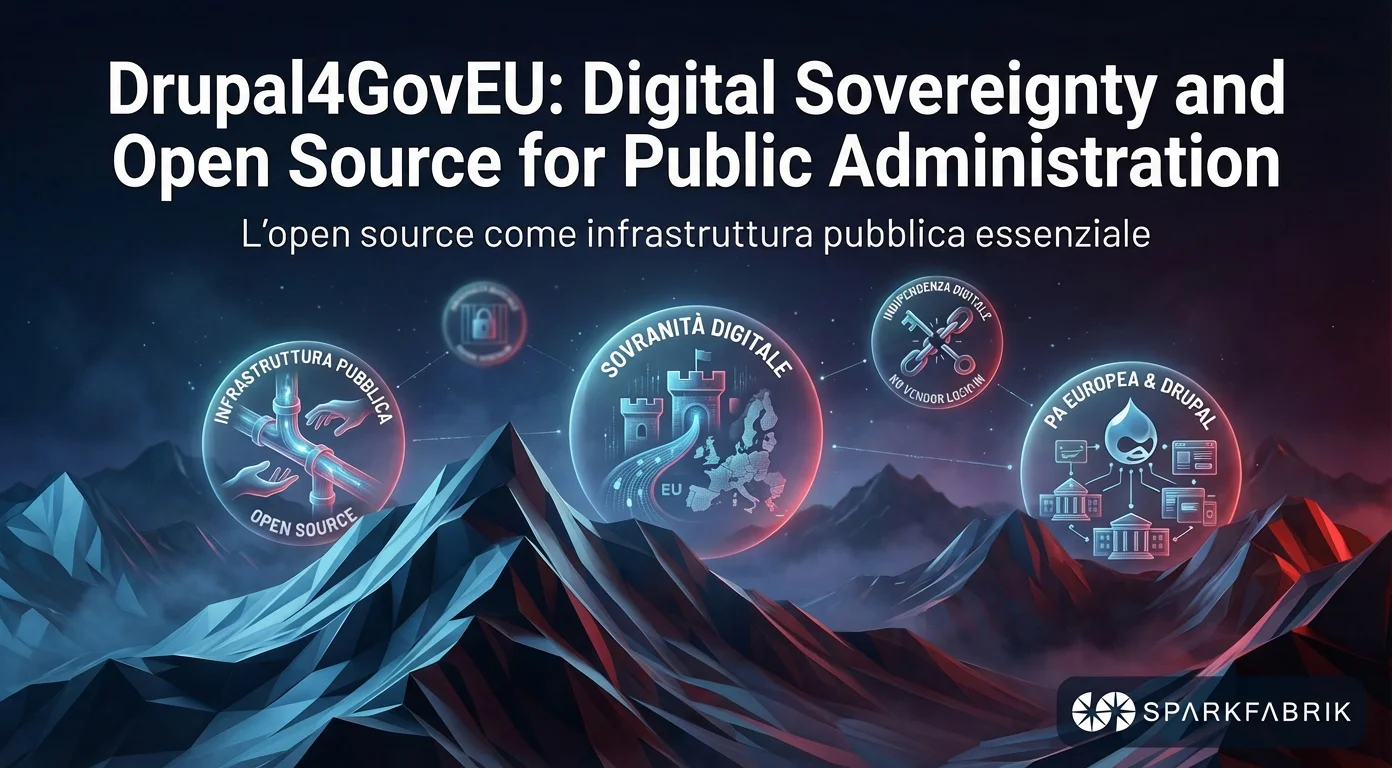
We saw the same common thread at Drupal4GovEU, the event focused on open source for the European Public Administration. And it obviously appeared in several talks presented at major events, such as the last DrupalCon in Vienna and the very recent DrupalCon Chicago.
The conclusion reached is unequivocal: continuing to treat content management platforms as simple web page providers is a calculation error that generates technical debt.
Indeed, Drupal is establishing and repositioning itself not as a simple CMS, but as the framework of choice for ambitious Digital Experience Platforms (DXP). We are no longer talking about managing web pages, but about governing APIs, digital identities, and complex workflows in a secure environment.
Forward-thinking companies are repositioning their investments. They are shifting budget from ephemeral frontends toward backend infrastructures that are governable, secure, and designed to last.
For a business decision-maker, understanding these dynamics is fundamental to correctly allocating IT budget. Continuing to treat Drupal exclusively as a content manager means underestimating a strategic asset essential for digital resilience, especially when combined with cloud-native technologies and AI.
Drupal as a business enabler: from CMS to Business Application Framework
Drupal has evolved from a simple open source CMS into a true application framework for the enterprise market. It functions as a business enabler by providing the architectural infrastructure necessary to manage complex workflows, advanced API integrations, and structured data, overcoming the functional limits of simple showcase sites.
During the working groups in Ghent, the discussion highlighted the need for an ontological redefinition. Market perception must align with the platform’s actual technical capabilities.
Traditionally, a CMS is viewed as a repository for text and images, but this vision is limiting. We no longer sell a packaged product. With Drupal, we provide a relational engine capable of orchestrating an entire company’s digital experience, thanks to an extremely flexible entity architecture.
This shift in perspective transforms the software from a cost center into a true Business Application Framework, capable of modeling unique business logic without forcing internal processes to adapt to pre-set software.
What does this mean in practical terms for the business? It means transforming the platform into the backbone for:
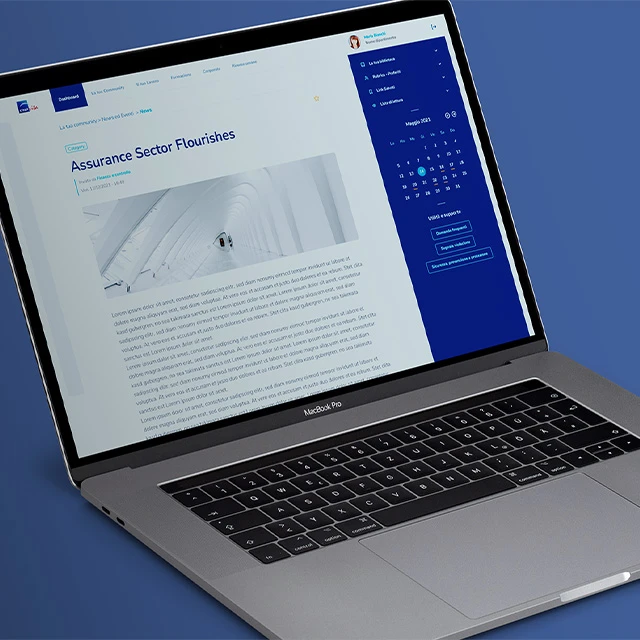
- Complex enterprise intranets: Granular permission management, multi-level approval workflows, and integration with corporate Identity Providers. (Discover the CNP Vita Intranet case study)
- Service portals: Where data security and accessibility are mandatory non-functional requirements.
- Headless Content Hub: Drupal acts as a single source of truth, decoupling the backend from the frontend and distributing content via REST or GraphQL APIs to various consumer applications.
- Data Management platforms: Native modeling of complex data relationships without the need to write SQL queries or manage manual schema migrations.
- LMS systems (Learning Management System): Proprietary e-learning platforms where progress tracking, skills certification, and protection of educational materials are non-negotiable requirements.
We see a concrete example in the manufacturing sector, where Drupal is adopted as middleware to aggregate data from ERP and CRM systems, exposing them in unified dashboards. This is a pure application framework use case, not that of a simple web page manager.
For IT decision-makers, understanding this evolution means entering a new era of content management for business, where content management is just a subset of much broader capabilities. There is now an unbridgeable gap between quick solutions and engineered platforms.
The difference between the two approaches manifests in several critical areas:
- Distinction between “disposable code” and “durable infrastructure.” AI, visual site builders, and modern frontend frameworks excel at rapid interface creation but introduce a high rate of obsolescence. Generated landing pages have a lifecycle measurable in months and do not survive corporate pivots.
- Long-term maintainability. The backend, business logic, and data model must ensure lasting stability. A Drupal-based infrastructure is designed for decade-long lifecycles, absorbing business evolutions.
- Isolated data vs. centralized hubs. Closed systems fragment information into inaccessible silos. A framework-first approach natively exposes every entity via REST or GraphQL APIs, acting as a single source of truth for omnichannel ecosystems.
- Standard logic vs. custom logic. SaaS products impose their own operational workflows. An open architecture allows for mapping granular permissions and approval flows exactly to existing corporate hierarchies.
Choosing this path means investing in a technology that scales with business complexity, ensuring solid foundations for the future. (To learn more: Complete Guide - Why choose Drupal for complex corporate sites)
Is Drupal the ideal solution for corporate digital sovereignty?
The advantages of Drupal for digital sovereignty lie in total control over architecture and data. Being open source, it eliminates the vendor lock-in typical of SaaS platforms, allowing CTOs to implement secure artificial intelligence models and maintain full infrastructure compliance without ceding control to third parties.
In the European enterprise market, the concept of sovereignty is often reduced to a mere matter of regulatory compliance and geographic server localization to respect GDPR. This vision is limiting. True technological sovereignty is only achieved when an organization possesses the unconditional ability to inspect, modify, and migrate its software stack without asking third parties for permission.
When critical infrastructure rests on closed cloud services, the company cedes control of its technological roadmap to the decisions of an external provider. Vendor lock-in represents the most underestimated operational risk in IT budgets today. Arbitrary changes to pricing models, sudden deprecation of fundamental APIs, or corporate acquisitions can paralyze a company’s digital operations.
Adopting open standards neutralizes this risk at the root. It returns bargaining power to management and the freedom to choose where and how to run their workloads, whether on hyperscaler cloud providers or private infrastructure.
This independence becomes crucial in the age of artificial intelligence. Companies possess invaluable information assets that cannot be fed into public language models. Sovereign AI requires platforms capable of orchestrating open source models or private instances within the corporate perimeter, allowing the use of artificial intelligence without exposing sensitive data to external networks.
The Drupal community shares this vision, embracing a vendor-agnostic approach that is easily adaptable. By using an open framework, it is possible to ensure security and compliance for corporate data by implementing Retrieval-Augmented Generation systems that query internal databases without ever exposing intellectual property on uncontrolled networks.
How does platform engineering transform Drupal into a durable infrastructure?
Platform engineering transforms Drupal into a durable infrastructure by applying cloud-native practices that ensure maximum reliability and scalability. By standardizing operations through an internal platform, development teams reduce cognitive load, cut technical debt, and significantly accelerate the time-to-market for new features.
The strategic transformation of Drupal into a business-critical application would not be possible without an evolution of the underlying infrastructure. Abandoning old monolithic hosting paradigms is the prerequisite for operating at an enterprise scale, in favor of a Cloud Native approach and Platform Engineering practices.
SparkFabrik’s vision is based on a rigorous engineering principle: the value of software is inseparable from the quality of the infrastructure that hosts it.
This is not a stylistic choice, but a reliability requirement. When an application becomes central to business processes, downtime or performance bottlenecks are intolerable. Investing in the underlying platform is the only proven method to mitigate obsolescence and ensure operational continuity.
To transform a CMS into a true cloud-native application, it is essential to create an internal developer platform to standardize operations. This methodological approach shifts the focus from manual server management to process automation, offering tangible business benefits:
- Immutability and reliability through containerization. The use of containers and modern orchestrators (e.g., Docker, Kubernetes) allows infrastructure to be managed as code. Production environments are not “updated” manually, but replaced entirely with every deploy. This eliminates “configuration drift” and ensures that the development environment is identical to the production one, reducing unexpected bugs.
- Horizontal scalability, resilience, and self-healing. Business applications have variable workloads. An architecture based on orchestrators like Kubernetes allows Drupal to scale horizontally (adding pods/nodes) in response to real traffic. This ensures high availability and self-healing, automatically restoring failed processes without human intervention and guaranteeing uptime.
- Operational standardization and reduction of cognitive load with the Internal Developer Platform (IDP). By providing developers with standard paths and preconfigured resources, the need to manage complex infrastructure configurations is eliminated. Teams can thus focus exclusively on writing business logic. This accelerates time-to-market while maintaining centralized control over infrastructure governance.
- Security integrated into the supply chain. By shifting security checks to the early stages of development, automated CI/CD pipelines block vulnerabilities before they reach production environments. This proactive approach is essential to meet enterprise security standards, from the very first line of code.
For IT decision-makers, the investment is not just in application software: the application and the platform must be designed in symbiosis. Without modern infrastructure, even the best Drupal code risks becoming unmanageable technical debt.
The impact of AI and agents in Drupal: collaboration or replacement?
Artificial intelligence does not replace software architecture, but enhances it by accelerating its tactical execution. Drupal provides the structure, validation rules, and data truth upon which generative models can operate, ensuring long-term governance essential for protecting corporate information assets.
The most common perspective error among IT decision-makers is considering AI as an alternative to traditional backend systems. On the contrary, advanced language models need structured platforms to avoid generating hallucinations or uncontrollable output. The integration between these two technologies pushes the framework up the corporate value chain, transforming it into the conductor of automated interactions.
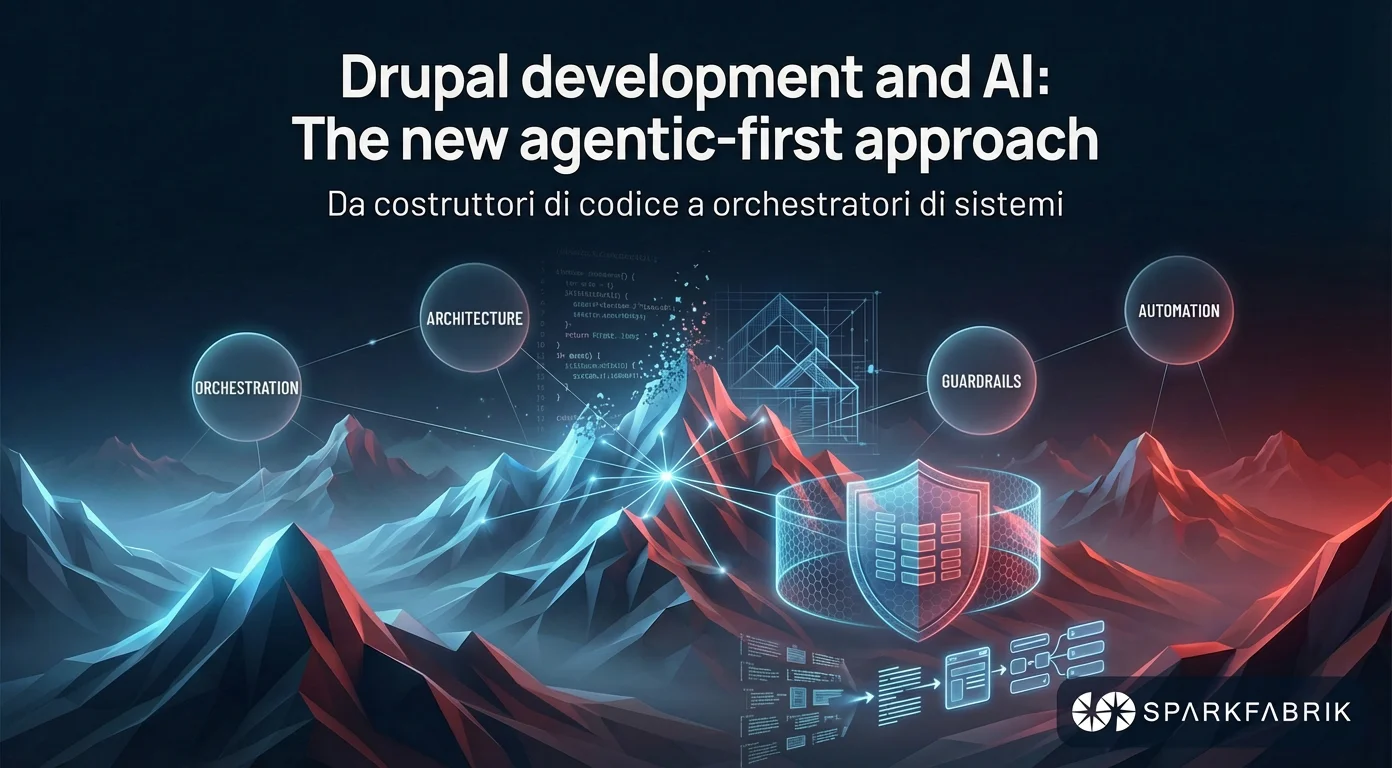
The real leap in quality lies in Agentic AI, or the ability to orchestrate autonomous agents that operate within a governed perimeter. For development teams, this means moving from simple prompt writing to designing complex system instructions that allow agents to interact securely with platform APIs (agentic coding).

CTOs must adopt a new agentic-first approach to development, ensuring that the infrastructure provides the validation rules, semantic context, and operational limits within which artificial intelligence can move without corrupting corporate data.
AI enhances Drupal and, in turn, Drupal provides the perfect structured and orchestrated context in which AI can thrive. This “technological synergy” (widely debated at all strategic events, from the Drupal Pivot Unconference in Ghent to the major DrupalCons), manifests through practical applications that redefine team efficiency:
- AI content governance: Models generate massive volumes of information, content, and metadata, and Drupal acts as a control layer. It is the framework that orchestrates AI agents and imposes approval workflows, ensuring that every output respects brand guidelines and legal requirements before publication.
- RAG (Retrieval-Augmented Generation): In corporate contexts, AI must provide answers based on secure internal data. The platform acts as a central hub to orchestrate corporate data toward vector databases, allowing AI agents to answer user queries based exclusively on certified corporate documentation, accessing only pertinent information and strictly respecting individual access permissions.
- Development acceleration: Generating pages with GenAI, visual building, and automating repetitive tasks frees up valuable engineering resources. This allows technical teams to focus on architecture, complex integrations, and security.
To fully understand how to implement these hybrid architectures in your business processes, we recommend consulting our overview of Drupal AI and the SparkFabrik vision, where we analyze the most effective integration strategies.
The future sees technical teams focusing on data architecture and security. In our experience at SparkFabrik, adopting AI reduces development time for repetitive tasks by 30%, but only if the underlying framework imposes strict rules that prevent generated code from compromising system stability in production.
Why is the “Pivot” necessary now?
Drupal’s strategic repositioning is necessary today because the market has split sharply. While basic online presence is now commoditized, the demand for deep integrations is growing. CTOs need flexible platforms to solve the build vs. buy dilemma without ceding architectural control.
IT budget optimization requires ruthless choices, even more so today, in a market where code and online presence have become commodities. Financing custom development for low-impact projects is a waste of engineering resources, as automated tools can cover those needs at a fraction of the cost. Think, for example, of the myriad SaaS, “no-code” solutions, and AI builders for creating landing pages. In these cases, a technology like Drupal is clearly inefficient.
However, applying the same cost-saving logic to core systems generates technical debt that is paid for by the inability to scale. Enterprise companies no longer ask for digital showcases, but transactional ecosystems. Needs have shifted toward deep integration.
This level of complexity manifests in advanced use cases that escape the capabilities of traditional CMSs. Structured and complex business cases like customer portals, intranets, e-learning platforms, and data repositories require solid foundations.
In this scenario, technology leaders constantly face the Build vs. Buy dilemma. Buying a finished product guarantees initial speed, but SaaS black boxes show their limits as soon as business processes deviate from the vendor’s intended standard. Serious structural rigidities arise, such as non-modifiable data schemas, API limits, dependence on development roadmaps, and vendor lock-in.
Building everything from scratch, on the other hand, entails unsustainable maintenance costs. A mature application framework offers the optimal middle ground: solid foundations already written and tested, combined with absolute freedom to customize business logic.
The theme of digital sovereignty should be read from this engineering perspective even before a regulatory one. It is not just a matter of data residency, but of control over architecture. European companies need platforms where database access, business logic, and integrations are not bound by black boxes.
Drupal positions itself as an open source framework that guarantees full access to the stack, allowing data to be modeled exactly as required by the business. It offers the flexibility of custom code and the robustness of an enterprise framework, leaving the simple site market to automated tools.
What are the next steps for IT decision-makers?
Owning your technology in an era of uncertainty represents the ultimate competitive advantage for enterprise companies. The transition to robust solutions requires an in-depth audit of current infrastructure and the adoption of open source platforms governed by rigorous engineering practices, capable of supporting business growth in the long term.
Here is a strategic checklist:
- Technical debt audit: Analyze your digital properties. Which are simple showcase sites and which are critical applications? Identify where you need control over data and software longevity. Those are the candidates for the new enterprise Drupal approach.
- Technological independence assessment: Do your current systems allow you to extract and migrate data without friction? If the answer is no, you are accumulating operational risk. Adopting open standards and open source platforms is the most effective technical mitigation against vendor lock-in.
- Platform-First roadmap: Stop funding siloed projects. Invest in the underlying platform. A cloud-native base has an initial setup cost, but it reduces the marginal cost of every subsequent application and ensures uniform security standards.
- Partner selection: Modern challenges require skills that go beyond traditional CMS development. You need a partner with expertise in distributed architectures, application security, and DevOps practices. Look for proven expertise in SRE and software lifecycle management.
The dividing line in the IT market is now clearly drawn. On one side, we find companies that continue to squander budget on application silos and closed platforms, accumulating operational risks. On the other, industry leaders who invest in open, scalable ecosystems ready for the secure integration of artificial intelligence.
Drupal Pivot and other strategic events have confirmed that technological maturity is not measured by the quantity of features, but by the ability to govern complexity. Drupal has chosen to position itself as the tool for those who build durable digital assets, offering total control over their technology.
We invite technology leaders to evaluate their current infrastructure with a critical eye. Is it ready to support business-critical processes for the next ten years? Or is it time to “pivot” toward more robust solutions capable of supporting the business for the next decade?
If your architecture does not guarantee data sovereignty and operational agility, we invite you to discover our Drupal development and consulting services and contact our experts to design a future-proof cloud-native platform together.