


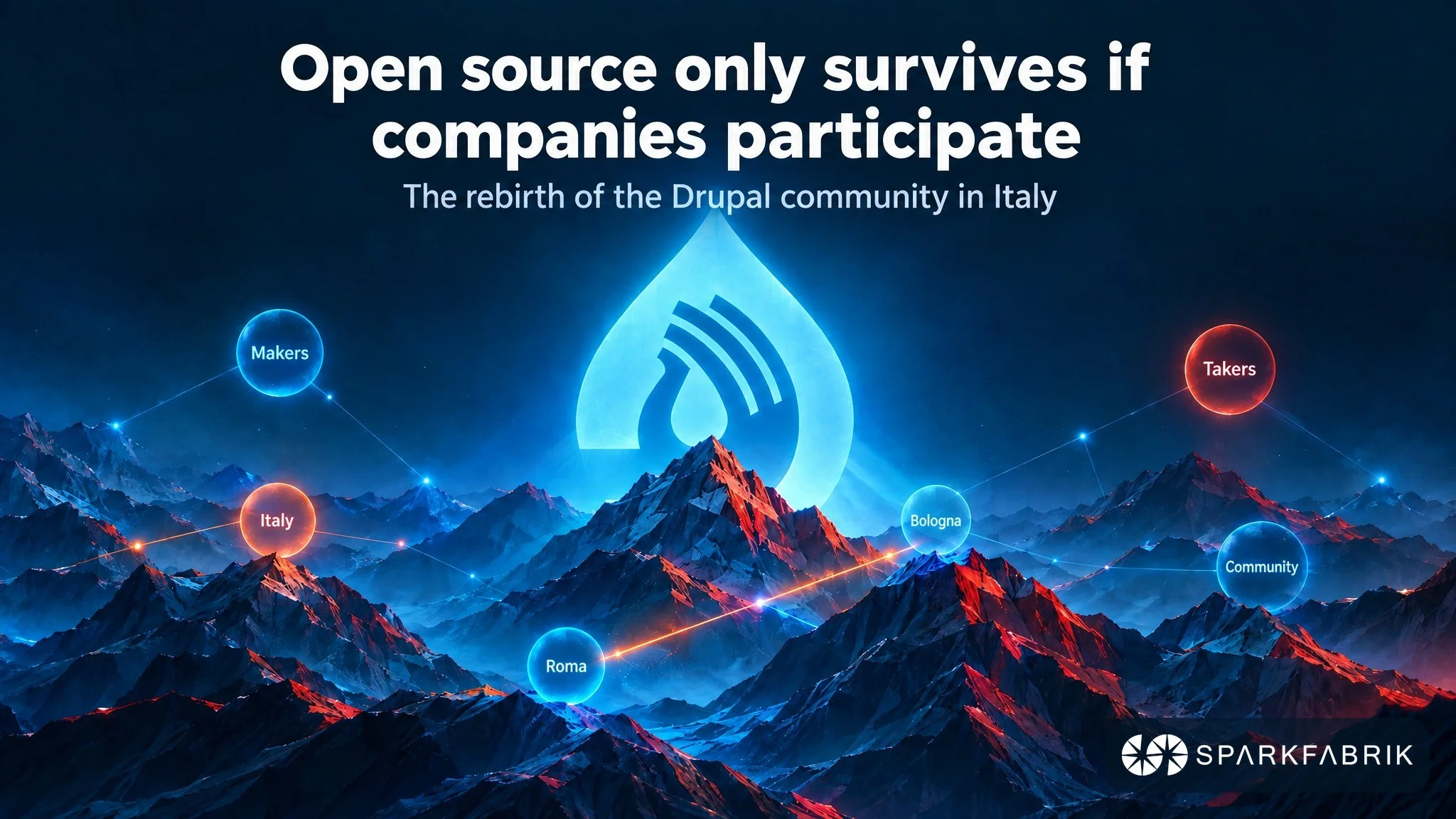
The rebirth of the Drupal community in Italy started from a void that lasted for years: no national camp, no stage to present a project, no room to meet others working on the same problems in another city. In the rest of the world, during that same period, Drupal continued to be what it has always been: one of the leading open source projects in existence, running in production across large enterprises, public administrations, universities, and media organizations. Beyond our borders, modules, agencies, and events grew. Here, the community faded away, and starting over meant rebuilding it almost from scratch.
It must be said without sugarcoating: in Italy, we are behind. Not on the code, which is the same everywhere, but on everything surrounding the code that determines whether a country carries weight in a project it uses every day.
The thesis of this piece concerns a precise responsibility. Open source thrives because certain companies decide to participate in it: not just by using the software, but by sponsoring events, sending speakers, and bringing their case studies to the stage. When no company does this, the community does not merely weaken: it ceases to exist. That is what happened here.
This text originated from a post we published on LinkedIn. We are expanding it into an essay because the issue deserves more than ten lines, and because it explains why we are organizing DrupalCamp Italy 2026. No complaints, nothing to sell.
One question remains: how did we arrive at that void, and whose responsibility is it?
Why did the Italian Drupal community go quiet for years?
The silence of the Italian Drupal community was not caused by a decline in the software itself, but by the fact that companies continued to use it without participating, organizing, or sponsoring anything locally. During the same years our silence grew, the project flourished outside our borders: it attracted new enterprise and public sector organizations, and it saw camps and conferences launch in countries that had never hosted one before. Even in Italy, demand for the software never disappeared: websites remained in production, upgrades were performed, and agencies continued to sell projects. What disappeared was the community, not Drupal.
What vanished was something else: participation. In Italy, a model of use without contribution prevailed. You install, you configure, you deliver, you invoice. None of these activities require meeting anyone outside your own project, and for years, almost no one felt the need to do so.
Why could this happen without anyone noticing? The answer lies in how Drupal is governed. The project does not belong to a single company: it is led by a global community and a non-profit foundation, the Drupal Association, ensuring the code remains public domain and cannot be locked down by a vendor. This is a concrete advantage in terms of independence and freedom from vendor lock-in. But it has a structural consequence that is rarely taken into account.
In a proprietary model, the vendor has a direct commercial interest in keeping the local scene active: it organizes national events, pays for venues, invites clients, and trains partners, because every person in the room represents pipeline. In a project governed by a foundation, that role is vacant by design. There is no central marketing department tasked with keeping the Italian, French, or Brazilian community alive. The foundation coordinates the global project; national communities exist only if someone local decides to step up and organize them.
The Italian void, therefore, is not an anomaly: it is a missing incentive. For years, no local player believed that filling that role was worth the cost, and distributed governance does not provide for someone else to step in on their behalf.
Yet if the void is the result of a collective choice, it can be undone by another choice. That is exactly what happened last year.
Rome proved that reviving the Drupal community in Italy was possible: it just needed an opportunity
Last year, a small group of people, including our team at SparkFabrik, decided that the void had lasted long enough and relaunched DrupalCamp Italy in Rome: people showed up, spoke, and contributed.1 There was no need to convince anyone of Drupal’s value; it was enough to offer a date and a place.
This fact shifts the burden of proof. For years, the implicit explanation for the Italian silence was that “there is no interest here”. Rome showed that interest was there, latent, and that supply was missing: demand existed, but no one was serving it. Anyone claiming today that a Drupal community makes no sense in Italy must explain why a venue filled up at the first available opportunity after years of absence.
What does a DrupalCamp do that a webinar cannot? The format is classic for open source community events: talk sessions, a dedicated contribution area, and, above all, long informal breaks between sessions. The most productive part is rarely on stage. It is the moment an architect who solved a migration challenge on a publishing project discovers that a peer from another agency is facing the same issue on a university portal, and they exchange contacts. No online documentation produces that encounter, because neither person knows what to search for in advance.
Open source is not just code. It is the people, the conversations, the case studies shared in public, and the relationships built in the hallway between talks.
DrupalCamp Italy 2026 will take place in Bologna on October 22, 2026, and compared to the Rome edition, it introduces three concrete changes:
Venue: no longer a university campus, but a dedicated conference venue, chosen for the city and its accessibility.
Organization: the operational setup confirms the collaboration among the three organizing companies, with roles and budgets divided from the start; it is organized by SparkFabrik alongside Bmeme and StripedCodex.2
Internationalization: the program features a top-tier lineup of Italian and international speakers. We have also seen strong movement from international sponsors, and the Drupal Association itself officially supports the event, including sending a keynote speaker. All of this demonstrates strong interest in the Italian market. To achieve these results, however, the schedule and budget coverage are built months in advance, not in the final weeks before the event.
Anyone who believes a healthy national community benefits everyone working with Drupal has a place in one of these two calls. Details on how to participate and event information are collected on the page dedicated to DrupalCamp Italy 2026.
One clarification helps avoid misunderstandings. The point of Rome is not “we pulled it off.” The point is that it showed it can be done, and that the premise used to justify the void for years was false.
Yet an uncomfortable question remains. If it works and benefits everyone, why did no one do it for so long? Because it costs money. That leads to the question of who pays.
The honest part: it costs money, and it is not a business
It costs money and yields no direct return: maintaining this approach takes budget, development hours, and team focus without offering a measurable financial return. Expenses accumulate across three fronts: licensing and infrastructure, ongoing maintenance, and time diverted from value-producing features; benefits, conversely, remain hard to prove with numbers. Item by item, this is the breakdown.
Organizing an event like DrupalCamp Italy means renting a venue, covering technical costs, managing registrations and communication, and, above all, pulling senior professionals away from billable projects for entire working days. None of the organizing companies profit from it: there is no hidden margin, no commercial pipeline that pays for itself by year-end. The entire argument stems from this reality.
This asymmetry is the real reason for the Italian void, far more than any supposed lack of interest. Organizers invest time and money without a direct return; those who use the software benefit from the community regardless of whether they participate. Every Italian agency selling Drupal projects gains from having trained developers, shared standards, and a project that keeps evolving. Yet none of these things happen automatically.
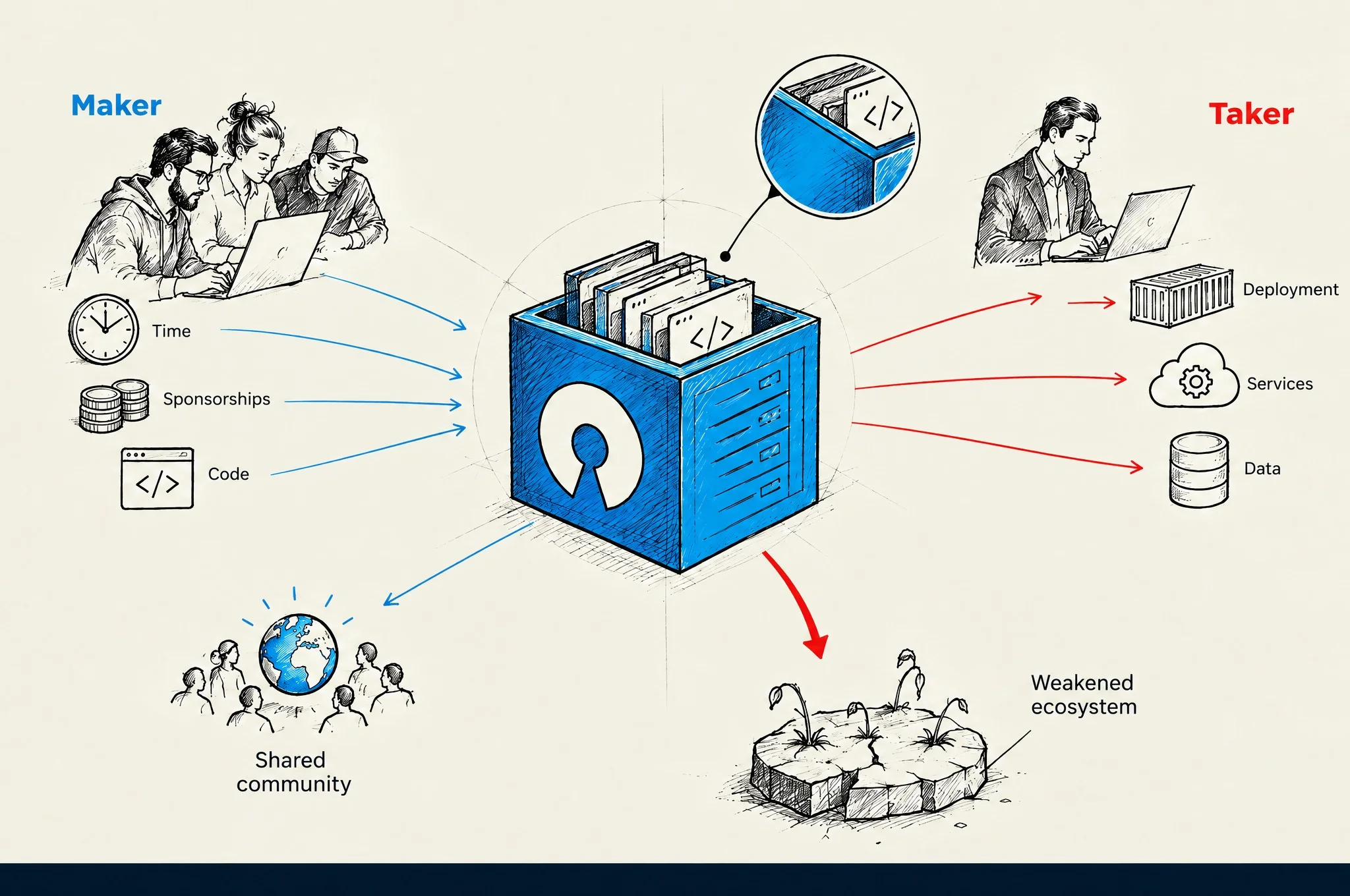
Dries Buytaert, founder of Drupal, described this dynamic as the maker/taker problem: in an open source project, contributors who build it (the makers) coexist with those who extract value without giving back (the takers). When the latter outgrow the former, sustainability breaks down. His insights on how to balance makers and takers to scale and sustain open source and on how to address the problem in practical terms address the global project, but the mechanism applies identically to a national scene. A country made only of takers does not have a community; it only has users.
A community is not a service someone else provides for free. It is the shared ground on which our businesses are built.
The models that keep open source communities alive are well known: event sponsorships, contributions to code and documentation,3 volunteer work organized during collective contribution days, and companies choosing to allocate part of their time to the common good of the project. None of this is free, and Drupal has made that explicit. The Drupal Certified Partner program by the Drupal Association formalizes corporate participation by requiring verified contributions and a financial commitment:4 belonging is not declared, it is proven.
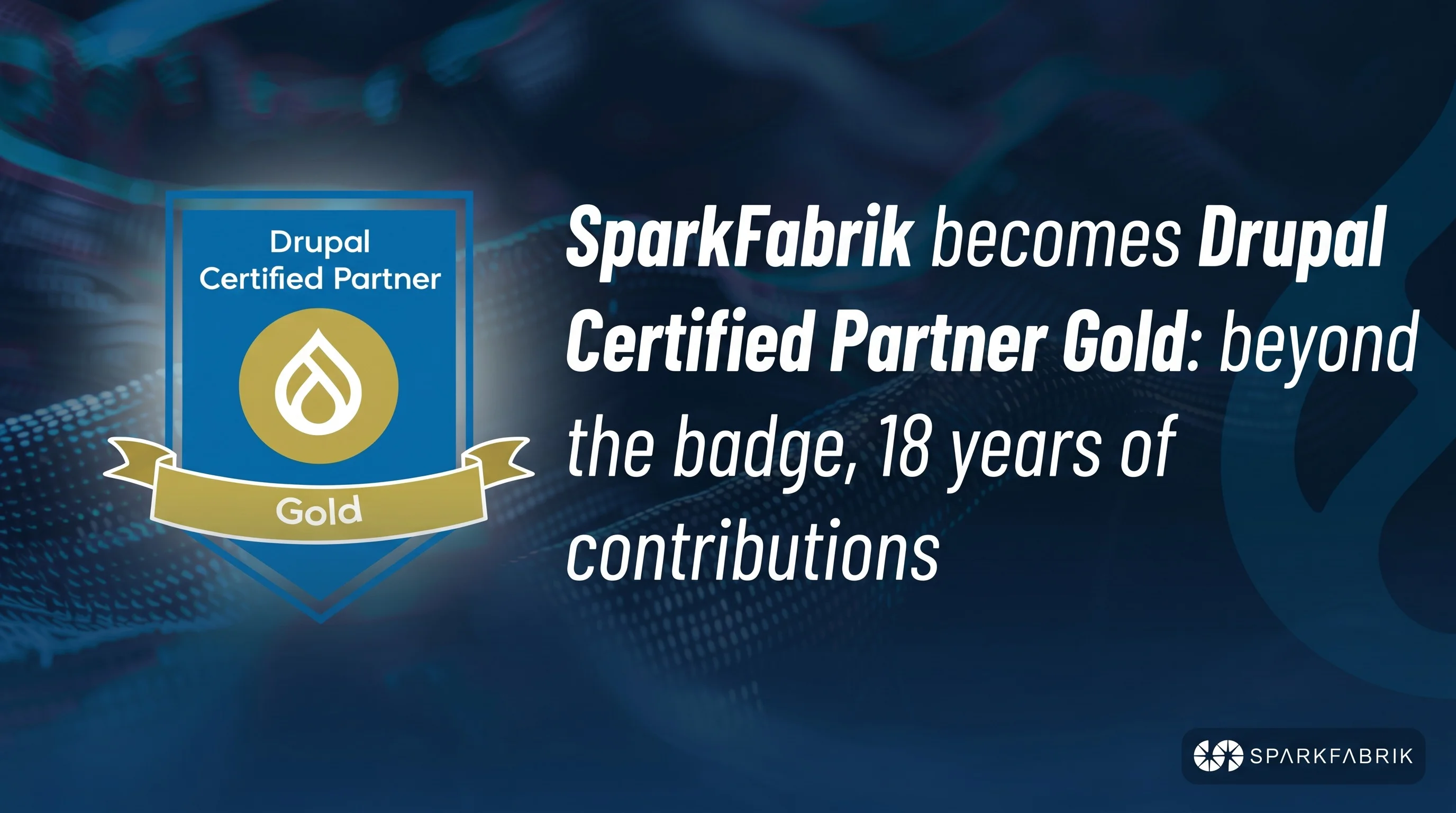
We mention this because it makes an otherwise vague concept measurable. At SparkFabrik, we were the first Italian company to achieve Gold status in that program,5 a journey that we shared when the recognition arrived and that we cite here for one reason: that kind of commitment has a cost, is tracked, and is not optional for anyone who wants to call themselves a project partner. This is not a competition with other Italian agencies. It is proof that participation can be measured, meaning its absence can be measured as well.
Accepting the cost reality brings us to the strongest objection. If it is costly and brings no direct return, why should a rational business do it?
The strongest objection, and why it falls short
Let us put it in the words of someone focused on their own profit and loss statement. Drupal moves forward regardless, with or without Italy: core releases arrive, modules get updated, and security is handled by a global team that does not need Bologna. Senior staff days are an agency’s most expensive resource, and every day on a stage is a non-billable day. Furthermore, knowledge no longer requires physical presence: documentation is online, DrupalCon talks are streamed, and local meetups end up recorded. A skeptic could even use our own example against us, as with our Talks on My Machine format: anyone who could not attend watched it in full on YouTube without spending a day traveling. Clients do not ask if you sponsor a camp; they ask for a quote. With tight margins, a national event is a cultural luxury, and skipping it is the rational choice.
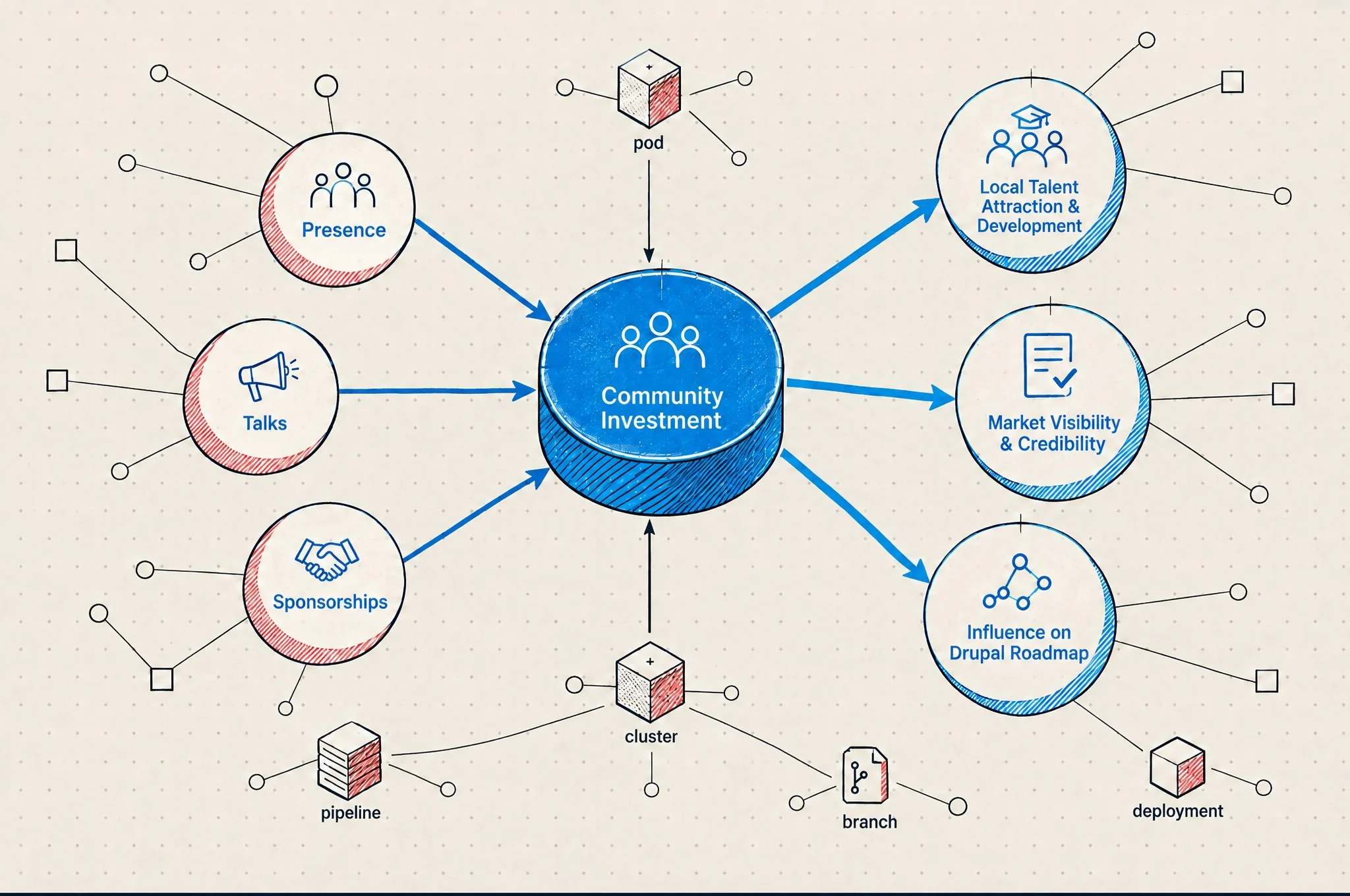
It is a serious objection. It fails for three concrete reasons.
- The developer pool. The talent pool of skilled Drupal professionals in Italy does not grow on its own. It grows when there is a place where a junior developer discovers this profession exists, and where a senior working in isolation realizes they are not alone. Those who do not contribute to growing that talent pool must compete for the same profiles with those who do, paying higher rates.
- The invisibility of Italian projects. In Italy, there are Drupal projects addressing complex technical challenges that almost no one outside the team knows about: multi-site migrations from Drupal 7 with dozens of instances to consolidate, multilingual management on institutional portals with complex translation and approval workflows, integrations with legacy public sector systems (such as SPID, PagoPA, and legacy databases), and media publications handling massive breaking news traffic spikes without degrading publishing speed. These are architectural solutions worth sharing, yet they remain confined to private repositories and internal meetings. A case study presented on stage changes how the market, as well as public and private buyers, assesses a technology: if no one shares how a public sector portal handled migrating from Drupal 7 to 10, decision-makers allocating tenders and budgets will look elsewhere.
- Decision-making influence. In a project governed by a foundation, those who participate in the conversation influence priorities: which issues get solved, which modules become standards, and which directions the core takes. This is not theory; it is why at SparkFabrik we built our business around open source rather than simply on top of it. The hours our developers dedicate to patches, modules, and contribution days are accounted for as an operational cost, and the resulting Contribution Credits brought us to the Gold tier of the partner program. In exchange, when an issue found on an Italian project becomes a core issue, we help shape the discussion rather than having it resolved in a way that does not suit our needs. Those who remain on the sidelines inherit choices made elsewhere, discovering them during upgrades when the cost to adapt is highest.
None of these three drivers produce a return in the same quarter the cost is incurred. All three impose a certain, higher cost on those who choose not to act: more expensive hiring, technology perceived as less mature by clients, and a product roadmap accepted passively rather than influenced.
We are behind. We stated this at the beginning and repeat it without sugarcoating. Yet within this same country, there is high-caliber work that has never been shared broadly: there is a national story to tell and a national community to rebuild around it. Together, these two realities are not a burden. They represent an opportunity waiting for someone willing to seize it.
Participating is maintenance, not generosity
The premise we started with returns here with added nuance. Participating in an open source community is neither generosity nor cultural patronage: it is maintenance of the shared infrastructure upon which our businesses depend. Like all maintenance, it costs money, yields no direct revenue, and is noticed primarily when it is missing.
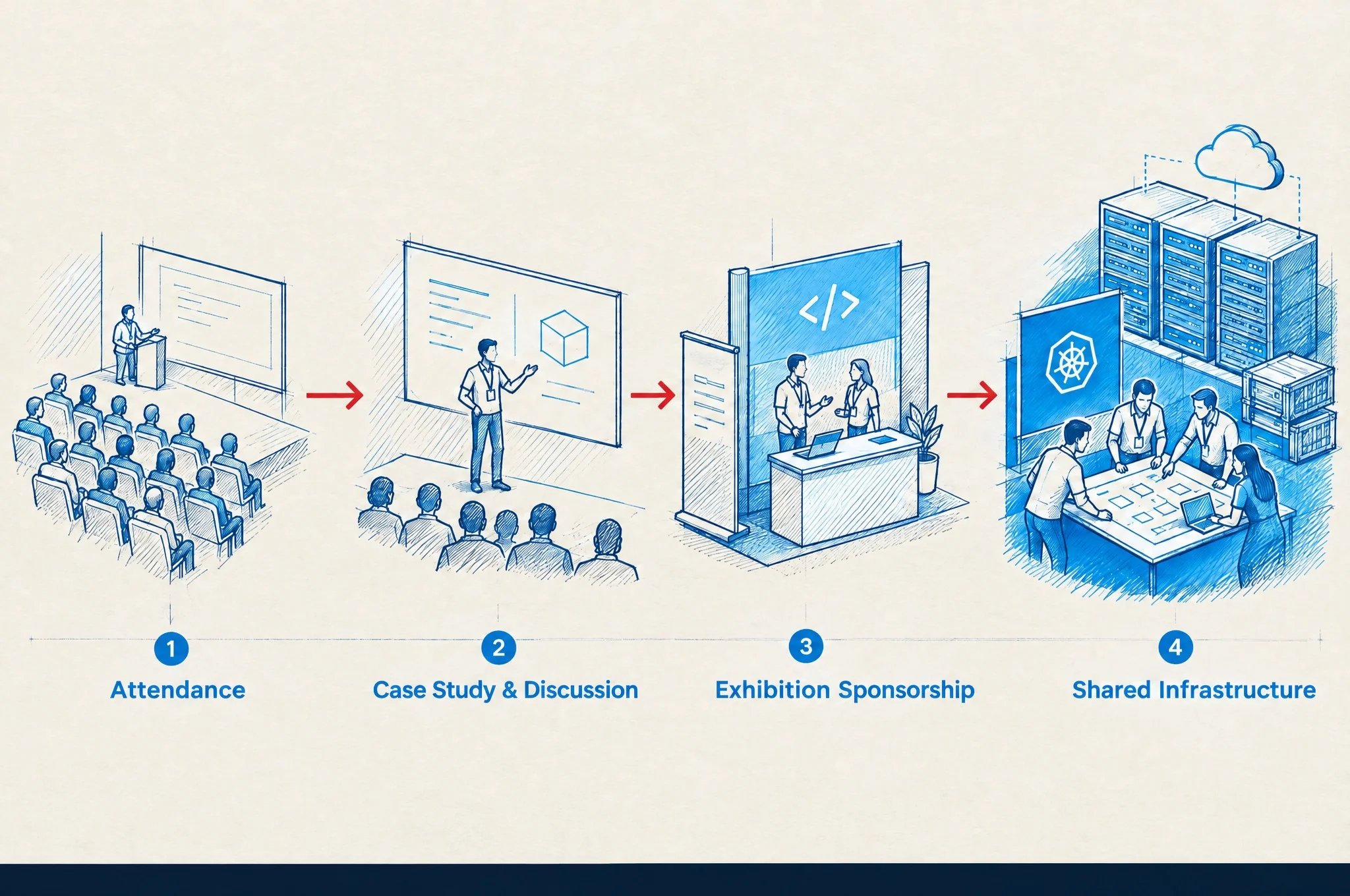
Participation takes many valid forms. If you work with Drupal, here are your options for DrupalCamp Italy 2026:
sponsor a track;
submit a talk proposal;
bring your team;
present your case study;
or simply show up in the room.
We organize it because we believe a healthy national community benefits everyone, not just the organizers. The official event page is on drupal.org; registration is open on ti.to.
Bologna, October 22, 2026.
Notes and sources
Note e fonti
The 2025 edition of DrupalCamp Italy brought the Italian Drupal community together for a day of talks, networking, and collaboration; the schedule and information about the upcoming edition are published on the DrupalCamp Italy 2026 page. ↩︎
SparkFabrik is a co-organizer of DrupalCamp Italy 2026, which will take place in Bologna on October 22, 2026, with tickets available and Call for Papers and Call for Sponsors open. (source: SparkFabrik è il primo Drupal Certified Partner Gold in Italia) ↩︎
Participants in the Global Contribution Day can contribute to Drupal not only through code, but also with documentation, translations, marketing, and frontend development, following the structure outlined by SparkFabrik. (source: Global Contribution Day 2026) ↩︎
SparkFabrik is the first Italian company to achieve Gold tier in the Drupal Association’s Drupal Certified Partner program, which requires both a minimum threshold of verified Contribution Credits and an annual financial commitment. (source: SparkFabrik è il primo Drupal Certified Partner Gold in Italia) ↩︎
SparkFabrik is a Gold-level Drupal Certified Partner, a recognition awarded by the Drupal Association based on actual contributions to the project (code, sponsorships, time dedicated to the community) rather than revenue. (source: Drupal Development and Consulting) ↩︎