

The combination of on-premise solutions and public or private cloud enables the design of optimal IT environments, with benefits in terms of flexibility, performance, and costs. Here’s how and why to implement hybrid cloud.
Hybrid cloud is becoming the preferred model for managing information systems among modern digital businesses.
According to Mordor Intelligence, the global hybrid solutions market, estimated at $52.16 billion in 2020, will reach a value of $145 billion by 2026, with a compound annual growth rate of 18.73% over the 2021-2026 period. According to a recent study by the Cloud Transformation Observatory at Politecnico di Milano, Mordor Intelligence’s forecast was actually exceeded in Italy. The Public & Hybrid Cloud component—meaning the set of services provided by external providers and the interconnection between public clouds, private clouds, and on-premises systems—recorded 30% growth in 2024 compared to 2023, with spending exceeding 4.8 billion euros (+30% over 2023).
AI represents the main driver of this growth, once again underscoring how cloud technology serves as an enabler for innovation. Moreover, the growing popularity of the cloud paradigm is fueled by a number of advantages, including the ability to combine on-premise and cloud technologies, resource scalability, infrastructure flexibility, and IT cost optimization. In short, cloud is now a foundational element of Digital Transformation.
But what exactly is hybrid cloud, and when does it make sense? Below, we attempt to answer these questions by exploring adoption paths, achievable benefits, and successful projects.
READ ALSO:
Pros and cons of multi-cloud: is it right for your business?
What is hybrid cloud?
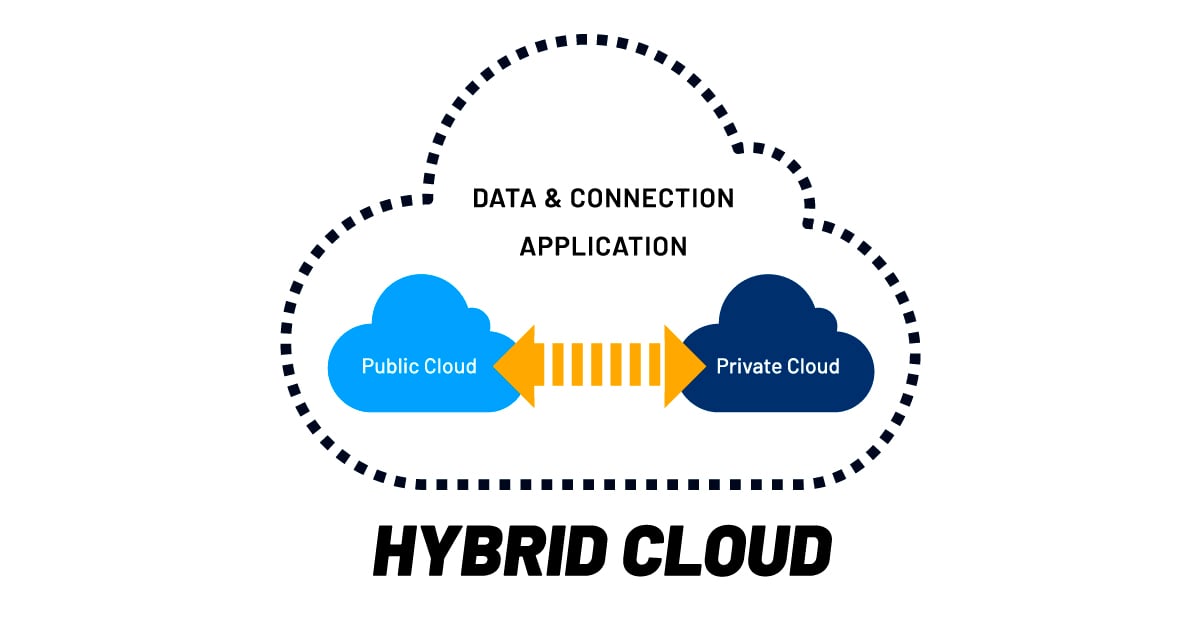
Hybrid cloud is an architectural system for building and managing IT environments that combines at least two private and/or public cloud solutions, incorporating portability, orchestration, and workload automation capabilities.
This definition leads us to a second question: what is private cloud, really, today? In an early stage, the term “private cloud” coincided with the concept of “on-premise,” where IT resources are delivered directly from the company’s local data center. Today, however, the Virtual & Hosted Private Cloud model is also more broadly considered: assets are delivered remotely by the provider, which reserves a dedicated portion of its infrastructure for the company.
Under the umbrella of “public cloud” fall the infrastructure and application solutions distributed by the provider, through proprietary data centers, as a shared service accessible by multiple users via the Internet. Public cloud is the domain primarily of multinational giants such as Amazon Web Services (AWS), Microsoft Azure, Google Cloud Platform, and Alibaba Cloud.
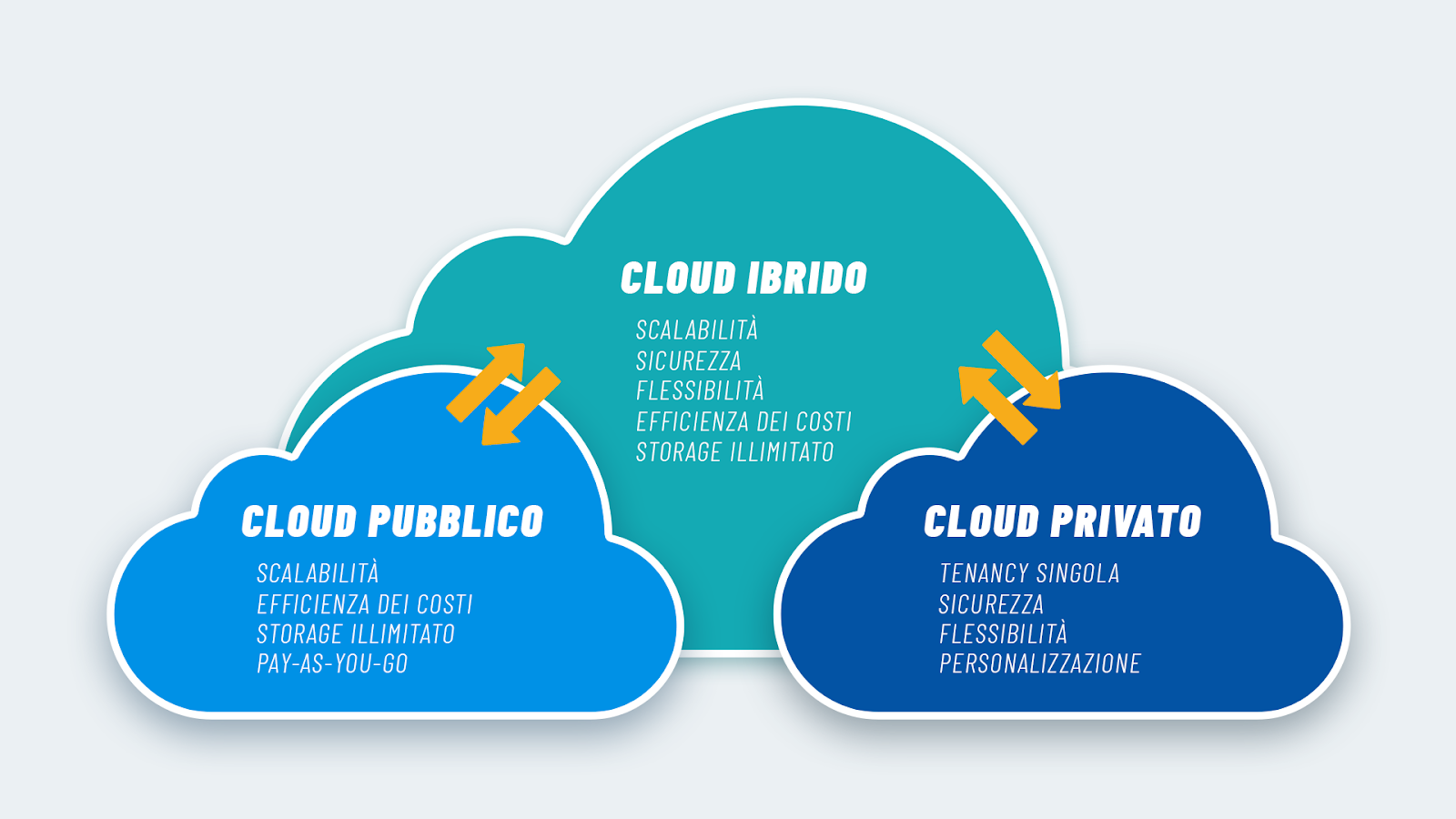
The private option proves more effective for companies that need to protect confidential information and carry out extensive customization of IT environments. The public alternative delivers high levels of flexibility and resource scalability, proving particularly useful for applications subject to sudden demand spikes.
TO LEARN MORE:
Private, public, or hybrid? A guide to choosing the right cloud
Hybrid cloud has the merit of combining private and public technologies, enabling companies to seize the opportunities of both paradigms, choosing on a case-by-case basis according to their needs and workload type.
What are the main technologies for hybrid cloud?
To enable interconnection between cloud and on-premise environments, there is an ecosystem of technologies that allow companies to manage data and workloads in a simple and efficient manner. Some examples include:
Kubernetes
The quintessential open-source container orchestration platform, Kubernetes is used to automate the deployment, management, and scaling of containerized applications across server clusters. It allows you to easily move and manage applications across different public and private clouds, ensuring operational continuity and flexibility.
Docker
Docker is a containerization platform that enables developers to create, distribute, and run applications in containers, making them portable across different environments. Docker containers include everything needed to run an application, including the code and libraries, ensuring consistency regardless of the infrastructure.
OpenShift
OpenShift is a containerization and orchestration platform developed by Red Hat and based on Kubernetes. It offers a comprehensive management infrastructure for containerized applications, including features for lifecycle management, process automation, and CI/CD pipeline support.
VMware vSphere and VMware Tanzu
VMware vSphere is a virtualization platform used to create and manage virtual machines (VMs), improving resource efficiency and operational flexibility of data centers. VMware Tanzu, on the other hand, is a Kubernetes-based platform that offers container management and orchestration capabilities, allowing you to deploy and manage Kubernetes clusters in hybrid cloud environments, integrating seamlessly with vSphere.
Ansible
Ansible is an automation tool that facilitates configuration and orchestration of services in hybrid cloud environments. Through scripts known as playbooks, Ansible enables the automation of operations such as application deployment, system configuration, and security policy management.
How hybrid cloud works
Getting into the technical details, hybrid cloud presents itself as an information ecosystem that connects and coordinates two or more independent clouds, featuring some fundamental characteristics:
- network connections (LAN, WAN, or VPN) that enable communication and data exchange between geographically distributed resources;
- integration and application interoperability, for example through the use of APIs;
- centralized orchestration tools that enable dynamic, on-demand allocation of infrastructure and application components;
- the use of infrastructure virtualization and application containerization technologies, which enable better management and portability of assets.
If initially hybrid cloud was the result of a necessity—namely ensuring integration and communication between the corporate on-premise data center and new cloud services purchased as needed—today it represents a deliberate strategic choice by a great many organizations.
As a result, the methods for building hybrid environments are also changing. Private and public resources were interfaced through middleware solutions and remote connections over a virtual private network. However, to ensure asset interoperability, as well as the movement of technologies and information from one cloud to another, highly complex integration software and specific VPN services were required, provided by the public cloud providers themselves as part of the subscription.
Currently, modern application architectures represent the primary tool for integration and the guarantee of portability. Development teams adopt technologies such as microservices and containers that make software solutions lighter to move and compatible with any infrastructure.
Microservices architecture allows you to design applications as a set of independent functional units that can be modified, invoked, and deployed individually. Containerization, on the other hand, places applications or microservices inside virtual instances of user space (containers), which are transferred from one cloud to another. Inside the package, which provides a complete execution environment, software runs without depending on the underlying hardware (and therefore the cloud).
New design techniques, however, make the application landscape more fragmented and complex to govern: this is where orchestration solutions like Kubernetes come in as key elements for building new hybrid IT environments, enabling the optimization and automation of container management.
READ ALSO:
Multi-cloud orchestration: tips for doing it the right way
The benefits of hybrid cloud
After the necessary technical clarifications, the benefits and opportunities arising from hybrid cloud remain to be explored. The main advantage to aim for is the flexibility of corporate information systems, with the ability to choose the optimal solutions each time (in terms of performance, costs, and security) for the delivery of IT projects. The market today offers a myriad of ready-made application features and services to draw from which, when correctly combined, enable the rapid construction of tailored solutions perfectly aligned with business requirements.
The variety of vendors and technology offerings also enables cost optimization: for each initiative and workload, the company is free to choose between on-premise solutions or public or private cloud, seeking the best economic value.
Distributing the IT environment across multiple clouds also offers advantages in terms of operational continuity, since you can rely on the availability of systems and services provided by different vendors. Added to this is the reduced risk of lock-in, as diversifying providers eliminates technological dependency on a single company and gives greater negotiating power.
Finally, hybrid cloud enables better management of information and process security. For handling certain types of particularly sensitive data subject to stricter regulatory compliance requirements, or for running applications considered business-critical, management within private clouds is preferable. For handling workloads of lower value and risk, public cloud services may be more convenient.
When and how to use hybrid cloud
In light of the advantages mentioned above, hybrid cloud proves to be the winning alternative for the majority of organizations because it allows them to capture the benefits of both types of cloud—public and private.
In the era of digitalization, business competitiveness hinges on the efficiency and effectiveness of the supporting IT infrastructure. Companies need to quickly develop and deliver valuable digital services, ensuring uninterrupted availability while cutting costs.
On one hand, public cloud enables the rapid implementation and scaling of resources as needed, delegating IT management and maintenance responsibilities to the provider, and choosing the optimal service from the vast portfolio of technologies available on the market. On the other hand, private cloud enables compliance with even the most stringent regulations regarding the protection and privacy of sensitive data, adhering to national, international, and industry-specific legislation. It also allows for greater customization of technology solutions and security levels, ensuring solidity and robustness.
In short, hybrid cloud expands the range of possibilities in terms of IT architecture and management, but it requires a forward-looking strategy at its foundation and specialized expertise. Starting from an analysis of the existing infrastructure, the ability to assess which type of cloud, offering, and provider best suits the company’s needs and specific workload is essential, selecting the most appropriate options.
It is necessary to be able to plan a cloud transformation journey—a customized, long-term infrastructure and application transformation path—intercepting emerging technology trends. In-depth knowledge of modern techniques and new software development tools is required, along with the willingness on the part of IT departments to make a step change, assuming an orchestration role and emphasizing governance aspects. Relying on a cloud migration service from a partner experienced in hybrid cloud topics can prove to be the winning option, as it allows the company to be guided toward the right choices based on past projects and accumulated know-how.
The choice of provider is also fundamental to the success of hybrid cloud initiatives and strategies. For example, Amazon Web Services offers solution packages that enable the construction of a hybrid environment, including hardware resources, APIs, management and migration tools. AWS thus simplifies and accelerates projects to extend the corporate data center to the cloud, implement edge computing applications, and leverage cloud services for on-premise resource administration. Google is also investing in hybrid cloud, as evidenced by the launch of Anthos, a platform that enables the rapid creation, optimization, and distribution of modern or legacy applications within public and private environments, leveraging the power of containers and Kubernetes.
Hybrid Cloud vs Multi-Cloud: What’s the Difference?
Hybrid cloud and multi-cloud are not the same thing, despite the terms often being used as synonyms. Hybrid cloud combines different public and private clouds that collaborate to share data and processes to perform the same activity. On the contrary, multi-cloud uses services offered by multiple public clouds to perform various activities, regardless of their location. Companies, to avoid dependency on a single provider, may choose to use resources from various providers to make the most of each service’s advantages.
A system based on hybrid cloud can also fall into the multi-cloud category if it integrates resources from a private cloud and at least two public cloud providers. In summary, while all multi-cloud configurations can include hybrid cloud elements, not all hybrid clouds automatically qualify as multi-cloud.
The choice between hybrid cloud and multi-cloud depends on specific business needs. Hybrid cloud is ideal for companies that need effective application governance, improved privacy, and want to integrate modern technologies like machine learning and AI without expanding existing infrastructure, optimizing ROI. On the other hand, multi-cloud is more suited for companies operating in a global digital context that need maximum application availability, flexibility in provider selection to maintain competitiveness, and improved response times for geographically distant users. Therefore, the right approach depends on the need to balance privacy, flexibility, innovation, and global availability.
Examples and cases of companies that have chosen hybrid cloud
Whether we’re talking about multi-cloud or hybrid cloud, we can say that the supply market is now mature: more and more companies have already chosen hybrid cloud for managing their IT ecosystems, reaping the benefits.
Reviewing some examples, Johnson & Johnson implemented an optimized architecture that connects local data centers to AWS cloud resources; Coca-Cola European Partners (CCEP) turned to IBM to move some mission-critical workloads to the cloud, building a hybrid environment; PayPal built a multi-cloud ecosystem, bringing together private and public solutions from different providers, including Google Cloud.
There are also national success stories. Two examples are the chemical-pharmaceutical multinational Zambon and the company Caleffi Hydronic Solutions, specialized in the production of components for heating, air conditioning, and plumbing systems. Both projects involved the combination of cloud services offered by Google Cloud Platform and Alibaba Cloud to manage corporate applications and websites in the West and East respectively, standardizing processes and centralizing governance.
In conclusion, the ability to choose and flexibility are criteria that will increasingly guide companies toward hybrid cloud in the future: the important thing is to start on the right foot, being able to rely on specialized expertise and the support of a trusted partner.