


The goal of the CNCF is to help organizations build scalable applications on public, private, and hybrid cloud. This support takes many forms: from technologies to events, here’s what the Cloud Native Computing Foundation does.
It’s easy to say “Cloud Native”; the process of adopting this paradigm is far less straightforward for organizations that decide to innovate their IT ecosystem. And this is where the CNCF comes into play.
When you decide to look into Cloud Native, some questions naturally arise:
- How do you evaluate the reliability and security of the tools available in the Cloud Native landscape? The success of the digital transformation project depends on them.
- How do you understand the direction in which theCloud Native paradigm is evolving? Innovation is great, but ideally with tools and methodologies that have been tested and whose robustness is guaranteed.
- How do youselect the best technology partners with the right skills and requirements to use Cloud Native tools? Relying on inexperienced collaborators risks significantly increasing project time and costs.
The Linux Foundation answered these questions in 2015 — the foundation created to standardize Linux and support its growth and adoption. The idea was as simple as it was effective: to create a hub for the Cloud Native world.
What is the CNCF
The project launched by the Linux Foundation is called the Cloud Native Computing Foundation, or CNCF for short. Today it is the place where some of the most important open source technologies (to name a few, Kubernetes andcontainers) meet with the leading players in the Tech world. Developers, large technology companies, enterprises implementing the Cloud Native paradigm: everyone gravitates around the CNCF.
In practice, as the CNCF explicitly states, the purpose of the project is to “build a sustainable ecosystem for Cloud Native software”.
The history of the Cloud Native Computing Foundation
The Foundation’s history is remarkable. And it couldn’t be otherwise, because the CNCF was born within the Linux Foundation at the behest of Silicon Valley’s biggest players. In 2015, Google, which until then had driven the development of Kubernetes, the open-source container orchestration and management system, decided to hand over its governance to the Linux Foundation. The Kubernetes project had reached maturity with version 1.0, and had clearly proven to be one of the key technologies of global infrastructure: a project too important to remain within a single company.
The Linux Foundation thus agreed to launch the CNCF project with the goal of “making Cloud Native ubiquitous”, immediately involving many large companies. In addition to Google (which coordinated the project until 2018), CoreOS, Mesosphere, Red Hat, Twitter, Huawei, Intel, Cisco, IBM, Docker, Univa, and VMware were also present from the start.
Today the members of the CNCF number more than 720, including us at SparkFabrik. And this is a very important point, as we’ll see shortly, because participating in the technical committees where the technological standards of the Internet’s core infrastructure are defined is of fundamental importance for those who work in this sector.
CNCF projects
It would be reductive to think of the CNCF as a simple vehicle that contains a single technology, namely Kubernetes. Even though, given the role Kubernetes plays in the development of the Cloud Native ecosystem, that alone would be no small thing.
Within the CNCF there are numerous projects organized into three increasing levels of technological maturity: Sandbox, Incubated, and Graduated. The criteria that determine a project’s maturity level also include its adoption rate, longevity, and whether it has been used in building reliable applications.
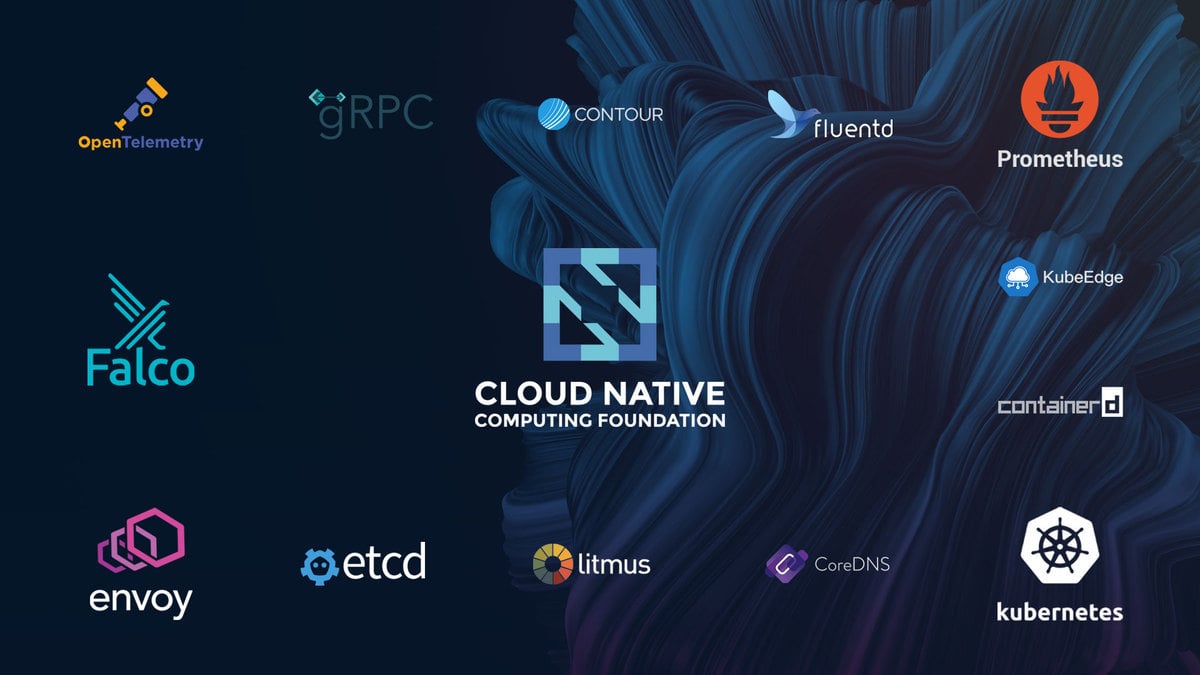
What are the main projects? The list is truly extensive: from Kubernetes (of course) to Prometheus, from etcd to CoreDNS, from Containerd to Envoy and Fluentd. But there are also the many projects under development in the CNCF incubator. Among them: Contour for Envoy, Falco, gRPC, KubeEdge, Litmus, OpenTelemetry.
It is a particularly rich ecosystem because some projects originate from the open source community, while others come from companies that then contribute them to the CNCF.
Navigating the Cloud Native world: Landscape, Trail Map, and Radar
The CNCF has also developed tools to map cloud technologies that fall within its scope of activity: the Cloud Native Landscape and the Cloud Native Trail Map. These two “maps”, together with the DevStats on GitHub, allow for a comprehensive cataloging of Cloud Native technologies and provide guidance on the goals and uses of each one. A particularly useful service considering how easy it is to feel confused or overwhelmed when choosing which technology to implement in your project.
Finally, since 2020 the CNCF has created its CNCF Technology Radar, which is a quarterly curated guide to some of the emerging technologies, all selected by CNCF experts.
TO LEARN MORE:** How to read the Cloud Native Landscape
Events organized by the CNCF
Among the CNCF’s initiatives are two events that take place simultaneously:**KubeCon and CloudNativeCon. They have effectively become the most important events for those involved in technology and business in the Cloud Native space. Opportunities for professional exchange, technology updates, and market trends: at KubeCon and CloudNativeCon, Cloud Native history is made.
The two events are held in rotation in different parts of the world three times a year. After the 2020 and 2021 editions were — for obvious reasons — virtual, the intention for the coming years is to return to in-person events.
The importance of certifications issued by the CNCF
That’s not all, though. One of the most important activities carried out by the CNCF is the certification of companies and individuals who use Cloud Native technologies, starting with Kubernetes. For example, there are currently 138 certified distributions and platforms for the use of Kubernetes, and there are various certification levels for administrators and developers who use Kubernetes, such as Kubernetes Training Partner (KTP) and Certified Kubernetes Security Specialist (CKS).
SparkFabrik has earned the Certified Kubernetes Administrator (CKA) and Certified Kubernetes Application Developer (CKAD) certifications. Furthermore, since our company has more than 10 Cloud Native certified developers, we have also obtained the Kubernetes Certified Service Provider certification.
CNCF certifications are fundamental for companies operating in the digital transformation market with a Cloud Native approach. They prove that the organization has the technological and strategic skills needed to plan and execute projects according to Cloud Native principles and best practices.**