



The time has come. With digital projects becoming increasingly pervasive and complex, a gradual and significant shift has taken place within organisations: UX Strategy is gaining ground in the field of user experience design, becoming ever more relevant.
In any digital project, we now take it for granted that usability is a cornerstone and a guarantee of success. This holds true both for end users and for developers themselves (they are users too, and their experience matters more and more). As a result, concepts such as User Experience, Developer Experience, roles like the UX Developer, the UX Strategist, and techniques such as User Story Mapping are increasingly indispensable in the digital landscape.
By now it is clear: the user must be the undisputed centre of design, and friction points during their experience must be minimised. But is it enough to simply adhere to usability principles? Are extensive prototyping and wireframing sufficient to achieve the goals we expect from a well-designed digital artefact?
Not quite. Brands and designers often need to broaden their vision and be more programmatic. This can happen precisely through the integration of UX strategy into their processes.
What is UX Strategy?
UX Strategy is precisely the combination of a strategic approach and UX design. It aims to ensure that design outputs, in addition to respecting usability and user-centred principles, are also correctly directed towards the business, communication, branding and marketing objectives of organisations.
The context in which User Experience Strategy operates is a broad, cross-functional strategic framework that always keeps the user and their satisfaction at the centre, while also integrating a careful understanding of the relationship between brand and user, and a deep awareness of the brand’s business challenges.
Sometimes UX Strategy does not limit its assessment to the digital touchpoint landscape, but broadens the vision by taking into account every point of contact between users and the brand, of any nature — including offline — when these are useful for comprehensively defining and analysing the paths and flows of target users.
Why is UX Strategy important?
UX Strategy defines at a high level the direction design should take and, above all, the reasoning behind it, enabling UX designers to consistently make informed choices that are coherent with the brand’s universe of meaning and, last but not least, measurable.
Like any strategic approach, UX Strategy needs to identify KPIs in order to quantify the benefits of the user experience that will be designed. This is precisely why it is essential that UX Strategy does not stop at the initial phases of a project but is embedded in a recursive model of constant verification — first of the UX design, and then of its implementation and development.
The synergy between UX Strategy and development is fundamental to ensuring that the planned experience is effectively implemented and that the final product meets both user expectations and the expected value for the brand.
When is UX Strategy necessary?
Although every UX intervention should always be framed within a decision-making framework with clearly defined purposes, UX Strategy is particularly necessary in cases of:
- Redefining a brand’s digital identity
- Designing a new digital product or service
- Introducing new target audiences to your user base
- Expanding digital touchpoints for the brand
- Revamping a legacy digital product or service
- Changing business, communication or marketing objectives
How is a UX Strategy developed?
In practice, the outputs that a UX Strategist can deliver consist of a series of typical activities and deliverables:
- Evidence analysis: in this phase, all the needs, typical behavioural patterns and user preferences gathered by UX Researchers are collected. Sometimes insights from customer support or offline contact points are integrated, when significant.
- Problem finding: through personas (detailed profiles of the different types of users who will use the product or service) and the creation of user journey maps (schematic visualisation of the various customer touchpoints with the product or service), UX Strategists can highlight pain points and opportunities for improvement.
- Strategic UX Plan: a careful dialogue with the brand makes it possible to understand the purposes and opportunities of the relevant business, defining — together with the other elements — the correct UX vision in which to place the project. The vision is embodied in an action plan that describes priorities and phases of UX implementation.
- Metrics and results measurement: business goals must be translated into expected outcomes at the level of user experience and, therefore, Customer Experience.
What are the principles of UX Strategy?
An effective User Experience strategy is built on three fundamental pillars. Vision, goals and planning are the components — or key stages — that make it possible to define an effective UX Strategy for any project. Let us analyse them in detail with the help of concrete examples.
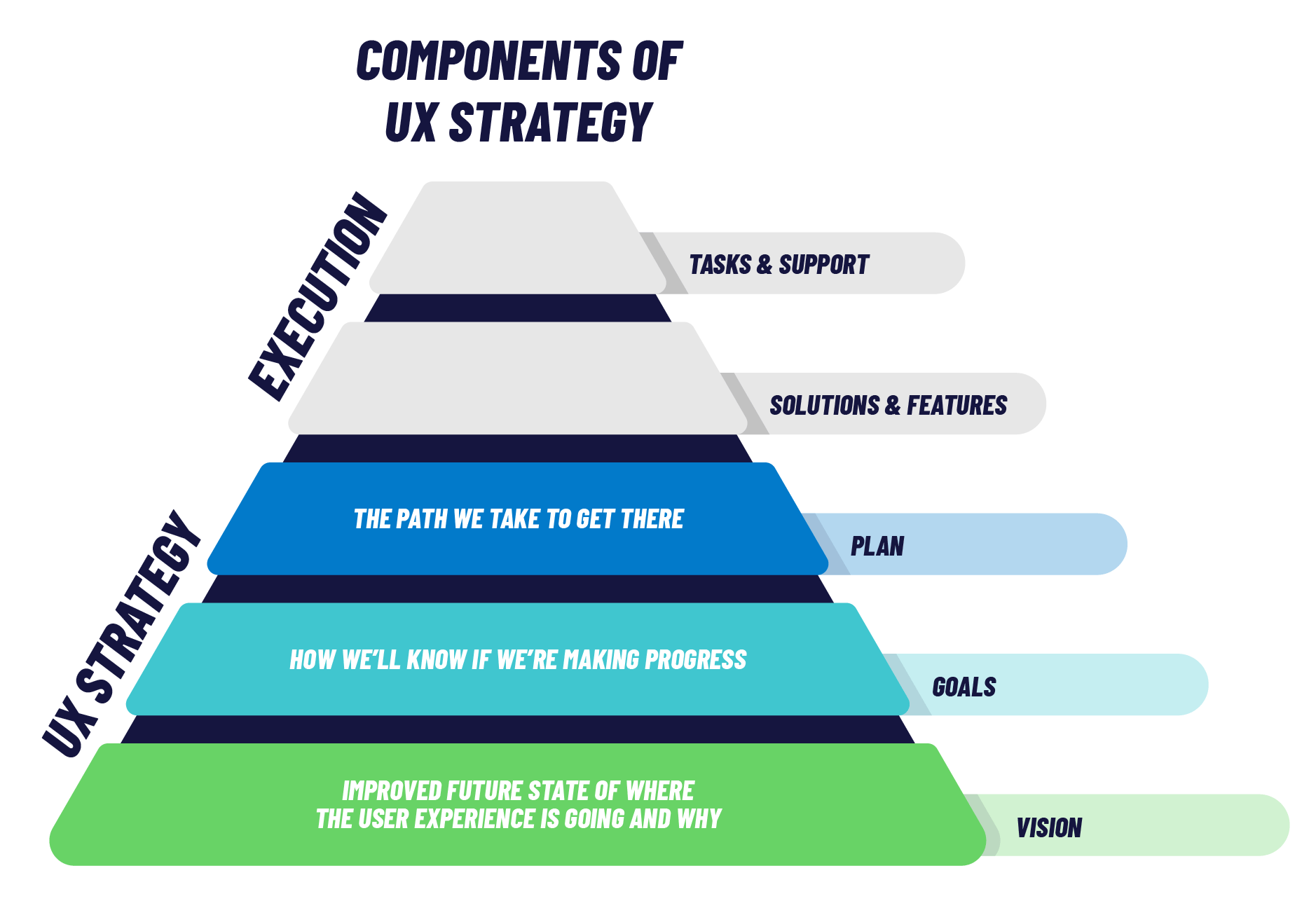
Image: the pyramid proposed by Nielsen Norman Group
1. Vision
The vision expresses where the company wants to go. It is centred on business objectives, with a long-term time horizon. It reflects the company’s ideals and aspirations, placing them in relation to the needs of the people the company serves with its products or services. What does this have to do with UX Strategy? Simple: for the vision to have meaning and value, it must be placed at the centre of any strategy — including UX Strategy. In short, the company vision must guide the team’s work, steering their choices so that these contribute, step by step, to achieving the long-term objectives the company has set for itself.
Example. Let us consider a company whose primary target audience is Gen Z. Its vision involves becoming a market player capable of capturing the attention of hyper-stimulated, constantly connected users with low loyalty and a high churn rate.
User research could lead to identifying the main problems with the company’s current touchpoints, investigating the key issues to be resolved. These issues could be found, for example, in the high abandonment rate of product usage explanation pages, combined with a high number of calls to customer care. A typical characteristic of this target audience is indeed “lazy questions”, which entail high customer support management costs.
2. Goals
Once the destination has been defined through the vision, a method for measuring progress is needed. Goals, together with metrics and key performance indicators (KPIs), should directly link user experience improvements to business objectives. The goals of a UX Strategy must therefore maintain a vision equally centred on both the user and the business.
Those working on UX Strategy must therefore understand how an organisation earns and spends money and what matters to it. Only then will user experience objectives and metrics be relevant to business priorities. To be more concrete, we can say that, within UX Strategy, objectives and metrics should highlight:
- Why the company will succeed by becoming user-centred
- Which actions have the greatest business impact
- What to prioritise
Example. The UX Strategy will identify the main objectives and the KPIs to measure them. As an example, let us return to the case of the company targeting Gen Z. We can translate the need to capture users’ attention through its website — without overloading customer service — into the following objectives:
- Reduce calls to customer care: the KPI will be the number of clicks on the page with contact information for support.
- Increase visit depth on the site: the KPI will be the change in the number of pages visited and the reduction of the bounce rate for certain target pages.
- Increase content reading time on the site: the KPI will be the change in time spent on a set of key pages on the company website.
3. PLANNING
The third fundamental element is planning. After considering the vision and developing relevant objectives and metrics to pursue it, it is time to take action. In other words, a plan is needed — in fact, more than one. Each UX objective is broken down into several specific sub-objectives. Including and rationally organising each sub-objective allows the team to monitor constant incremental progress.
In addition to the objectives, the plan should also include approximate timelines, prerequisites, dependencies and other important elements.
The plan helps to prioritise activities and address uncertainties. However, plans should describe, not prescribe. The plan communicates in general terms what needs to be taken into consideration and when, while working towards the objectives. It is normal and desirable for a plan not to be perfectly linear and rigid, nor for it to define in advance which solutions to execute in order to achieve the objectives. It is up to the teams working on user experience to decide, once the plan has been defined.
Example. Returning to our example, the objectives accompanied by KPIs will be pursued through a series of programmatic actions based on increasing visual elements versus textual ones, on the one hand, and on a more granular organisation of page content on the other. The plan defines the timeframe within which these actions will be implemented, along with relevant details:
- Q1 - Scanning: Reduce long texts into shorter paragraphs that can be easily scanned on the page at first scroll (by incorporating elements such as accordions, quotes, headings with different weights).
- Q1 - Process schematisation: introduction of step-by-step wizards, visual explanations and infographics in sections that explain how the product works.
- Q1 - Video: creation of a UX where videos can be easily integrated to replace walls of text.
- Q1 - Mobile first: prevalence of “one thumb, one eyeball” navigation elements that allow easy and fast consumption on mobile, with the extensive use of gestures and elements navigable with one hand, just the thumb, and one eye always on the external context.
In summary
UX Strategy emerges prominently in a context where digital projects are increasingly complex. Through the integration of a strategic approach and UX design, it aims to steer design outputs towards business, communication and branding objectives.
Its importance is revealed in the constant alignment between business and the design and development team, ensuring a cross-functional vision that guides activities, from evidence analysis to the definition of a strategic UX plan. Essential in cases of redefining the brand’s digital identity or introducing new target audiences, UX Strategy is built on several interconnected principles that synergistically shape a user experience that is targeted and functional to business objectives.
The constant dialogue between business and the design and development team is essential to ensure that every activity — whether wireframing, prototyping or front-end development — is directed towards a single direction, delivering value to both users and the brand.