
Since January 5, 2025, Drupal 7 is officially an obsolete technology. This doesn’t mean it no longer works, but it is no longer supported in any way by the open-source community. In other words, the inevitable moment to migrate to a more up-to-date version of the CMS has arrived, with the latest version being Drupal 11. This is the only way to ensure long-term continuity for your projects.
Read also: Why choose Drupal for complex enterprise websites
Drupal 7 Has Reached End of Life
In the software world, “End of Active Support” (EOS) and “End of Life” (EOL) represent critical phases in the lifecycle of a digital product or service. EOS indicates that the software will no longer receive new features or improvements from the development team. EOL, which follows EOS, marks the definitive end of support.
Once a piece of software reaches EOL, it no longer receives any updates, including critical security patches. Essentially, it is the signal from the company or community managing the product that it is now necessary to migrate to a more recent version or adopt an alternative solution.
The reason for this introduction? Simple — Drupal 7 has been in EOS for several years and has recently reached EOL as well:
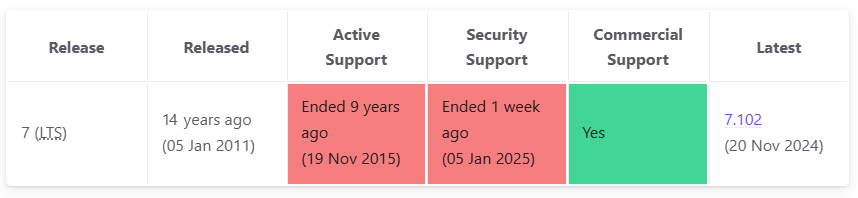
Specifically, the EOL of Drupal 7 began on January 5, 2025. From that date, all updates have been discontinued, including security patches and bug fixes. Considering that Drupal 7 was released 14 years ago, it was inevitable that the lifecycle of this beloved version of the popular CMS would eventually come to an end.
The implications are clear: all websites and online services running on Drupal 7 are now vulnerable to significant security risks. This scenario presents non-negligible risks, which will be explored in more detail in the next chapter.
Why Switch to Drupal 11 Now? The Risks of Staying on Drupal 7
It’s time to examine the consequences of using Drupal 7, a piece of software that has surpassed both its End of Active Support and End of Life.
Consequences of EOS
With Drupal 7 reaching EOS, it becomes increasingly difficult to keep our software in step with new technological requirements:
- Incompatibility with new technologies: Drupal 7 supports PHP from version 5.6 to 8.2, but it is not compatible with versions 8.3 and 8.4, which are currently the most recent. The same applies to MySQL, supported only up to version 8.0, which is not the latest available. This limits developers’ capabilities.
- Software obsolescence: Due to the lack of evolution and updates, Drupal 7 becomes increasingly unsuitable for modern web technologies. This reduces the competitiveness of sites built with that version of the CMS. Additionally, a site based on an EOL version of Drupal could be constrained by legacy versions of plugins, modules, and themes.
- Performance issues: The lack of optimizations and improvements makes sites built on Drupal 7 more vulnerable to performance slowdowns.
- Lack of technical support: Without assistance from the community or official developers, resolving issues becomes more complex, forcing you to resort to paid external support services.
- Increased risk of downtime: The absence of official support leads to an increase in technical problems that, without quick solutions, can cause frequent service interruptions.
Consequences of EOL
The greatest concerns arising from Drupal 7 reaching EOL are related to security:
- Complete absence of security updates: Without new patches, sites are exposed to critical vulnerabilities that malicious users can exploit to steal data or disrupt service operations. This opens the door to serious software security issues.
- Compliance issues: Over time, sites using EOL versions of Drupal tend to no longer meet the security, accessibility, and privacy standards required by regulations such as GDPR or the European Accessibility Act, with potential penalties and reputational damage.
The Solution Is Drupal 11
It is clear, then, that Drupal 7 must be replaced as soon as possible to avoid technological, reputational, and business problems. The question now is: what is the ideal solution to replace it? The answer is Drupal 11, the very latest version of the CMS!
Drupal 11 was released on August 2, 2024 and is currently the only version of the CMS with active support:
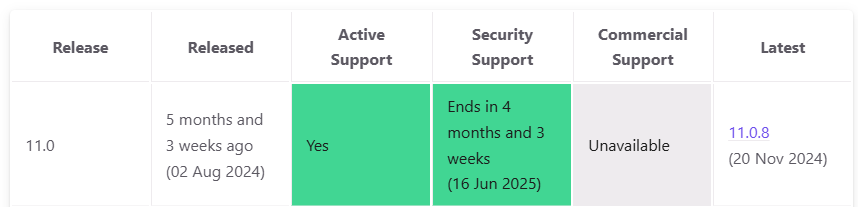
As indicated, the EOL for Drupal 11 is set for June 16, 2025, but there is no reason to worry: the 11.x versions are destined to be supported for several years, certainly at least until the end of 2027:
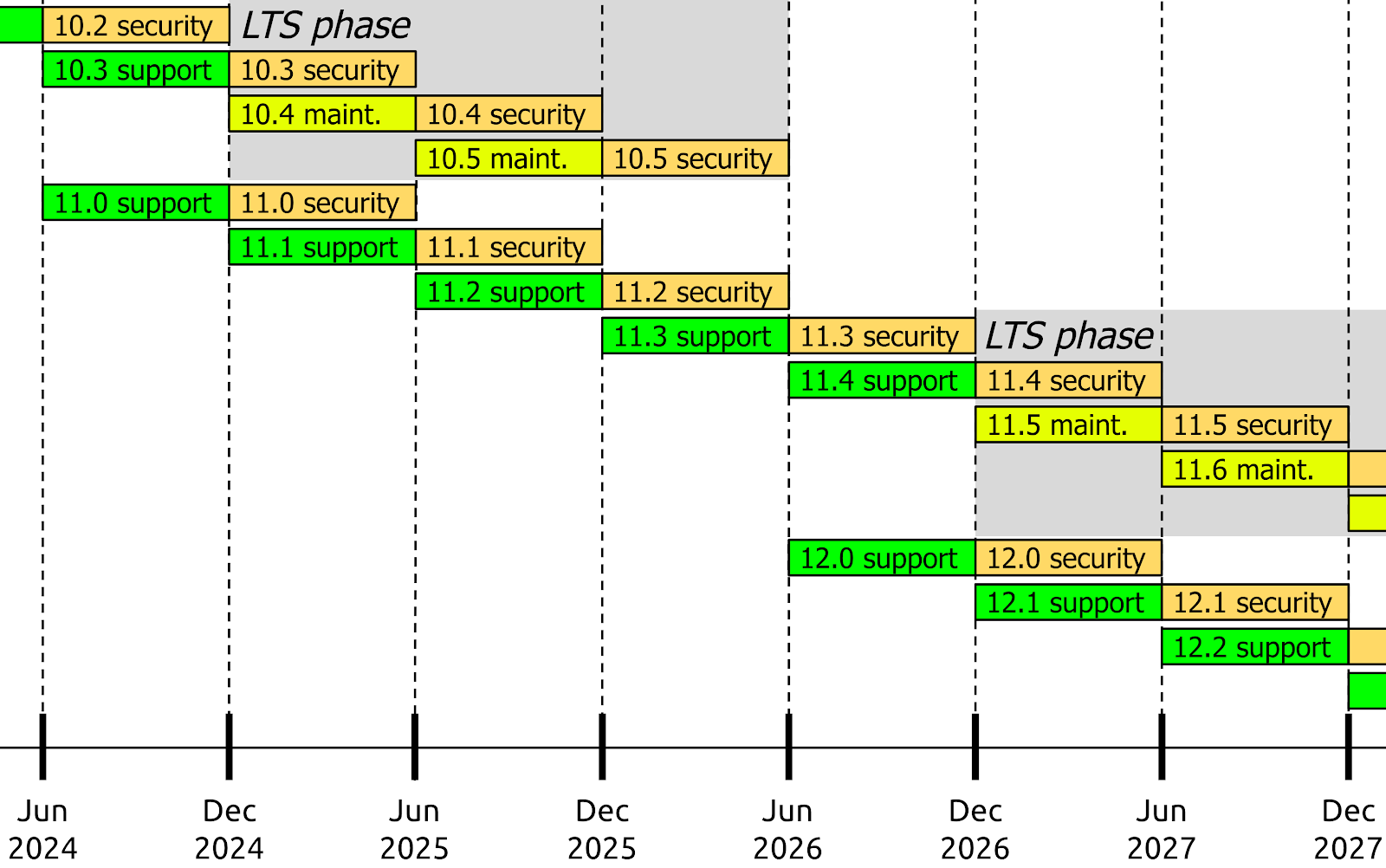
The benefit of switching to Drupal 11 now is that updates between sub-versions (such as from 11.0 to 11.1) are generally quick and painless. Furthermore, Drupal 11.4 is set to become an LTS (Long Term Support version) in 2026, which means it will be supported for several years to come.
Key Advantages of Drupal 11 over Drupal 7
Improved Security with Symfony 7
The Drupal 11 engine is built on Symfony 7.1, a powerful open-source PHP framework, which significantly improves security through protection against common threats such as SQL injection and XSS attacks.
One of the key improvements from adopting Symfony 7 is its modern architecture, which makes Drupal 11 more robust and easier to maintain than previous versions. This integration optimizes both performance and security, and enables more flexible permission management, as well as advanced protection against unauthorized access.
Finally, features introduced in previous versions, such as the ability to disable the super-user account in Drupal 10, represent a further step forward in preventing critical exploits.
AI Integration
Starting from version 10, the Drupal CMS introduces advanced AI-based features through the Drupal AI module. Further refined in Drupal 11, this framework enables the integration of AI solutions from both external providers and open-source models.
The main AI submodules are:
- AI Core: Access and customization of AI models.
- AI Search: Advanced AI-based semantic search.
- AI Assistants API + Chatbot: Centralized and flexible chatbot configuration.
- AI Content: Tools for adjusting tone, summarizing texts, suggesting taxonomies, and verifying content.
- AI Translate: Instant content translation for multilingual sites.
Drupal AI simplifies the automation and optimization of editorial processes, offering greater flexibility and innovation. It also opens the door to building more advanced sites that are in line with current user expectations.
More Modern Interface Optimized for Accessibility
Drupal 11 features a completely redesigned user interface based on WCAG 2.1 accessibility standards. Many measures have been taken to make the system easier to use, regardless of the user’s technical expertise. This ensures a more intuitive and inclusive experience, even for users with disabilities.
Performance Improvements
Drupal 11 has been optimized to deliver significantly superior performance compared to Drupal 7. The transition to PHP 8.3 and MySQL 8.0 has reduced code execution and query times, improving speed and responsiveness. Specifically, developers have streamlined the Drupal core by eliminating redundancies and refining key functionalities.
Additionally, the caching system has been enhanced to lighten server load and reduce page loading times. These innovations ensure a smoother user experience and greater scalability, even for complex enterprise websites.
Simplified Content Management
Drupal 11 offers a content management system that is significantly more advanced than Drupal 7. Features like the always-visible action bar and the new unified view for managing revisions make creating, organizing, and editing content faster and more efficient.
The new user interface facilitates field reuse and simplifies complex content management. These improvements not only support daily content management but also contribute to a better user experience.
Long-Term Support
Drupal 11 guarantees a development cycle spanning several years, with support and security updates until 2027 and beyond. This makes it a winning and reliable choice for both short-term and long-term projects.
Compared to Drupal 7, which is now out of support, Drupal 11 ensures operational continuity and protection against emerging vulnerabilities. The CMS roadmap provides for regular updates to improve functionality and compatibility with new technologies, keeping the system always up to date and in step with technological evolution.
Migrating from Drupal 7 to 11 Is Necessary and Easy
The official Drupal data speaks for itself: 36% of all sites built with Drupal are still on Drupal 7. While this figure is alarming, it also means that if your site is still on Drupal 7, you’re not alone!
However, this does not make the problem any less serious. The flip side is that over 60% of Drupal sites are already on a version newer than 7. Considering the issues highlighted in this article, there is no doubt that the time to move to a more recent version is now.
The fact that your site is running an obsolete version of Drupal actually represents an opportunity to make a significant leap and move directly to the most up-to-date, powerful, and performant version 11 of Drupal.
Concerns about migration — such as operational disruptions, data loss, layout changes, and other difficulties — are understandable. However, these issues can easily be overcome with the support of a team of experts with years of Drupal experience, who will ensure a gradual, effective, and seamless migration process.
Conclusions
Drupal 7 has been around for nearly 15 years and the time has finally come to retire it. 2025 marks the End of Life for one of the most successful versions of Drupal, one of the most widely used CMS platforms in the world.
The risks associated with using a technology that is no longer supported are too high, and it is therefore essential to migrate to a more modern and innovative solution, such as Drupal 11. This version is the most recent, performant, and user-friendly ever released.
Unfortunately, every migration brings with it uncertainties and challenges, but relying on experts guarantees a painless transition within the desired timeline.
Not sure who to turn to for your Drupal 11 migration? SparkFabrik, the Italian company with the largest number of Acquia-certified Drupal developers, is ready to help. Learn more about our Drupal services!