




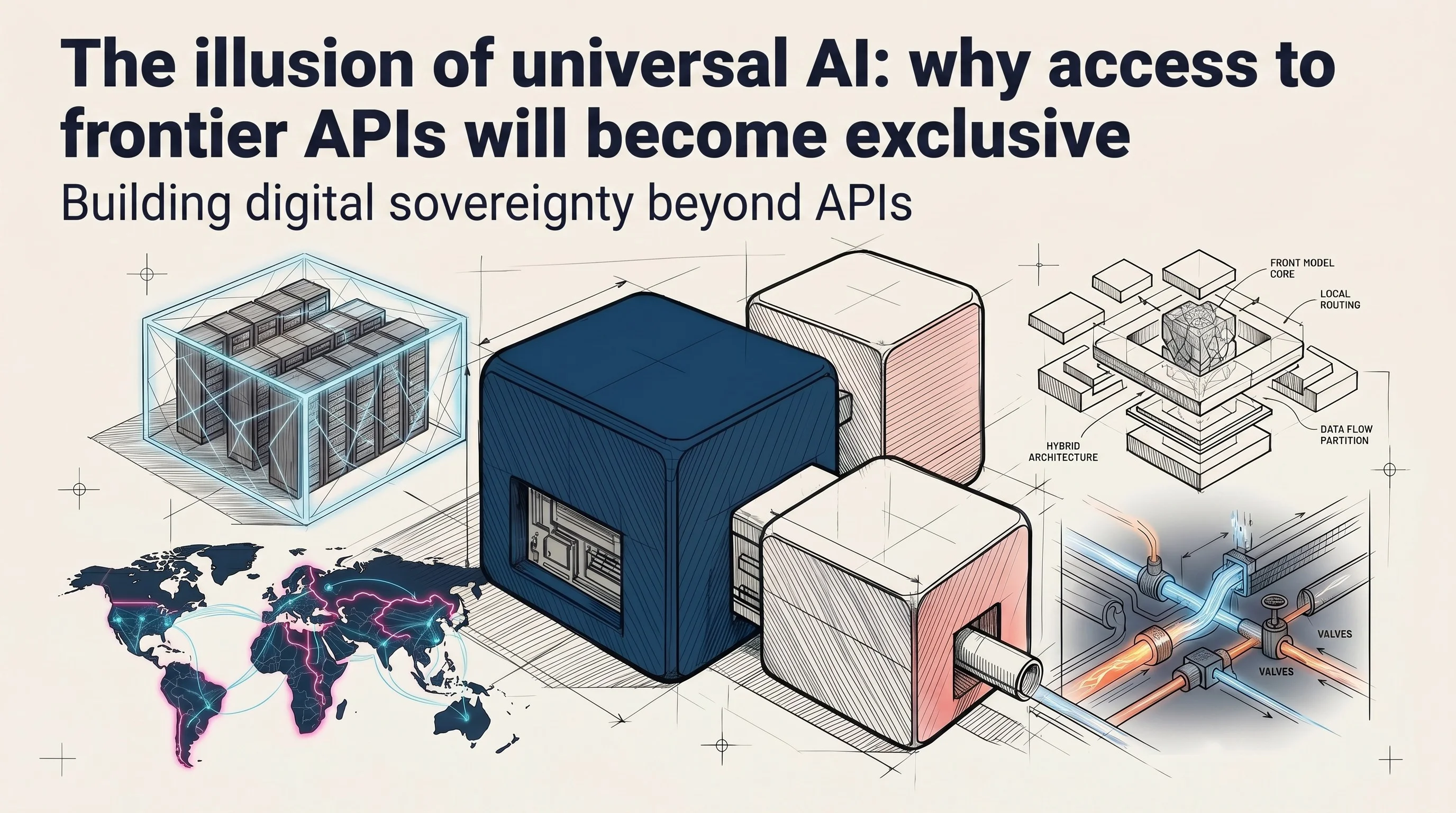
Building your core business on a frontier API means delegating operational continuity to geopolitics. An infrastructure can shut down suddenly, not due to a technical failure, but because your country has been removed from a whitelist.
Access to frontier artificial intelligence models will not be universal: it is becoming scarce, selective, and shaped by geopolitics. The promise that LLM tokens would follow the trajectory of traditional software, becoming ever more abundant and ever cheaper, runs into the physical limits of today’s infrastructure and the strategic choices already being made by American providers. Anton Leicht crystallises this in his analysis Cut Off: frontier-model access is becoming a resource for the few. The first signs of the Californian taps being turned off demand a proactive change in course. Organizations can no longer simply consume external services; they must begin to engineer internal systems capable of operating autonomously, decoupling their business from future decisions made overseas.
The end of the Microsoft model and the Mythos case
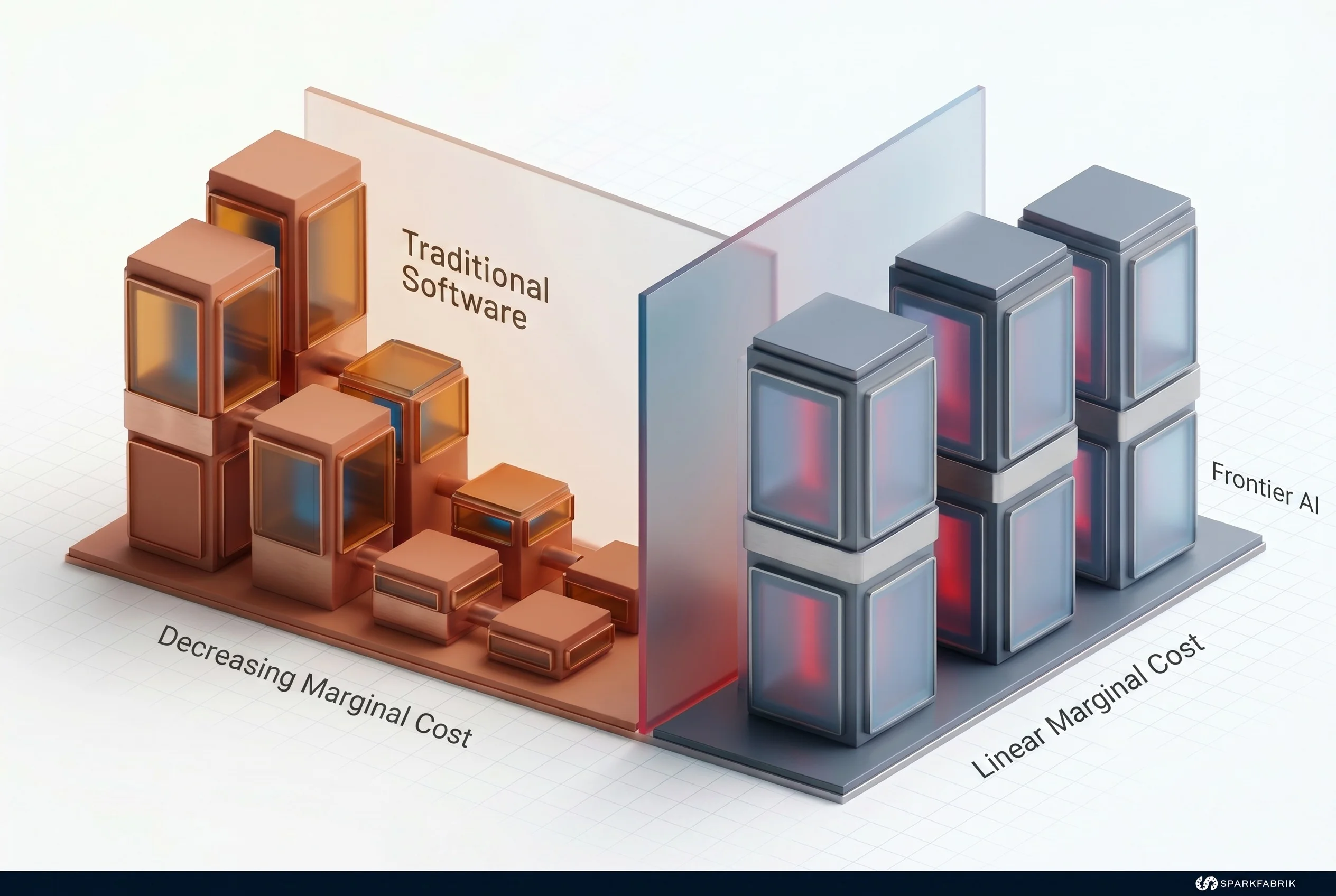
Those who work in IT are accustomed to a precise logic: software has a marginal cost of zero. When Microsoft develops an operating system, the cost to distribute the first copy is immense, but the cost to distribute the millionth is irrelevant. This dynamic has convinced many decision-makers that frontier artificial intelligence will follow the same path as the mass market. Unfortunately, generative AI does not follow these economic rules.
The most direct evidence comes from Microsoft itself. The Redmond giant has announced that from June 2026 GitHub Copilot will abandon flat-rate subscriptions for usage-based billing based on AI Credits (github.blog). If the leader of the developer-tools market cannot sustain flat-rate pricing against inference costs, the illusion that AI tokens will follow the trajectory of traditional software pricing is officially over. The economic fracture between managed services and self-hosted infrastructure is the subject of our analysis AI agent harnesses: the great pricing divergence.
Frontier models are not infinitely scalable consumer goods. We got a taste of this at the beginning of April, when Anthropic announced Mythos, a top-tier model dedicated to cybersecurity. European companies expected to be able to integrate it into their workflows. Instead, scrolling through the announcement page, startups and system integrators from the Old Continent found a closed list of privileged partners, almost exclusively US-based corporations. Europe was left out, a fact also reported by Politico.
Observing the moves of competitors, a clear picture emerges. OpenAI recently launched the Daybreak initiative for its gpt-5.5-cyber model. In this case, too, the promise of a universal release was replaced by strictly limited access. Leading companies are giving the first signals that they want to close the gates.
Why is this happening? American companies are facing issues of physical, economic, and strategic survival. Value is shifting from the raw algorithm to the infrastructure required to run it securely, and that infrastructure is currently not enough for everyone.
The computational collapse and the threat of distillation
Providing access to a frontier model is a zero-sum game. Every generated token consumes real energy, real computing power, and physical hardware that cannot be allocated elsewhere. We are witnessing a compute crunch, a global supply deficit thoroughly analyzed by The Economist. The situation is so strained that even giants like Anthropic are forced to seek compute capacity deals with rivals like xAI.
Just as free cloud services impose strict storage limits (for example, the classic 15 GB maximum offered by Google Drive for basic accounts), AI infrastructures are hitting the insurmountable wall of the marginal cost per token. No software optimization can withstand the friction of physics.
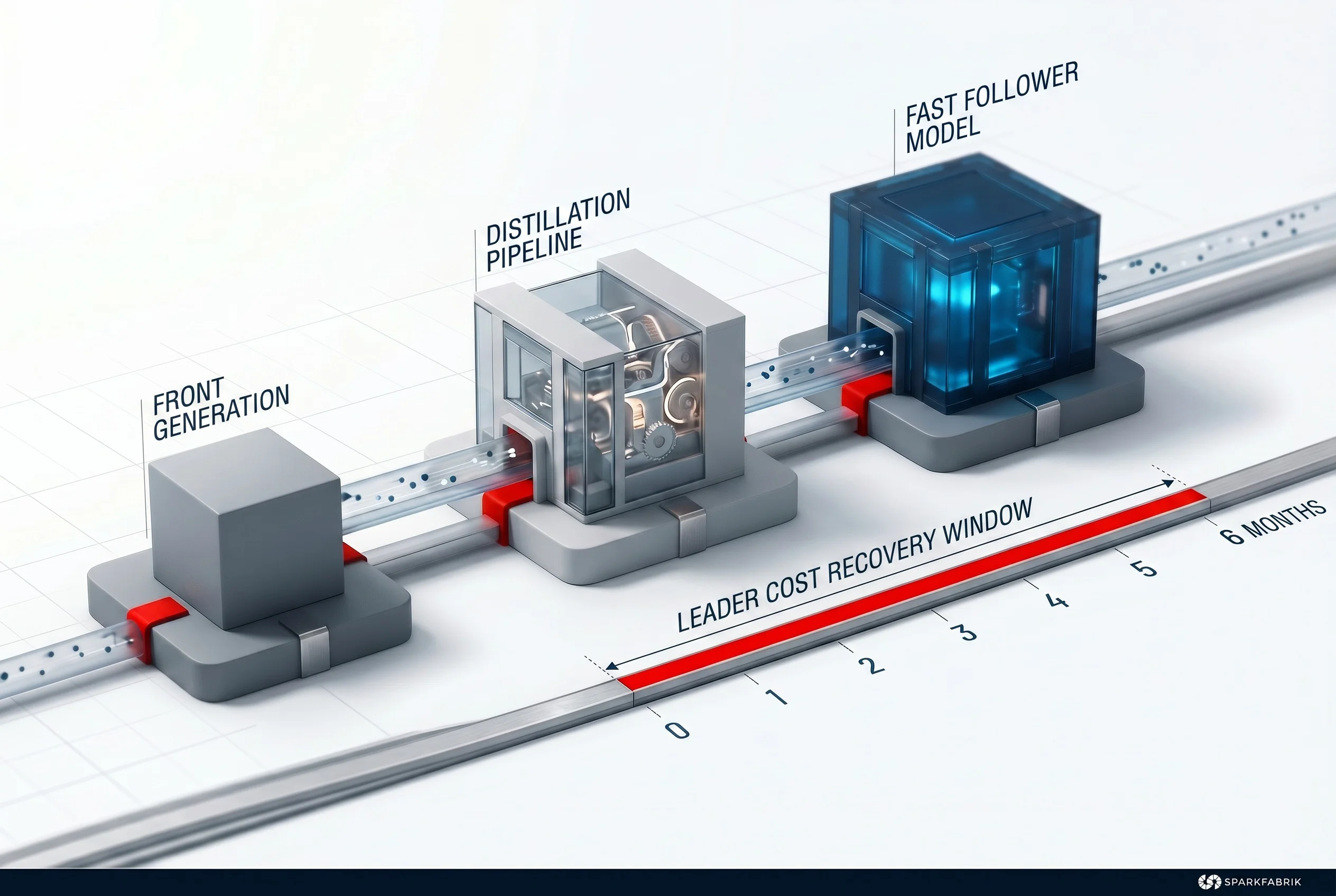
Added to this limit is a devastating commercial problem: distillation. Fast followers, such as the Chinese company DeepSeek, manage to maintain a lag of only 6–9 months behind the American technological frontier. They do this by leveraging open API access to train their own models on the results generated by market leaders. The proliferation of open-source generative AI tools for development has enormously accelerated this knowledge transfer process.
The economics of this dynamic are unsustainable for those doing primary research. According to a study by the IAPS institute, frontier model developers today have a window of only 6 months to recover their immense investments in R&D before their model is cloned through distillation attacks. Opening an API to the entire world means selling your industrial secrets for a few cents per million tokens. The logical reaction we might see on a large scale is the closing of access, the implementation of rigorous Know Your Customer (KYC) checks, and the limitation of use to trusted partners. If the infrastructure creaks and intellectual property evaporates, politics intervenes to decide who has the right to sit at the table.
The geopolitics of tokens: when access becomes a weapon
The United States government has stopped viewing artificial intelligence as just another software sector. Today, it treats it as a critical national security asset and a powerful tool for diplomatic leverage. The dynamics at play closely resemble those of military cybersecurity.
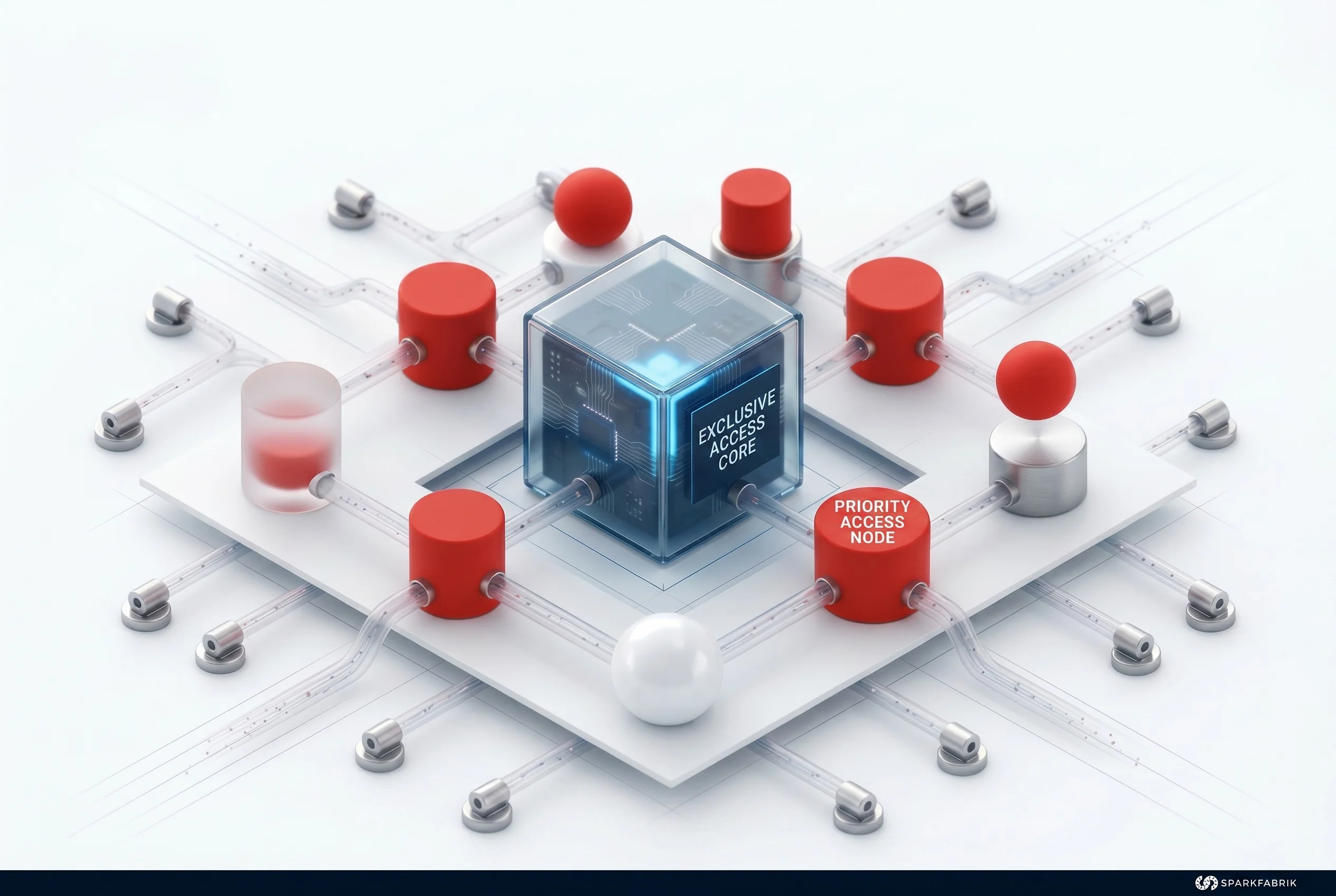
The logic is ruthless but consistent. Anton Leicht raises an unequivocal point: if I were the NSA and I were sitting on a pile of zero-day vulnerabilities, I would absolutely want to know which of these exploits a model like Mythos is capable of finding. I would want to use that strategic advantage before vendors publish patches. This is not a conspiracy theory; it is the recent history of computing, as the EternalBlue case teaches us. Providing an advanced cybersecurity model to foreign governments or non-aligned companies means ceding a tactical advantage that is unacceptable to American intelligence.
This protectionist stance is reflected in concrete legislative initiatives. The GAIN Act proposal follows this exact trajectory, ensuring that American buyers have the right of first refusal on computational resources and tokens generated on national soil. Access to AI is becoming a bargaining chip in international relations, influencing trade deals and alliances, as highlighted by the tensions over technology agreements discussed by Donald Trump and Keir Starmer reported by The Guardian, or by the new regulations analyzed by the Washington Post.
The illusion of democratic access to AI risks vanishing soon. We are heading toward a global rift between those who control frontier models and those who are excluded.
Warhol used to say that the great thing about Coca-Cola is that the President of the United States drinks the exact same Coca-Cola that you do. Until yesterday, a small European agency queried the same OpenAI API used by the Pentagon, but the future trajectory points in another direction. This potential AI divide, analyzed by Foreign Affairs and RAND reports on global security, turns the impacts of the regulatory framework on the European Union’s digital sovereignty into issues of pure economic survival. The clock has already started: as the CEO of Mistral warned on Business Insider, Europe has a window of only two years to avoid irreversible technological dependence on the United States. For this reason, European companies and global middle powers (FAI) cannot stand by and watch, hoping for an invitation to the exclusive club.
Beyond the fence: hybrid architecture as the only way
If unlimited access to frontier APIs will no longer be guaranteed for everyone, how should a European company behave to continue releasing competitive software? The answer is not to build a trillion-parameter language model in the company basement. The solution lies in software engineering, specifically in AI layering and the adoption of hybrid architectures.
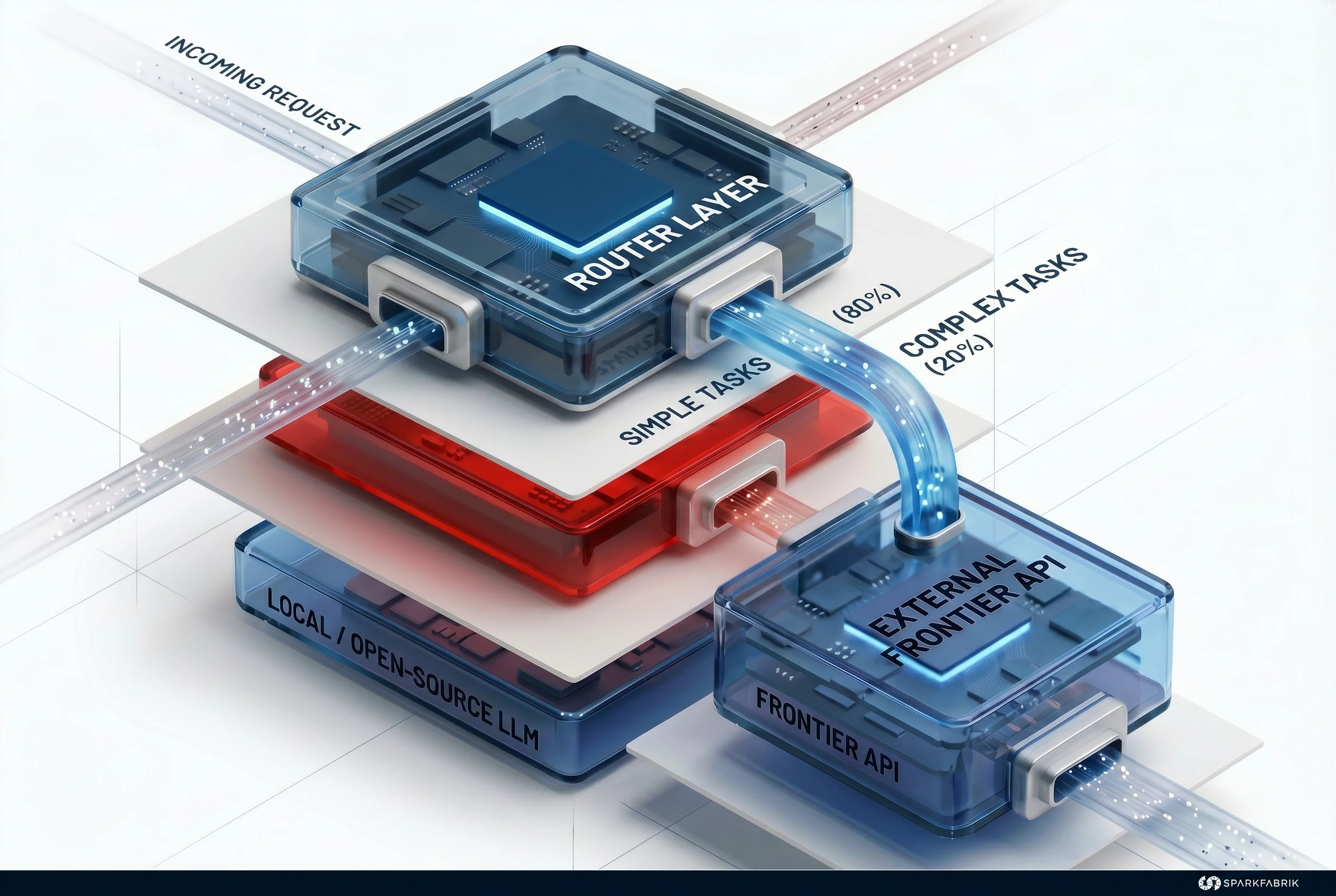
We must shift the focus from “which model to use” to “how to orchestrate models.” Building an application by binding it directly to the APIs of a single American provider is now an unacceptable architectural risk. Companies must build intermediate abstraction layers. Good architectural design allows for dynamic routing, evaluating the complexity of the request in real-time and routing it to the most suitable, available, and economical model at that moment.
In practice, imagine a customer support system. A simple ticket classification request is routed to a fast and cheap local model, while only the analysis of a complex legal contract reaches the expensive frontier model.
You don’t need an advanced generalist model to solve 80% of business problems. Local infrastructure becomes the true defensive shield.
Data extraction from an invoice or the generation of internal technical documentation can be brilliantly handled by local open-source models, trained and optimized for specific domains. This approach drastically reduces operational costs, ensures data privacy, and eliminates the risk of geopolitical lock-out. As highlighted by Leicht in his reflections on import imperatives and reiterated by RAND reports on data center security, maintaining control over your own computing environments is the only sustainable strategy.
The integration of artificial intelligence into enterprise architectures oriented toward sovereignty demonstrates that it is possible to maintain total control over one’s operations. Reserving calls to frontier models only for complex reasoning tasks means optimizing resources and protecting the business, proving that independence is first and foremost an architectural choice. In a period that Anton Leicht defines as the most dangerous time for AI policy, those who design compartmentalized systems survive future external blocks.
Conclusion
The exhaustion of universal access to frontier AI does not stop technological development, but it redefines its rules: competitive advantage shifts from the passive use of models to their control.
The scarcity of tokens and geopolitical restrictions are drawing a clear line between those who are subject to the decisions of large providers and those who maintain control of their own infrastructure.
The companies that will thrive in the next decade will not be those with the highest budget to pay for expensive overseas API subscriptions. They will be those that have understood how to protect digital transformation processes from service interruptions. Designing systems capable of functioning, scaling, and generating value even on the day the San Francisco tap might be turned off is no longer a theoretical exercise. It is the only sensible industrial plan to ensure the sovereignty and future of your business.