


Modern business, increasingly global and dynamic, requires flexible IT infrastructures and the ability to rapidly enable new application services. Cloud computing — in its hybrid, public, or private forms — proves to be the cornerstone (if not the only viable path) for supporting the transformation of businesses toward more agile and successful technology-driven organizational models.
This article is aimed at those in charge of digital innovation within organizations, to clarify which type of cloud to choose based on the criteria of security, flexibility, and cost.
Cloud growth in Italy and worldwide
Cloud computing offers organizations of any size and industry a range of benefits spanning from resource scalability to pay-per-use billing. After initial hesitations, mainly due to security concerns, the new paradigm has now reached full adoption maturity.
According to statistics reported by Forbes, nearly 83% of workloads, regardless of size and criticality, will reside in the cloud. Report Linker claims that the global cloud market will reach $623.3 billion by 2023, with a compound annual growth rate (CAGR) of 18%, measured from 2018. The Politecnico di Milano estimated in 2019 an 18% growth for the Italian cloud market compared to the previous year, with total revenues of 2.7 billion euros. A trend also reflected by the opening of the first Italian AWS Region, based in Milan.
These numbers will inevitably need revision due to the Coronavirus emergency (with the global recession, a contraction of technology budgets is inevitable), but they signal the now decisive shift of companies toward the cloud as the optimal model for IT management and consumption. It should not be forgotten that the cloud also represents the foundation for enabling Smart Working applications, a mandatory working arrangement during the pandemic but one increasingly demanded in the future as well.
READ ALSO: Technology as a driver of business growth
Hybrid, public, and private cloud: what are they?
The cloud is, in short, a necessary choice to fully embrace the promises of digital transformation, but it must be carefully considered, especially given the different options available. Before evaluating which solution might best suit a specific business context, a clarification of terms is useful: what exactly do we mean by hybrid, public, and private cloud?
Citing the definition from NIST (National Institute for Standards and Technology), cloud computing is a model that enables on-demand network access to a set of shared ICT resources (servers, storage, networks, platforms, applications) from any location.
- With this common premise, the private cloud provides an infrastructure reserved for a single company (or group), which retains control or entrusts management to a provider. Initially, the private cloud was conceived as an on-premise model, hosted within the company’s own datacenter, but today it is more typically understood as a Virtual & Hosted Private Cloud, where resources reside in the provider’s datacenter and are distributed remotely.
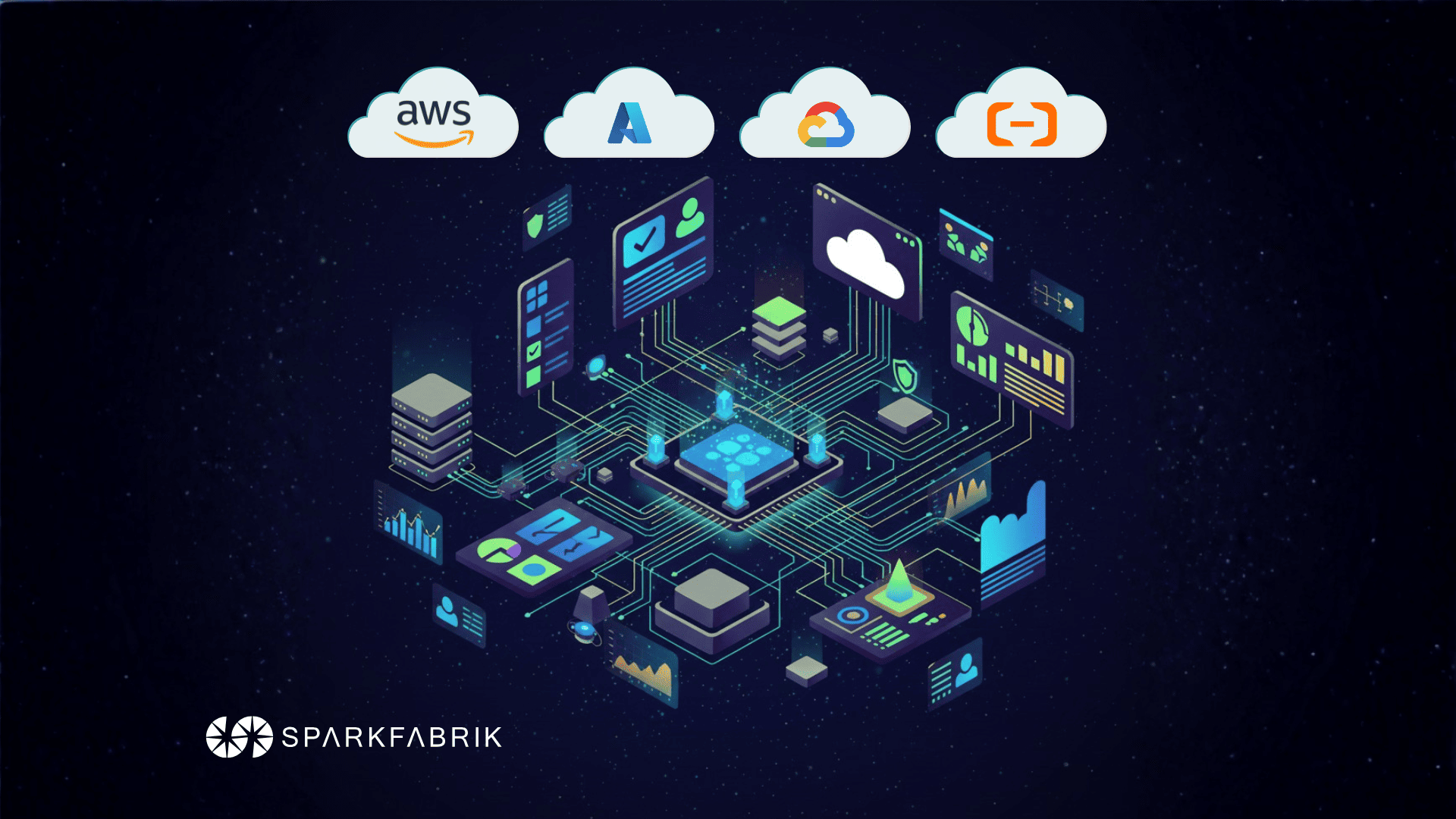
- With the public cloud, on the other hand, the provider makes hardware and software solutions accessible via the Internet from its own infrastructure, with resources shared among multiple users. Major public cloud providers include Amazon Web Services (AWS), Microsoft Azure, Google Cloud Platform, and Alibaba Cloud.
- The hybrid cloud combines at least two different clouds (public and/or private), creating an integrated environment where applications can move seamlessly from one system to another and resources are centrally coordinated through dedicated management and orchestration platforms.
With these terms clarified, it is now possible to compare the three cloud computing models by evaluating their advantages and limitations across three fundamental criteria: security, flexibility, and costs.
Cloud security: attention to compliance and responsibility
Security has always been the main barrier to cloud adoption. The new IT paradigm involves a significant organizational and cultural shift: moving corporate information assets to a third-party datacenter means, in a sense, losing control over them.
On the other hand, the economies of scale and the firepower of major cloud providers can guarantee greater protection measures than any individual company could achieve on its own. However, it is important to carefully define, through contracts, the division of responsibilities between provider and company regarding the different layers of security (infrastructure, data, and so on).
Analyzing the three types of cloud — private, public, and hybrid — from a security perspective, several considerations emerge:
- Thanks to its dedicated environment designed according to business requirements, the private cloud ensures the highest levels of protection, guaranteeing that resources are accessible only to the individual user organization. It also offers the ability to add and configure customized security layers.
- The public cloud requires some additional care during provider selection. The provider must ensure proper infrastructure maintenance to secure data and provide guarantees of regulatory compliance (for example, a datacenter located outside Europe might not comply with EU regulations on privacy and sensitive data protection). To ensure such parameters, several public providers are opening regions ever closer to their customers: a prime example is the already mentioned AWS Region in Milan.
- The hybrid cloud provides a compromise: private clouds can be used to host workloads involving sensitive or particularly critical data, while the public model can be adopted where convenient for lower-risk information.
Flexibility, the true advantage of the cloud
Infrastructure flexibility, resource scalability, and deployment speed are among the main benefits of the cloud, providing the agility needed for digital business. Thanks to these characteristics, cloud computing also has the merit of fostering the adoption of DevOps methodologies, which shorten application design, delivery, and maintenance cycles through close collaboration between developers and Operations.
- In terms of elasticity, the private cloud is the formula with the most limitations. It must be designed and sized to account for potential high peaks and load volumes; otherwise, the ability to scale rapidly when needed would be compromised or severely limited.
- The public cloud, on the other hand, ensures high levels of flexibility and the ability to sustain unpredictable workloads with nearly instantaneous resource provisioning.
- The hybrid cloud allows you to achieve the scalability of the public model when needed and for applications subject to peak loads. It also adds an additional element of flexibility by enabling you to seamlessly shift workloads from one environment to another as needed.
Cloud costs, myths and what you need to know
Cost reduction was the first benefit that companies sought through cloud adoption. By leveraging the cloud, companies have the opportunity to cut infrastructure management expenses and dedicated personnel costs, while also benefiting from the operational continuity guaranteed by providers (no downtime means eliminating inefficiencies and losses). However, the economic advantages must be assessed over the medium-to-long term, and the choice of deployment model is critical to achieving the desired savings.
- The private cloud is most suitable for large organizations managing heavy workloads. The pay-per-use pricing typical of the public model could prove uneconomical for large volumes and may hold unpleasant surprises if business needs grow steadily over time.
- The public cloud favors a pay-as-you-go approach: companies pay only for the resources they actually use, eliminating heavy upfront investments and any maintenance costs, thereby converting CapEx into OpEx. However, costs could escalate for companies that need to manage large data volumes and require specific infrastructure configurations.
- The hybrid cloud once again allows you to leverage the advantages of both models, but could cause management challenges (specific expertise is often lacking), with the risk of failing to optimize resources and achieve efficiency.
Hybrid, public, private: which cloud should you choose?
In light of what has been described, how can you determine which cloud deployment model best suits your business needs?
Here is a simple summary to help with the selection.
Private Cloud
The private cloud is recommended for public or private organizations that require an extremely secure environment to manage confidential information or that have customization needs (for example, specific hardware requirements, configurations, or additional protection layers, including those needed to meet compliance requirements related to their industry and the type of data processed).
Of course, companies choosing a private cloud must be able to guarantee a minimum initial investment capacity. Some large companies choose the private cloud when they need to manage particularly high data volumes and workloads, in order to contain the steep costs generated by the public model alternative.
Among large companies that have embraced the private model, the energy giant Eni was among the Italian pioneers, consolidating all infrastructure scattered across Italy and the world into a single group datacenter, from which IT resources are distributed in an as-a-service model to all subsidiaries. The initiative dates back to 2012.
Public Cloud
The public cloud is most suitable for organizations with a variable number of users and periodic or unpredictable request peaks, requiring computational needs that are constantly changing and must be met promptly. Consider, for example, e-commerce portals that must handle the surge of visits and orders during Black Friday or the holiday season. The public cloud is also well-suited for companies that need a complete development environment to test their applications (these are solutions known as Platform-as-a-Service).
To cite an example among big players that have chosen the public cloud, General Electric moved nearly all its applications (both internal and customer-facing) to the AWS and Microsoft clouds. Solutions sensitive to federal regulations remain in company datacenters, with the goal of future migration once regulatory alignment is achieved.
Hybrid Cloud
The hybrid cloud is the model set to become the most dominant in the coming years, as it allows managing multiple workloads with agility, ensuring optimal computational performance and security requirements for each application. However, companies will need to be adequately prepared to ensure full interoperability across environments, guaranteeing the portability of data and applications; this requires appropriate skills, orchestration tools, and the support of an expert and reputable partner. The hybrid cloud (particularly in its multi-cloud form, combining services from multiple vendors) is especially suited for business internationalization scenarios, supporting company expansion beyond national and regional borders.
For example, the chemical-pharmaceutical multinational Zambon consolidated its management platform for its website ecosystem in the cloud, leveraging Google Cloud Platform for the West and Alibaba Cloud for the East. A similar experience applies to Caleffi Hydronic Solutions, which strengthened its presence in the Chinese market by relying on the Hangzhou-based provider’s solutions alongside Google’s cloud.