


Companies choose Cloud Computing and the Cloud Native approach to grow their projects and scale quickly. But scaling has a cost: more cloud resources mean higher bills. At what point does that cost increase remain acceptable? To keep spending on Cloud services under control, FinOps (Cloud Financial Management) comes into play—a practice that falls under Cloud Management.
What is FinOps?
FinOps refers to the set of practices dedicated to Cloud Financial Operations: monitoring, forecasting, and optimizing costs related to the use of consumption-based services hosted on one or more Cloud providers.
The FinOps Foundation defines FinOps1 as “an evolving cloud financial management discipline and cultural practice,” and adds that it “enables organizations to get maximum business value by helping engineering, finance, technology and business teams to collaborate on data-driven spending decisions.”
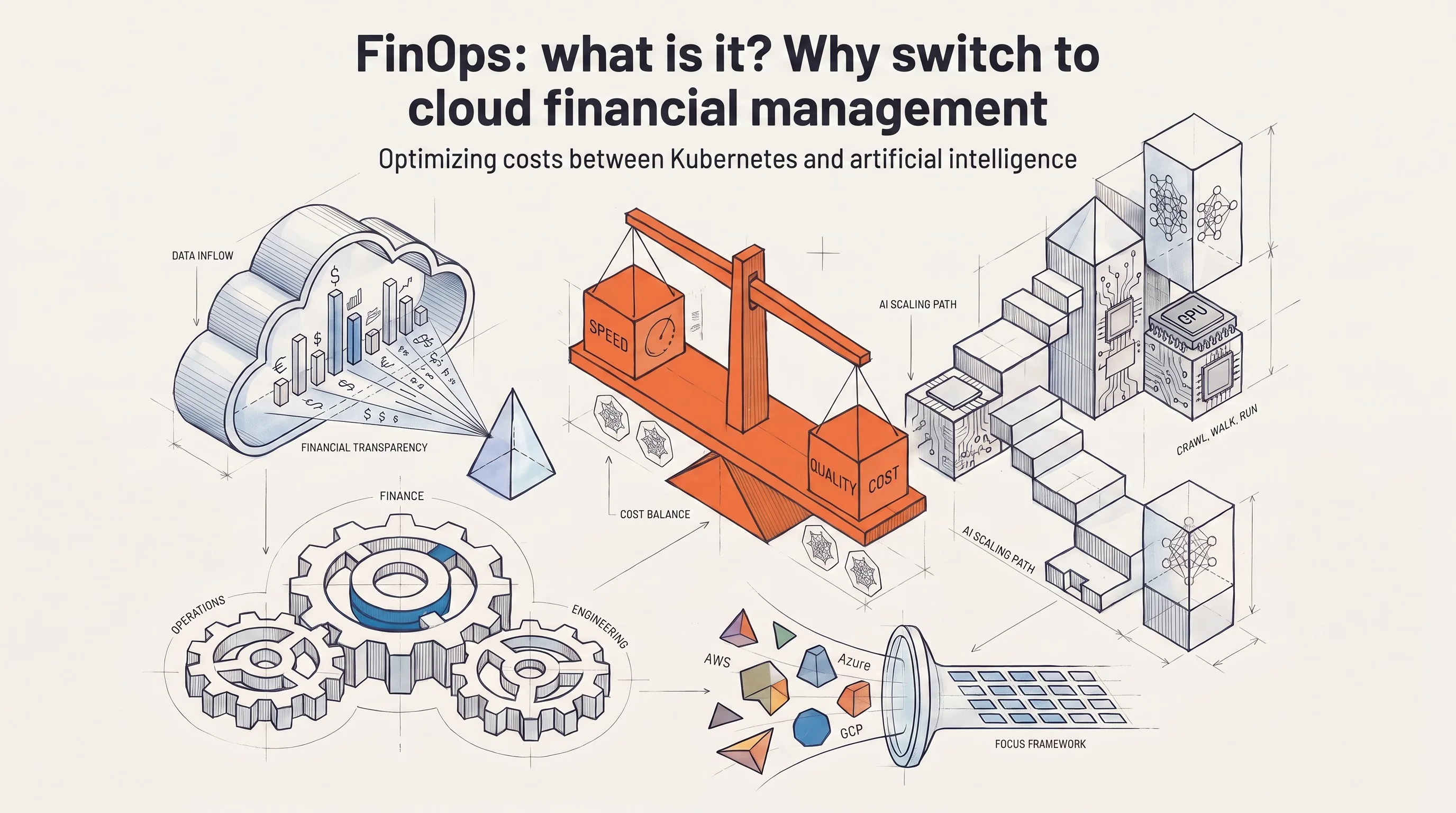
The term FinOps combines two words, financial and operations, and refers as much to a discipline as to a cultural mindset, in a similar way to DevOps. The goal of FinOps is precise: to promote collaboration between operations, finance, and engineering departments, to maximize the value produced without losing sight of how Cloud service spending affects the final result.
This collaboration is accompanied by a data-driven decision-making model destined to evolve continuously: it matures as teams and the organization gain awareness and mastery of the optimization levers offered by the Cloud.
READ ALSO: FinOps and GreenOps: efficient and ecological cloud management
What are the benefits of FinOps for cloud management?
Having defined what FinOps is, the next question is inevitable: what is it for and why should a company adopt it?
The practical goal of FinOps is to balance cost, speed, and quality, making Cloud usage more efficient. In this way, companies can continue to invest in innovation with greater awareness, thanks to:
- More accurate forecasting, management, and allocation of costs “shared” between different initiatives.
- Waste reduction, a topic linked to Green Cloud and CO2 emissions resulting from unused computing power.
- Greater financial accountability of IT teams, and therefore a financially responsible use of the Cloud.
Those working in the Cloud Native field today cannot stop at the fundamental concepts of the Cloud, such as microservices architecture, containers, or the DevOps methodology. Efficient financial management is an enabling and critical factor in every Cloud Native initiative.
READ ALSO: DevOps: What it is and how to introduce it in the company
How can the effectiveness of FinOps be measured?
With the FinOps model, organizations collect and organize all the KPIs necessary to evaluate the project’s progress. This is how one understands if the hypotheses formulated during the drafting of the business case hold up in practice. Equally important, when these hypotheses do not hold up, it is possible to analyze the data to identify corrective actions to be taken.
An example might concern the hypothesis on the load volumes that need to be supported in production and, consequently, the number of consumption-based resources that need to be purchased. But how exactly? How is it concretely verified?
FinOps provides a specific framework that companies can adopt. Through reporting capabilities, tagging operations, and capacity plans, a homogeneous view is built (in case more than one cloud provider is monitored) and, above all, one that is understandable to all departments of the organization.
The birth of the FinOps framework
The FinOps framework was formalized by the FinOps Foundation2, a program sponsored by the Linux Foundation dedicated to spreading the Cloud Financial Management discipline in the IT industry through the definition and sharing of common standards and best practices. Within the FinOps framework, and therefore in every implementation, we find:
- Principles: the fundamental points on which collaboration between cross-functional teams and the level of responsibility of each actor in the implementation or governance of the initiative is based.
- Personas: the professional roles that need to be involved in a FinOps project.
- Phases: the steps and actions that the organization and teams face based on the degree of maturity. The FinOps Foundation adopts a crawl, walk, run approach, which is iterative and incremental.
- Domains: the areas where operational activities resulting from the decision-making process can or must intervene.
The structure of the framework follows the evolution of the industry, and these thematic areas change with the advent of new computational models. Today, the most concrete push comes from GenAI and Machine Learning, which introduce spending items that are difficult to govern with traditional cloud metrics. The framework is extending to specifically monitor model training and inference costs, an area known as LLMOps or AI FinOps.
An important piece in this landscape is FOCUS (FinOps Open Cost & Usage Specification)3, the open-source standard promoted by the FinOps Foundation to normalize cost and usage data from different providers.
The problem it solves is concrete and well known to anyone who has managed a multi-cloud bill: each provider exposes spending data with different schemas, nomenclatures, and granularities, and aggregation becomes an exercise in manual reconciliation even before analysis.
FOCUS defines a common format for columns, metrics, and dimensions, so that AWS, Azure, and Google Cloud spending can be compared without building ad-hoc transformation pipelines every time.
To grasp the practical difference, just look at how the key billing fields change when the standard is adopted:
| Concept | Native nomenclature (examples) | FOCUS Column |
|---|---|---|
| Actual cost incurred | UnblendedCost, costInBillingCurrency, cost | BilledCost |
| Amortized cost | AmortizedCost, various negotiated prices | EffectiveCost |
| Providing service | ProductName, meterCategory, service.description | ServiceName |
| Billing period | heterogeneous formats and time zones | BillingPeriodStart / BillingPeriodEnd |
FOCUS becomes particularly relevant in the context of AI FinOps4: when inference costs are distributed across multiple providers and managed LLM services, a unified schema is the precondition for correctly allocating spending and identifying waste. Without a common vocabulary, the same monitoring mechanisms provided by LLMOps practices5 end up fragmented into incompatible dashboards. From our experience, starting from a normalized data model significantly reduces the time spent “making the numbers add up” and leaves teams room for the work that really matters: optimization decisions.
The principles of a Cloud FinOps model
The principles of the FinOps model define the guidelines with which different corporate roles operate and collaborate. Let’s look at them in detail:
- Teams must collaborate. An organization that wants to adopt the model but at the same time maintain vertical silos loses the ability to decide while taking all corporate points of view into account.
- Every team is responsible for its own costs. The sizing and allocation of Cloud costs is the responsibility of the team sponsor/owner of the initiative.
- Centralized governance. A central board coordinates and supervises the application of the framework.
- Timely and easily accessible reporting. Producing KPIs and reports on Cloud costs must not be a time-consuming operation, but as close as possible to Self-BI models.
- Value & Data driven decisions. Choices based on the value that the Cloud has in that specific circumstance, with the most suitable hosting model also in relation to the strategic nature of the initiative.
- Leverage the benefits of a dynamic cost model. A model that encapsulates both computational capacity costs and licensing costs, traditionally considered a separate item, allowing for a double level of consolidation and optimization.
The structure of a FinOps team
A FinOps team is heterogeneous: it brings together different professional roles and corporate areas that contribute in a participatory way to value creation.
Like any cross-functional team, it lends itself easily to the outsourcing of certain profiles. In this way, resources are optimized and access is gained to skills not necessarily present in the company, but nonetheless key to a correct FinOps strategy. The fundamental roles are:
- FinOps Practitioner: facilitator and framework expert, a figure similar to the Scrum Master.
- Executive: focus on accountability, transparency, and the progress of the initiative in terms of budget and time.
- Business/Product Owner: focal point for internal initiatives where the Cloud is a key element.
- Finance/Procurement: work with the FinOps Practitioner to interpret collected data and metrics.
- Engineering/Operation: responsible for the delivery and maintenance of the value produced.
How to implement the FinOps model?
At this point, one fact is clear: the correct financial management of Cloud services is critical for the success of any Cloud project. How, then, to apply the principles of FinOps in your reality?
Regardless of the maturity level, the framework can be adopted following a well-defined path. In the 1st Meeting “Cloud Cost Management and FinOps,” organized by the Cloud Transformation Observatory of the Politecnico di Milano, the three phases that make up the FinOps lifecycle were described.
The first phase provides the visibility necessary to create shared responsibility. The second identifies efficiency opportunities and determines their value. The last defines and implements the processes to achieve technology, finance, and business goals. Let’s look at them in detail.
1. First phase: inform
The first phase of FinOps focuses on cataloging cloud spending to obtain precise chargebacks and showbacks. In this phase, the dynamics of Cloud usage by corporate teams are also analyzed.
KPI for the first phase: percentage of Cloud costs correctly allocated via chargeback.
2. Second phase: optimize
Once spending is mapped and the necessary skills are acquired, the company moves on to optimizing its cloud presence, for example, through rightsizing and automatic shutdown activities. The census of corporate needs helps limit the use of on-demand services, which are usually more expensive.
KPI for the second phase: percentage of Cloud in commitment compared to Cloud on demand.
3. Third phase: operate
Organizations begin to continuously monitor business objectives and reference KPIs, involving the Cloud Cost Center of Excellence built around corporate, financial, and operational stakeholders, who also define the most appropriate governance policies and models.
KPI for the third phase: variance between the Cloud spending forecast and actual spending.
FinOps and Cloud Native: technological variations of the model
Once the team is defined and the phases are understood, it remains to be understood how to translate the guidelines identified in the benchmarking and optimization phases into technological choices.
In a Cloud Native context, the reference architecture uses a microservices model hosted in a cluster based on Kubernetes (whether it’s RedHat’s OpenShift, AWS’s Elastic Kubernetes Service, or Microsoft Azure’s Azure Kubernetes Service).
In this context, resources can be sized, governed, and monitored through technological capabilities, definable during the deployment or design phase:
- Resource request/limits: identify at the Pod level the resources that can be requested and are necessary for the service;
- Quality of Service: the type of workload, to optimize the density of node usage by the scheduler;
- Namespace: internal logical segregation of the cluster that defines a maximum ceiling of CPU/RAM that the contained pods can use;
- Autoscaler: both vertical and horizontal, they help regulate the number of replicas of a POD within the cluster.
Respecting these guidelines, and educating teams not to neglect them, allows for keeping the actual use of computing capacity under control, whether Cloud or on-premise, and maximizing its usage density.
Finally, with appropriate data collection and reporting tools, technical metrics based on CPU/RAM can be converted into more readable monetary values. A step in line with the core principle of transparency and easily accessible reporting for all corporate stakeholders.
How can FinOps evolve in the future?
The FinOps philosophy and practices are relatively new, yet they are already changing how organizations manage their cloud infrastructure. What to expect, then, for the future? Some areas seem destined to evolve more than others.
The first is the ecosystem of tools for Cloud Financial Management. As the FinOps approach matures, tools will multiply, with more and more providers and proposals. Alongside current aggregators for cloud cost management, such as Flexera One, Cloudability, and CloudHealth, new automation tools (beyond Ansible, Terraform, Kubernetes) and optimization tools (such as NetApp Spot) will arrive.
A second aspect of the evolution of FinOps concerns the increasingly marked correlation between cloud spending and business value. The cultural change triggered by FinOps will lead to measuring spending with unit economics logic: no longer as a mere infrastructure cost, but based on the corporate and economic value they generate. Clarity on spending and accurate metrics will help organizations set goals based on business performance and identify where to invest to obtain added value.
In other words, the data-driven approach to cloud and IT spending decisions will become increasingly predominant, supported by more precise and complete tools.
FinOps in the era of AI? How to manage token and GPU costs
The data-driven principle finds a particular application in AI cost management, the discipline that extends FinOps principles to the consumption of generative models and machine learning workloads. Anyone who has brought an LLM into production knows the problem: costs do not grow linearly with the number of users, but with the tokens processed and the GPU hours allocated. A single call to a reasoning model with a broad context can cost twenty or thirty times more than a request to a compact model, and without granular visibility, the end-of-month bill becomes impossible to attribute to teams, features, or customers.
The consumption of API tokens is the first item to monitor. In AI projects, we apply three concrete levers: model routing, which directs simple requests to cheaper models and reserves frontier models for tasks that truly require them; semantic caching of recurring responses; and prompt compression to reduce input tokens. To these is added the monitoring of the ratio between input and output tokens, often overlooked but decisive when using RAG techniques with large contexts.
On the infrastructure front, the allocation of GPU instances is typically the most expensive source of waste. Reserved but unused GPUs during development or low-traffic periods burn budget without producing value. Here, LLMOps practices converge with platform engineering: autoscaling based on the depth of inference queues, sharing GPUs between multiple workloads via time-slicing or MIG, and using spot instances for interruption-tolerant training jobs.
To make the two cost dimensions comparable, it is useful to map the optimization levers against their impact:
| Cost area | Optimization lever | Typical impact |
|---|---|---|
| API Tokens | Model routing to smaller models | Significant reduction in cost per request |
| API Tokens | Semantic caching and prompt compression (Caveman, Headroom) | Fewer tokens processed for the same result |
| GPU | Autoscaling and time-slicing | Better utilization of allocated resources |
| GPU | Spot instances for interruptible jobs | Reduction in hourly computing cost |
AI cost management does not replace traditional FinOps discipline; rather, it extends it with specific metrics and cadences.
While classic cloud computing operates on monthly or quarterly optimization cycles, costs related to AI models require near real-time monitoring, because spending can vary greatly from one day to the next based on usage patterns, model updates, or traffic spikes to generative AI features.
The most mature organizations are creating a dedicated governance layer, with teams that combine FinOps, MLOps, and platform engineering skills to define alert thresholds, dynamic budgets per project or team, and weekly consumption reviews.
This hybrid approach allows for intercepting cost anomalies before they become structural, maintaining consistency with the principles of visibility, accountability, and optimization that guide FinOps in general.
The point is that these optimizations cannot be one-off decisions: they must be part of a continuous feedback cycle, where consumption data feeds architectural choices. It is the same data-driven logic described above, applied to a domain where cost variability is much higher than in traditional cloud.
It is precisely in this direction that Continuous FinOps6 is moving: no longer periodic cost reviews, but an automated and permanent loop of measurement, optimization, and operation. The most recent piece of this approach is AI agents designed to support continuous monitoring workflows. AWS FinOps Agent6, now in public preview, is a concrete example: it analyzes spending patterns and suggests optimization interventions in a conversational way, bringing agentic logic into the cost governance cycle.
In conclusion
The FinOps model improves the financial management of consumption-based Cloud services. It is useful for organizations that leverage the potential of the Cloud and even more so for those that are growing and managing complex Kubernetes clusters. It is also evolving to specifically monitor costs related to modern AI solutions, which present dedicated challenges, proving to be a concrete necessity for organizations investing in this area.
In short, FinOps offers a framework that companies can adopt to manage cloud costs and balance speed, cost, and quality. The result is a more efficient use of the Cloud, investments without waste, and sustainable growth over time.
Want to identify optimization opportunities thanks to FinOps practices? Contact our experts: we can help you find areas for improvement not only in costs but also in security, performance, and scalability.
Notes and sources
FinOps, FinOps is an operational framework and cultural practice that maximizes the business value of cloud technology by fostering collaboration between engineering, finance, and business teams. (source: https://www.finops.org/framework/) ↩︎
FinOps Foundation, The FinOps Foundation is a non-profit trade association hosted by the Linux Foundation, dedicated to advancing cloud financial management through community, education, and best practices. (source: https://www.finops.org/about/) ↩︎
FOCUS (FinOps Open Cost & Usage Specification), FOCUS (FinOps Open Cost & Usage Specification) is an open-source technical standard maintained by the FinOps Foundation that normalizes billing datasets across cloud and technology vendors. (source: https://focus.finops.org/) ↩︎
AI FinOps, AI FinOps is a specialized financial discipline and FinOps Foundation technology category that applies cloud financial management principles to track, allocate, and optimize AI workload costs. (source: https://www.finout.io/blog/finops-for-ai-the-definitive-overview) ↩︎
LLMOps, LLMOps encompasses the specialized practices, workflows, and tools used to develop, deploy, and manage large language models throughout their lifecycle. (source: https://aisera.com/blog/llmops/) ↩︎
Continuous FinOps, Continuous FinOps is a standard operational practice that applies financial accountability to cloud and AI usage through an ongoing, automated loop of measuring, optimizing, and operating. (source: https://aws.amazon.com/it/blogs/aws-cloud-financial-management/aws-finops-agent-is-now-public-preview/) ↩︎ ↩︎