




Drupal1 powers approximately 14% of the top 10,000 websites in the world2. This is a remarkable figure, bucking the trend of the CMS’s decline in the generalist market. The question for those evaluating the platform today is a practical one: what really changes with the new strategy, and is it worth betting on for an enterprise or mid-market project?
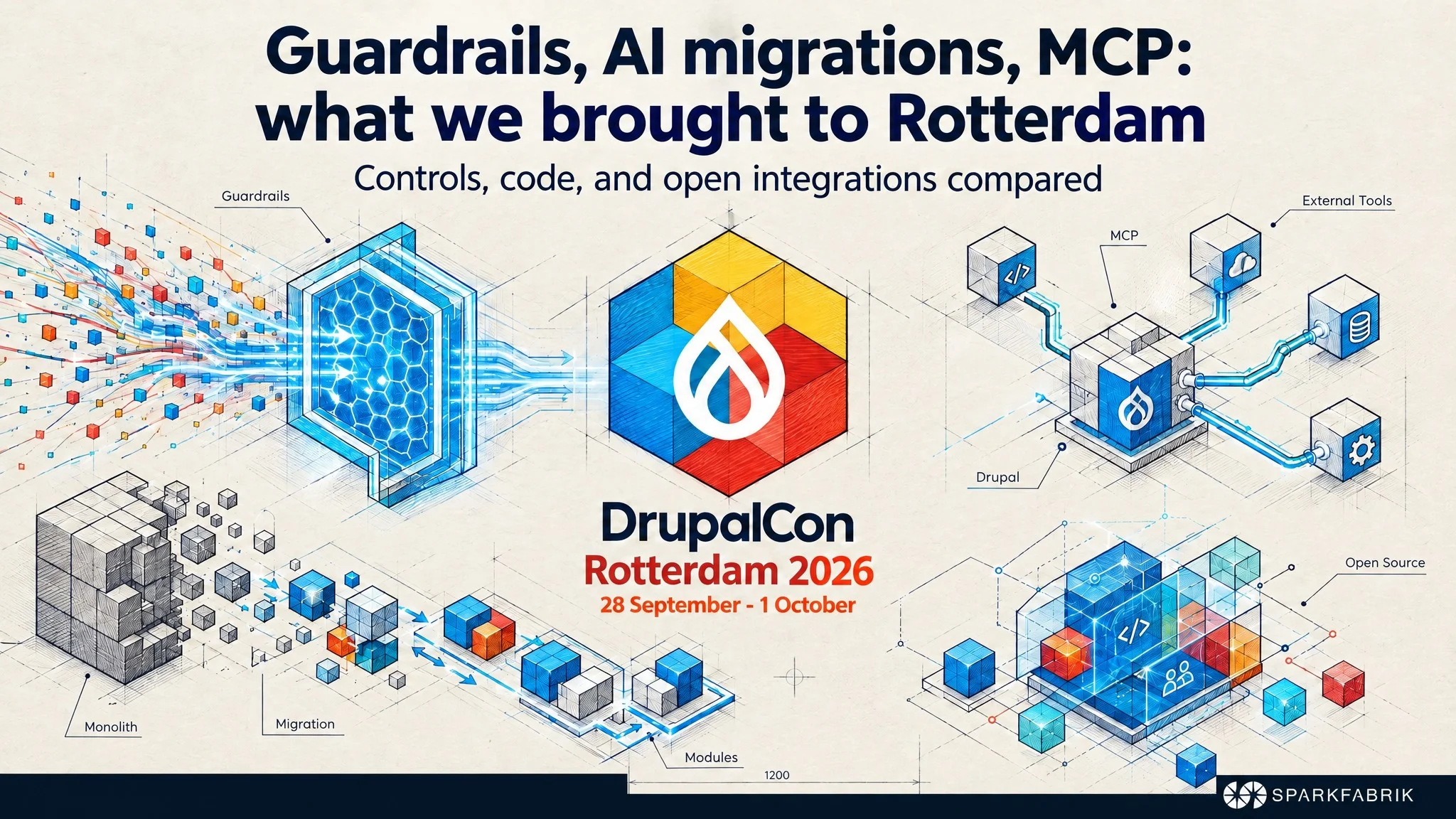
The launch of Drupal CMS on January 15, 2025, coinciding with the project’s 24th birthday and the end of support for Drupal 73, marked a turning point. With the Product Strategy 2.04 published in June 2026, the Drupal Association redefined the course: Drupal CMS 2.0 adopts an agentic-first approach and opens up to the mid-market, without sacrificing the enterprise solidity that remains its core market.
Recipes, Drupal Canvas, and native AI are not just marketing labels. The thesis of this article, from our perspective as a long-time contributor to the project, is simple: simplifying does not mean dumbing down, but empowering those who build.
What is Drupal CMS and what changes with strategy 2.0?
Drupal CMS5 is an out-of-the-box distribution built on top of Drupal Core, born as the Starshot project in August 2024. While Drupal Core is the flexible framework designed for developers, Drupal CMS adds guided workflows, pre-defined components, and browser-based installation, so that even a non-technical profile can launch a site in minutes rather than days.
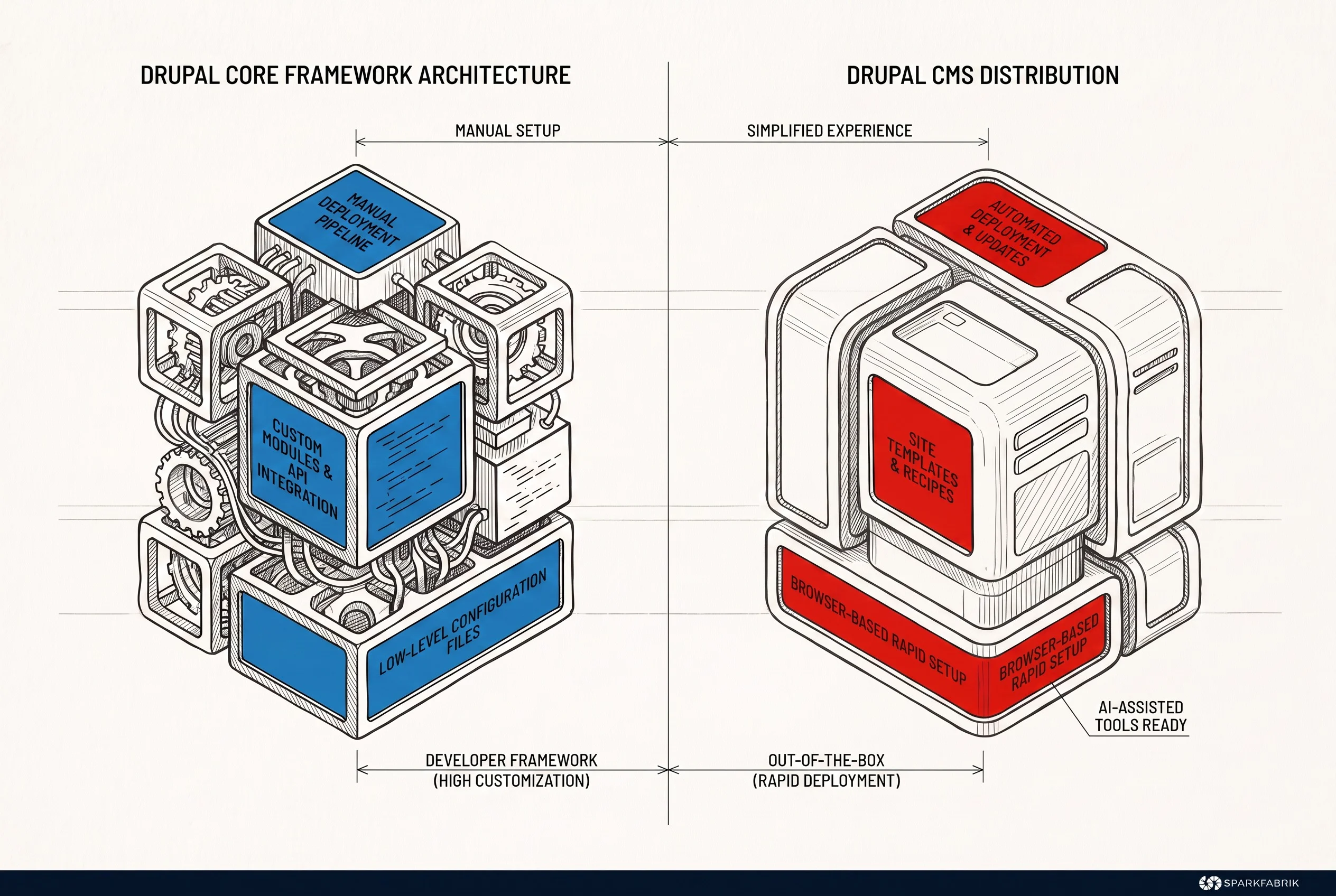
The terminological confusion between the two levels is the most searched point by those approaching the platform. Clarifying it is crucial: you choose Core when you need to build a custom solution; you choose the distribution when time-to-value matters. We have analyzed this positioning extensively, explaining how Drupal CMS redefines content management for business, which is useful for those who need to frame the technological transition.
The heart of the simplification is Recipes6: declarative configuration packages, defined in recipe.yml files, that combine modules, configurations, and sample content. They are not limited to installation: they can be applied at any point in the project lifecycle. Making them possible required the development of 4 new APIs integrated into the core. Through the Project Browser, a user can assemble an events site in a few minutes by installing recipes and modules without writing code7.
The three innovations that qualify strategy 2.0 compared to Starshot are:
Recipes and Site Templates8, for guided onboarding and reduced time-to-value;
Drupal Canvas9 for drag-and-drop visual site building;
Drupal AI10 and integrated hosting, with simplified distribution (also installable locally via DDEV).
The jump between the two versions is concrete: the initial Starshot strategy aimed for ease of use, while 2.0 expands the scope to hosting, distribution, and AI, extending the timeline to June 202811. From our experience in the field, pre-defined components and guided workflows reduce implementation times by up to 40%.
| Drupal Core | Drupal CMS | |
|---|---|---|
| User target | Developers | Business teams and non-technical users |
| Setup time | Days | Minutes via Project Browser |
| Customization | Maximum, custom | Guided via Recipes and Site Templates |
Why the agentic-first approach redefines the role of the CMS?
Agentic-first means designing every CMS workflow so that it can be operated by an AI agent, not just adding a widget that generates text in the editor. AI becomes infrastructure: it operates within taxonomies, permissions, and approval workflows, with humans maintaining supervision over quality and governance. It is a shift in the role of the CMS, from a container to an orchestratable platform.
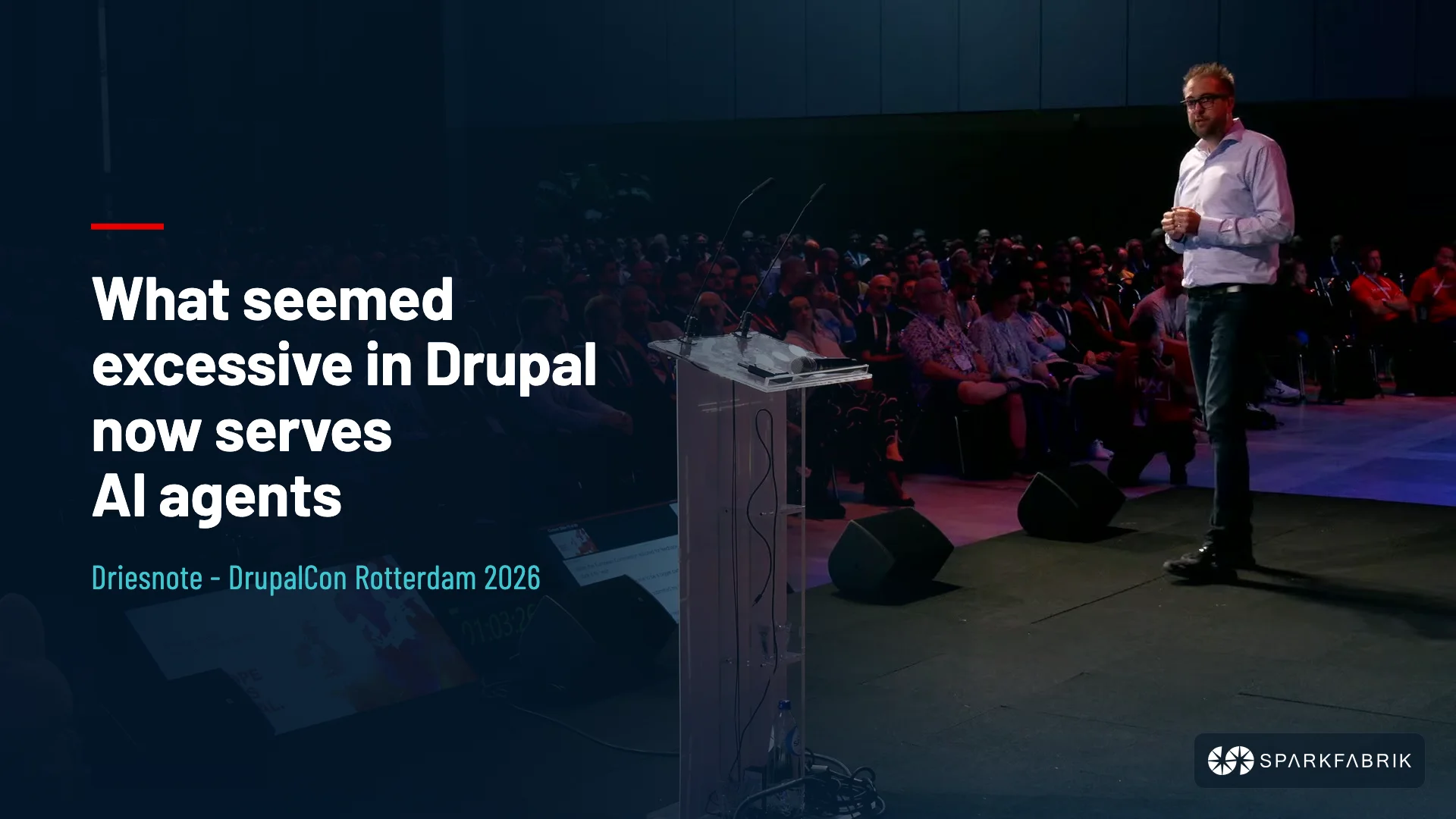
Is AI in a CMS a feature or infrastructure? Drupal’s roadmap answers clearly: every internal process must be natively ready to be orchestrated by intelligent agents. We have worked on this vision since the early stages of Starshot, contributing specifically to the Drupal AI Initiative by creating AI agents and the guardrails system, writing tests, improving documentation, and producing recipes12.
This idea of Drupal AI as connective tissue, rather than a disconnected assistant, is at the heart of the new agentic-first approach to Drupal development, where the CTO’s role evolves toward agent orchestration.
Governance is the condition for all of this to work in production. Drupal structures it on three pillars:
Context Control Center13: centralized definition of brand, persona, and topics assigned to models, so that output remains consistent with company guidelines;
Human in the Loop: AI generates drafts, people review and approve before publication, relying on native Workflow and Content Moderation modules;
versioning and auditing of generated content, to keep every change transparent and reversible.
Here emerges the gap that enterprise decision-makers must manage. Where do the models run? External LLM APIs have a cost per token and raise data leakage risks, with implications for GDPR and the EU AI Act. The choice between external models (such as those integrated into CKEditor for content suggestions) and self-hosted models on cloud-native architectures becomes a compliance decision, not just a technical one. Guardrails serve exactly this purpose: defining what AI can and cannot do.
AI as a skill gap filler, not a noise generator
AI integrated into Drupal is not for producing more content, but better content. It democratizes vertical skills (SEO, copywriting, accessibility) that are often lacking in editorial teams, raising the overall quality standard.
The opposite risk is real: speed without quality control equals brand risk. A CMS that floods channels with flat text worsens information overload instead of solving it.
The stated goal is to produce value, not volume, and Drupal’s governed architecture is the framework of rules that makes it possible. Furthermore, in Drupal, AI is seen as a catalyst for human skills, not a replacement for people.

Does the push toward the mid-market strengthen or weaken the enterprise?
Opening up to the mid-market is not a fallback, but an investment in the vitality of the ecosystem. The enterprise remains Drupal’s core market, where the platform boasts unusual penetration among organizations with over 10,000 employees. Attracting medium-sized projects broadens the base of contributors and developers without compromising the robustness needed by large organizations.
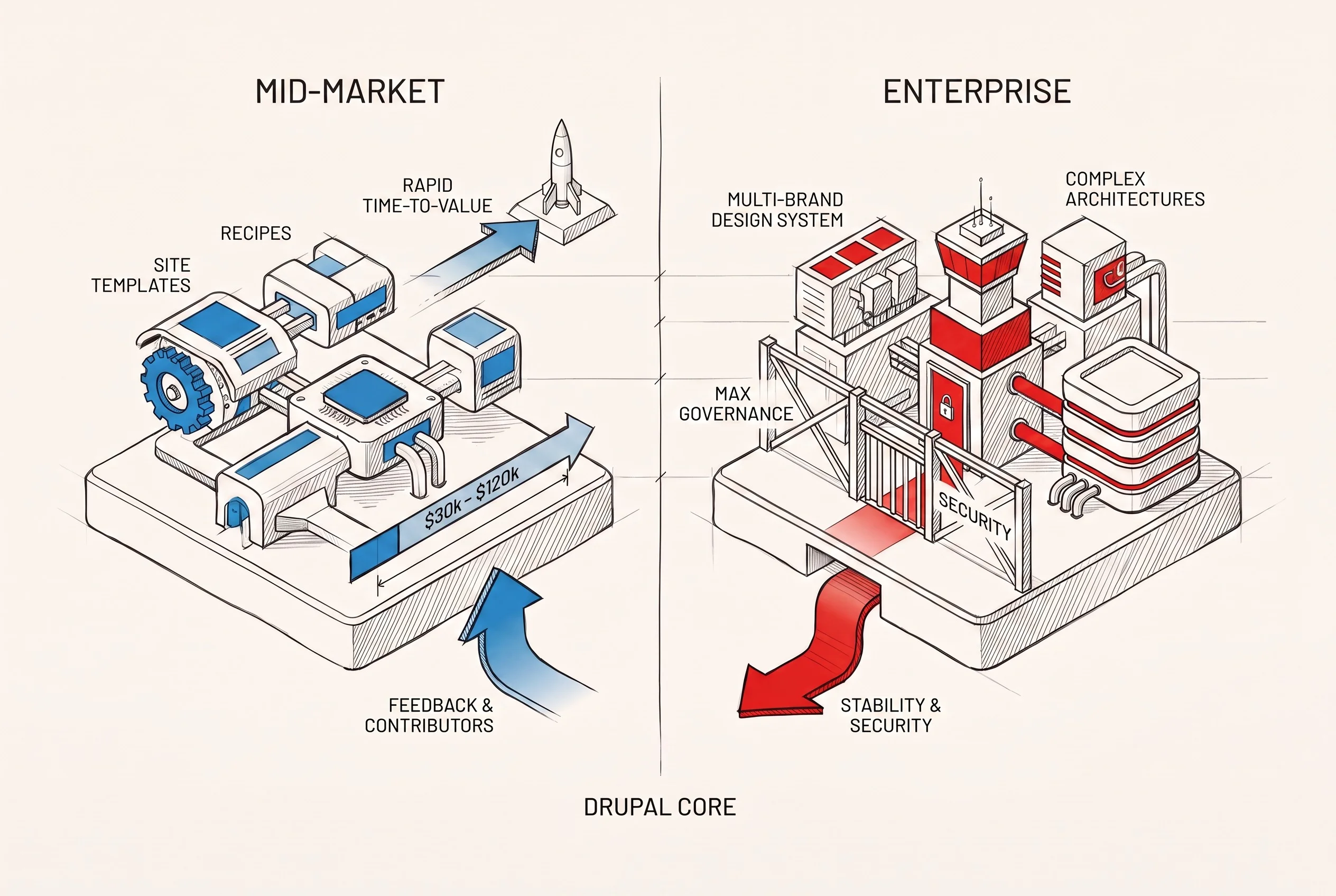
The segment it aims to open up to most, as declared by strategy 2.0, is mid-market projects, with total budgets between $30,000 and $120,000 (approximately €25,000-100,000). Drupal does not target entry-level sites nor compete with low-end website builders, which remain explicitly out of target: the goal is to bridge the gap between those sites and large enterprise architectures, offering reduced time-to-value through ready-to-use Site Templates.
For a decision-maker, the numbers that matter are economic and related to stability:
Savings of up to 60-80% on three-year TCO compared to other solutions like Adobe Experience Manager, thanks to the elimination of annual licenses14;
an ecosystem of over 10,000 active developers globally, with thousands of modules ready to use15;
open-source nature and absence of vendor lock-in16, with control over code, data, and roadmap as digital sovereignty assets.
The enterprise remains the core for verifiable reasons. The Economist, NASA, and the University of Oxford use Drupal for their digital experiences17. The American Medical Association consolidated WordPress and Drupal sites into a single platform. The Nestlé case18, presented at DrupalCon Vienna 2025, shows a multi-brand design system structured on three levels (core, UI components, brand overrides) that governs over 100 sites and allows for the instantiation of new projects in days instead of weeks. These are scenarios that validate the architectural and security advantages that make Drupal the choice for complex corporate sites, the same ones that strategy 2.0 now extends to the mid-market.
Want to achieve similar results for your organization? Talk to our specialists to design a custom transition to Drupal.
Canvas, Display Builder, and flexibility as the true differentiator
The simplification of site building does not impose a single tool. Drupal Canvas takes a central role in the roadmap for visual editing, but Drupal’s historical flexibility offers alternatives like Display Builder19 for projects with different needs. Not a mandatory path, but architectural options chosen based on the project.
The Visual Builder, or Experience Builder, unifies Layout Builder and Paragraphs into a drag-and-drop interface that allows installing, configuring, and extending Drupal entirely from the browser20. Canvas is the central direction of the roadmap, and we have seen its use in production, along with native design systems and enterprise AI, among the practical innovations that emerged at DrupalCon Vienna 2025.
Flexibility has always been Drupal’s strength, and this is where differentiation happens. At the Drupal X Business21 event, we explored Display Builder as an alternative designed for enterprise contexts with complex design systems that require granular layout control. The practical choice depends on the context:
Drupal Canvas when editorial autonomy and speed of page assembly by business teams are needed;
Display Builder when the project has an articulated design system and requires fine control over components and structure.
The future of theming reinforces this flexibility. Drupal 11.3 and 11.422 introduce the Styles API23 (with utilities for typography, colors, spacing, and a themes & modes system) and the Design Tokens API24 (with scoped values that become CSS variables only at runtime), paving the way for the arrival of Drupal 12 expected in December 202625, about which news is already starting to circulate and to which we will soon dedicate a specific article.
The goal is to separate theming from the application and automate the workflow from Figma to the browser, a direct advantage for multi-brand consistency and accessibility (WCAG 2.1 AA, European Accessibility Act).
Added to this is the native support for headless architectures, traditional or hybrid via REST, JSON:API, and GraphQL, which distinguishes Drupal from pure headless solutions like Contentful, Strapi, and Storyblok26. This modularity, not a single tool, is the lasting competitive differentiator.
What it means for those evaluating Drupal CMS today
Product Strategy 2.0 does not dumb down Drupal: it empowers those who build it (agencies and developers) to deliver value to business teams more quickly. Those evaluating the platform today should read the change along three axes.
Agentic-first as governed infrastructure, not as a feature: AI operates within workflows, permissions, and Human in the Loop patterns, with compliance (GDPR, EU AI Act) as a project constraint.
Opening to the mid-market that provides vitality without affecting the enterprise, with a TCO up to 60-80% lower than AEM and an open-source ecosystem free of vendor lock-in.
Architectural flexibility between Canvas and Display Builder as a differentiator that survives trends.
To maximize the ROI of your digital presence, plan a migration to Drupal or request an assessment of your architecture from our team. As long-time contributors to the project and the first Drupal Gold Certified Partners in Italy, we will provide you with a clear action plan to optimize performance, reduce technical debt, and ensure regulatory compliance.

Notes and sources
Drupal: Drupal is a free, open-source content management system (CMS) and modular framework written in PHP, used for building scalable websites and digital experiences. (source: https://www.drupal.org/what-is-drupal) ↩︎
Drupal powers approximately 14% of the top 10,000 websites in the world.: According to Drupal.org, Drupal is an open-source CMS that powers at least 14% of the top 10,000 websites worldwide, highlighting its strong adoption among high-traffic enterprise sites. (source: https://trends.builtwith.com/cms/Drupal) ↩︎
Drupal CMS, the evolution of the Starshot project, was officially launched on January 15, 2025, coinciding with Drupal’s twenty-fourth birthday, aligning with the end of support for Drupal 7. (source: Drupal CMS: the no-code revolution in web development) ↩︎
Product Strategy 2.0: Published in June-July 2026, Product Strategy 2.0 is an updated roadmap for Drupal CMS that replaces the 2024 Starshot strategy. It prioritizes agency and developer success to drive broader adoption. (source: https://www.drupal.org/about/initiatives/cms/blog/drupal-cms-product-strategy-version-20) ↩︎
Drupal CMS (formerly Starshot) is a user-friendly, no-code-first content management system enabling site builders to quickly create and extend Drupal websites using pre-packaged Recipes. This overview from Acquia explains how it differs from Drupal Core. (source: https://www.acquia.com/blog/drupal-cms) ↩︎
Recipes, Drupal Recipes are declarative configuration packages that automate module installation, configuration, and default content creation. They can be applied at any point in a site’s lifecycle. (source: https://www.drupal.org/project/distributions_recipes) ↩︎
Drupal CMS Recipes are pre-defined features that combine modules, configurations, and content, allowing even non-technical users to create an event website in minutes via the Project Browser, instead of the days of work required with Drupal Core. (source: Drupal CMS: the no-code revolution in web development) ↩︎
Site Templates, Site Templates are pre-built, industry-specific starting points in Drupal CMS that combine themes, content structures, and functionality to drastically reduce implementation times. (source: https://www.drupal.org/about/initiatives/cms/strategy-2026) ↩︎
Drupal Canvas, Drupal Canvas is a visual, component-based page builder included in Drupal CMS 2.0. Formerly known as Experience Builder, it provides a drag-and-drop interface for creating sites without coding. (source: https://www.drupal.org/blog/drupal-cms-20-is-here-visual-building-ai-and-site-templates-transform-drupal) ↩︎
Drupal AI, Drupal AI is an orchestration framework and module that integrates artificial intelligence capabilities into Drupal, enabling automated editorial workflows, content generation, and AI agent management. (source: https://new.drupal.org/ai/about-drupal-ai) ↩︎
https://www.drupal.org/about/initiatives/cms/strategy-2026, Drupal CMS product strategy version 2.0 outlines the platform’s direction, focusing on empowering agencies and developers to build faster while integrating AI as core infrastructure. (source: https://www.drupal.org/about/initiatives/cms/blog/drupal-cms-product-strategy-version-20) ↩︎
SparkFabrik has collaborated as a contributor since the early stages of the Starshot project, participating in the creation of AI agents, writing tests, improving documentation, and creating recipes for Drupal CMS. (source: Drupal CMS: the no-code revolution in web development) ↩︎
Context Control Center, A Drupal AI governance module that centrally manages brand voice, audience personas, and editorial rules to ensure consistent, on-brand AI outputs. (source: https://www.drupal.org/about/starshot/initiatives/ai/blog/the-future-of-ai-powered-web-creation-is-people-first-not-prompt-first) ↩︎
By adopting Drupal CMS instead of Adobe Experience Manager (AEM), savings of up to 60-80% on TCO can be achieved over a three-year horizon, thanks to the elimination of annual licensing costs. (source: Drupal CMS: a comparison with the main alternatives) ↩︎
Drupal has an ecosystem of over 10,000 active developers globally, with thousands of modules available out of the box. (source: Drupal CMS: a comparison with the main alternatives) ↩︎
Unlike closed-source no-code platforms like Wix, Squarespace, and Weebly, Drupal is open-source with an API-first architecture, avoiding vendor lock-in and allowing integration with third-party systems. (source: Low-code platforms and no-code platforms: the future of development with Drupal) ↩︎
The Economist, NASA, and the University of Oxford are among the organizations that have chosen Drupal as the CMS for their sites, as documented in the official Success Stories on drupal.org. (source: Drupal CMS: Bet on the digital experience) ↩︎
Nestlé, Nestlé is a multinational enterprise that presented a case study at DrupalCon Vienna 2025 detailing its scalable multi-brand design system built on Drupal. (source: https://events.drupal.org/vienna2025/session/nestle-nutrition-scalable-multibrand-design-system-drupal) ↩︎
Display Builder, Display Builder is a Drupal module within the UI Suite ecosystem providing a unified, design-system-native visual building interface. It serves as an enterprise alternative to Drupal Canvas. (source: https://www.drupal.org/project/display_builder) ↩︎
Drupal CMS, developed as part of the Starshot initiative, introduces ‘recipes’ (pre-defined features that combine modules, configurations, and content) and the Experience Builder, which combines Layout Builder and Paragraphs with a drag-and-drop interface, to allow installing, configuring, and extending Drupal entirely from the browser. (source: Low-code platforms and no-code platforms: the future of development with Drupal) ↩︎
Drupal X Business, Drupal X Business is an online event hosted by SparkFabrik focused on AI, design systems, and automation. During the event, Display Builder was presented as an enterprise alternative to Canvas. (source: DRUPAL X BUSINESS: Next-Gen Digital Experiences) ↩︎
Drupal 11, Drupal 11 is a major release of the open-source content management system, launched in August 2024. It features updated dependencies like Symfony 7 and PHP 8.3, and improved site-building tools. (source: https://www.drupal.org/project/drupal/releases/11.0.0) ↩︎
Styles API, The Styles API is a Drupal module that allows developers to register theme templates using a YAML file, replacing hook_theme() to separate theme definitions from code. (source: https://www.drupal.org/project/styles_api) ↩︎
Design Tokens API, The Design Tokens API is a Drupal core initiative that enables runtime tokens for consistent theming. It uses the W3C Design Tokens format to bridge design tools like Figma and CSS variables. (source: https://uisuite.net/ui-suite-monthly-29-paving-the-path-to-design-system-native-drupal/) ↩︎
Drupal 12 is expected to be released in early December 2026. (source: https://www.drupal.org/project/drupal/issues/3449806) ↩︎
Drupal CMS natively supports headless, traditional, or hybrid architectures, with REST, JSON:API, and GraphQL protocols, distinguishing itself from pure headless solutions like Contentful and Strapi and from headless-only solutions like Storyblok. (source: Drupal CMS: a comparison with the main alternatives) ↩︎