
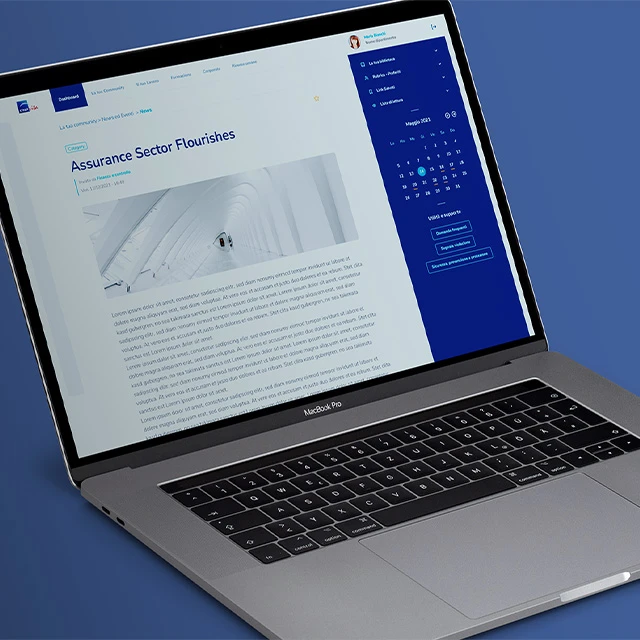
Created about 20 years ago, Drupal is one of the most widely adopted and appreciated Open Source CMS.
Its founder, Dries Buytaert, is also the creator of Acquia, which is to Drupal what RedHat is to Linux: it demonstrates that it is possible to generate tangible value from Open Source software. A noble purpose also recognized by Gartner, which positioned Acquia, and therefore Drupal, in the most important sector of the Magic Quadrant for Digital Experience platforms. Alongside names such as Adobe.
The importance of Drupal
Today more than 3% of websites worldwide use Drupal, which is one of the largest Open Source projects on the market. It is a CMS (content management system) that today powers a wide range of very different websites and applications: from personal blogs to large enterprise and institutional platforms, including in the public administration sector. It is widely held that Drupal can also be defined as a CMF (content management framework) due to its high flexibility: it is effectively a system that facilitates the use of reusable components or custom software for web content management.
The base installation, Drupal Core, already provides all the functionality of an advanced and modern CMS, such as:
- WYSIWYG editing tools based on the new CKEditor 5
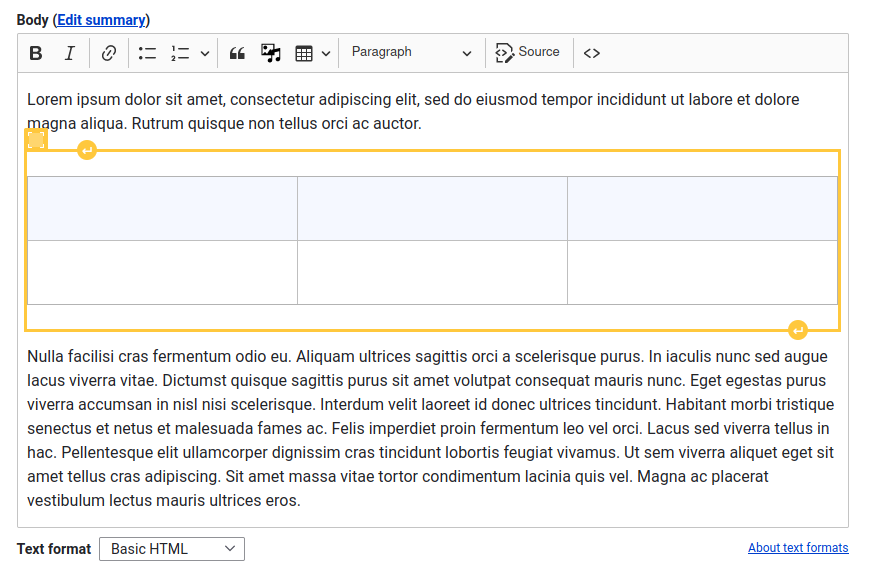
Drupal CKEditor 5
- Granular management of users, roles, and permissions
- Flexible and customized content structuring with content types, taxonomies, and menu structures
- SEO tools to manage metadata, URLs, and sitemap generation
- A powerful built-in search engine that is fully customizable
But these are just some of the features provided by the core; the other advantage of Drupal is its extensibility: Drupal’s modular approach allows not only the internal development of new custom features and integrations, but also access to the work of a very large community of independent developers around the world.
10 advantages of Drupal
Recently in the spotlight for the release of Drupal 9, this CMS can be a winning choice for organizations, even large ones, looking for a platform that meets their needs and looks to the future, toward a full digital transformation.
After all, the advantages of Drupal for enterprise websites are many, and it is worth reviewing the main ones: we have identified ten that we believe are worth sharing.
Advantage 1: it is Open Source
The first advantage of Drupal is that it is an Open Source project: its extended developer community is composed of more than 1 million members, with 117,000 developers actively contributing to the project’s development every day and from every part of the world.
This means that, in addition to no licensing costs and no vendor lock-in typical of proprietary platforms, everyone can benefit from more than 44,000 free modules to extend Drupal’s functionality and integrate with third-party platforms.
Drupal’s worldwide adoption is widespread: there are more than 30 communities revolving around drupal.org that offer support in more than 40 different languages, not to mention the countless mailing lists and discussion groups. Drupal’s universe is populated by tens of thousands of developers and designers around the world.
Advantage 2: it is reliable and widely adopted
When selecting a CMS, companies look for reliability, proven track record, and support. Drupal fully meets this description:
- It is in the top 3 most used CMS in the world
- It has been around for 20 years
- It is continuously updated without ever losing stability
- After new releases, it guarantees support for previous versions for at least 5 years
You should also consider the availability of resources: here we return to the community theme, one of Drupal’s strong points. Thanks to the work of community members, it is possible to take advantage of free and clearly Open Source contrib modules, unlike other CMSs where additional features often come at a cost. In other words, the Drupal ecosystem works because everyone can benefit from the work and experience of other members, without having to reinvent the wheel every time. This makes it possible to find modules that integrate with virtually any type of service.
Many companies already benefit from this CMS. Among them are major institutions, from NASA’s website to NBC’s. But there are many more examples, such as The Economist, Warner Music Group, the Australian Government, Tesla, Pfizer, the University of Oxford, and cosmetics group Lush.
Advantage 3: it is secure
What makes Drupal a secure CMS? And why can we describe its codebase as high-quality and minimally vulnerable?
- Its organizational model. Drupal’s large community collaborates proactively to improve the platform and review code. The community also includes large companies and organizations that, as a matter of internal policy, frequently conduct security audits. Every bug found by members is reported to the Security Team, composed of about forty security experts, who respond promptly. The same team also carefully examines modules created by the community to ensure the codebase is secure and stable, before making them available to everyone.
- The way it is built. Drupal is indeed secure “by design” as it meets all the security criteria established by the Open Web Application Security Project (OWASP).
- Security mechanisms. Many measures are taken to ensure access security and permission control. To name a few:
- Specific contrib modules to increase password security and robustness, or to enable two-factor authentication mechanisms;
- User permission management is designed to minimize errors by limiting the actions of specific roles. For example, it is possible to set different permissions for authors, editors, and publishers;
- There is a complete and advanced notification system for updates and potential anomalies.
Advantage 4: it handles complex editorial flows and workflows
Drupal proves to be flexible, complete, and adaptable in the content uploading, editing, and publishing phase. Since version 8, it has offered editorial workflow management directly in core, thanks to the Workflow and Content Moderation modules.
The latter is particularly useful for organizations where multiple people, with different roles and permissions, need to collaborate on content: it allows, for example, keeping content in draft to be reviewed, approved, and published by the appropriate person, without affecting the already live version in any way. It also keeps track of who modified what and when through a complete content revision system. The same module also allows the creation of custom workflows, for example with intermediate states between the classic “review”, “approve”, and “live”, and the creation of to-do lists for the people responsible for review and approval.
Drupal 9 introduces even more features to improve the content creation experience. Some examples?
- Layout builder: a new tool for creating and editing pages easily with drag-and-drop, without having to frequently rely on the development team.
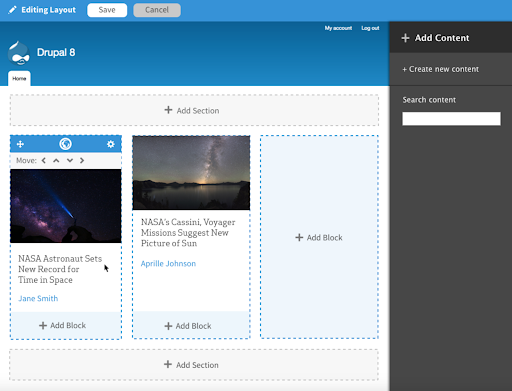
Drupal Layout Builder
- Media library WYSIWYG: media management has been further improved, a feature that allows editors and designers to collaborate on images, videos, and other assets. Like all Drupal components, it is fully configurable.
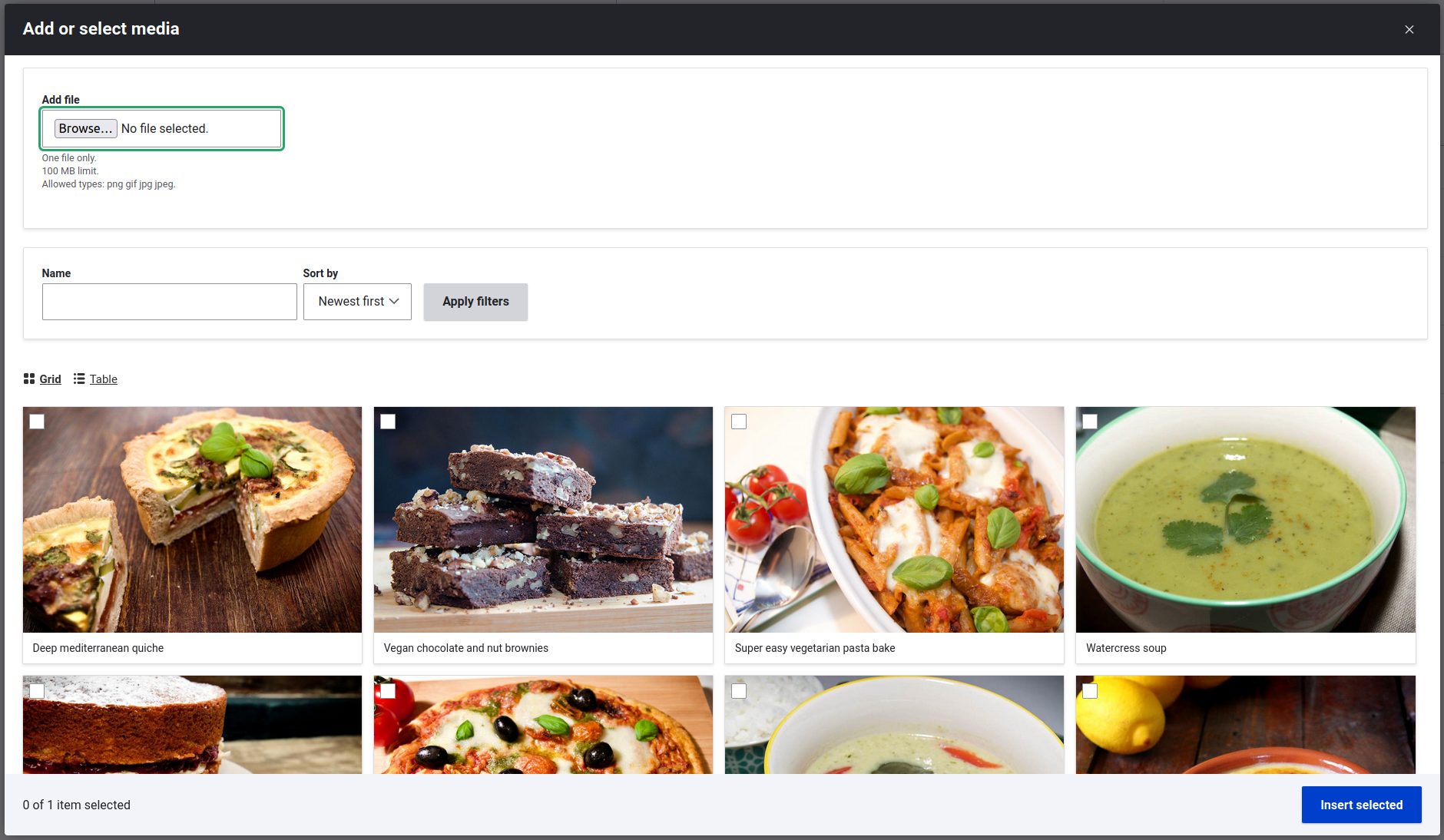
Drupal Media Library
- Claro: the new default theme for administration interfaces, it is more accessible, responsive, intuitive, and visually appealing than the previous Seven theme. It adheres to the new Drupal Design System.
Advantage 5: it has advanced multilingual management built into the core
Among the many innovations introduced by Drupal 8, which represents a milestone in the platform’s evolution, is the inclusion in the core of multilingual functionality, previously available through an independent contrib module.
Thanks to four built-in modules (Language, Content Translation, Configuration Translation, and Interface Translation), Drupal allows you to:
- Choose the language to use during installation
- Choose from a very comprehensive list with about a hundred options
- Take advantage of existing interface translations (and optionally contribute to their completion, if they are not currently 100% translated)
- Configure in a granular way which site elements can be translated and which cannot, and specify the default language for each element
- Easily switch between languages using language switchers, consequently improving the user experience

Language switcher
Among the languages supported by Drupal, there are also 8 with RTL (right-to-left) writing. This translates into the ability to use a single enterprise CMS to create content that can be translated and adapted to markets that are radically different from a linguistic structure standpoint, such as China, Japan, Korea, India, the Middle East, or North Africa.
Advantage 6: it natively handles Multisite functionality
Many organizations need a central system capable of governing a small galaxy of websites. Using the same CMS instance to manage completely separate websites reduces maintenance costs and increases ease of maintenance over time, while also allowing you to optimize and reuse already available assets.
Thanks to Drupal’s Multisite functionality, all sites can share the same codebase or part of it, and consequently the related themes and modules. The platform is effectively a shared library of integrations, features, UI components, and workflows that can be used at will across different sites.
At the same time, there is also great customization potential for individual sites. For each instance, it is possible to independently manage domains or URLs, databases, enabled modules, enabled themes, configurations, files, and user profiles.
The great advantage of this functionality is certainly time savings: for example, updates and upgrades do not need to be repeated for every website — it only needs to be done once for all. Thanks to Multisite, introducing new features is also simplified, since every new feature created for a single instance can be propagated to all sites that are part of the ecosystem.
Advantage 7: it delivers excellent performance
A fast website contributes significantly to improving user experience, usability, and engagement. Not to mention that speed is also an important ranking factor for Google’s algorithm. Drupal is one of the most efficient CMSs in ensuring high performance and scalability.
Here are some of the features that enable faster delivery:
- Cache optimization: from Drupal 8 onward, you can benefit from both a highly cache-friendly core and contrib modules created specifically to improve performance. Among the core modules: Internal Page Cache, Internal Dynamic Page Cache, BigPipe. Some useful contrib modules: Sessionless BigPipe, Quicklink.
- CDN Module: alters file URLs allowing assets such as CSS, JavaScript, images, videos, and fonts to be downloaded from the CDN instead of the web server. This reduces page load time.
- Lazy load: loads images and content as the user scrolls through the page, rather than pre-loading everything at request time.
- Image optimization: Drupal 8 allows you to set image compression ratios and improve page performance. It also allows configuring specific strategies to optimize image sizes based on different screen or device dimensions, to serve the correct image.
- Bandwidth optimization: all CSS and JavaScript files can be aggregated into a single file to speed up page loading. With the contrib module Advanced CSS/JS Aggregation, it is possible to define more advanced aggregation strategies.
Advantage 8: it is API-first
One of the most interesting characteristics of Drupal and its design philosophy relates to APIs. Drupal’s architecture can be decoupled to operate in “headless” mode. This makes it possible, for example, to have a backend that exposes APIs (in this case Drupal) and a separate frontend that consumes them through a framework like Angular, React, or Vue.js (in general, there is no limitation on the choice of a preferred frontend framework).
Why choose Drupal as a headless CMS? Here are some good reasons:
- Drupal launched the API-first initiative several years ago, with strong participation from the entire community to make Drupal a platform fully compatible with the headless approach
- Starting from Drupal 8.2, the RESTful module is available in core, enabling easy interaction with all standard entities available in Drupal (nodes, users, taxonomies, comments). Accompanied by the REST UI module, it is possible to have very detailed control over what can be accessed via the REST API and how.
- Starting from Drupal 8.8, JSON: API has been integrated into the core. It strictly follows the JSON: API specification and significantly improves the REST experience with Drupal. A developer only needs to be familiar with the standard to start working with the API very quickly, without having to spend hours of training on Drupal.
- The contrib module GraphQL allows you to expose GraphQL schemas from Drupal.
- Wide availability of documentation, examples, tutorials, and support.
Advantage 9: it is mobile-first
Today, being mobile-first is a fundamental requirement for every website. Over the years, the Drupal community has invested heavily in making Drupal a first class mobile platform through a dedicated initiative.
Here are some of the features worth mentioning:
- Responsive design for Admin: it is possible to create, add, or edit content from mobile or tablet thanks to the WYSIWYG editor that adapts to the screen size
- Responsive themes: from Drupal 8 onward, all core themes are natively responsive
- Responsive images: thanks to the Breakpoints and Responsive Images modules, images on the site can be configured to serve different images automatically scaled based on the requesting device.
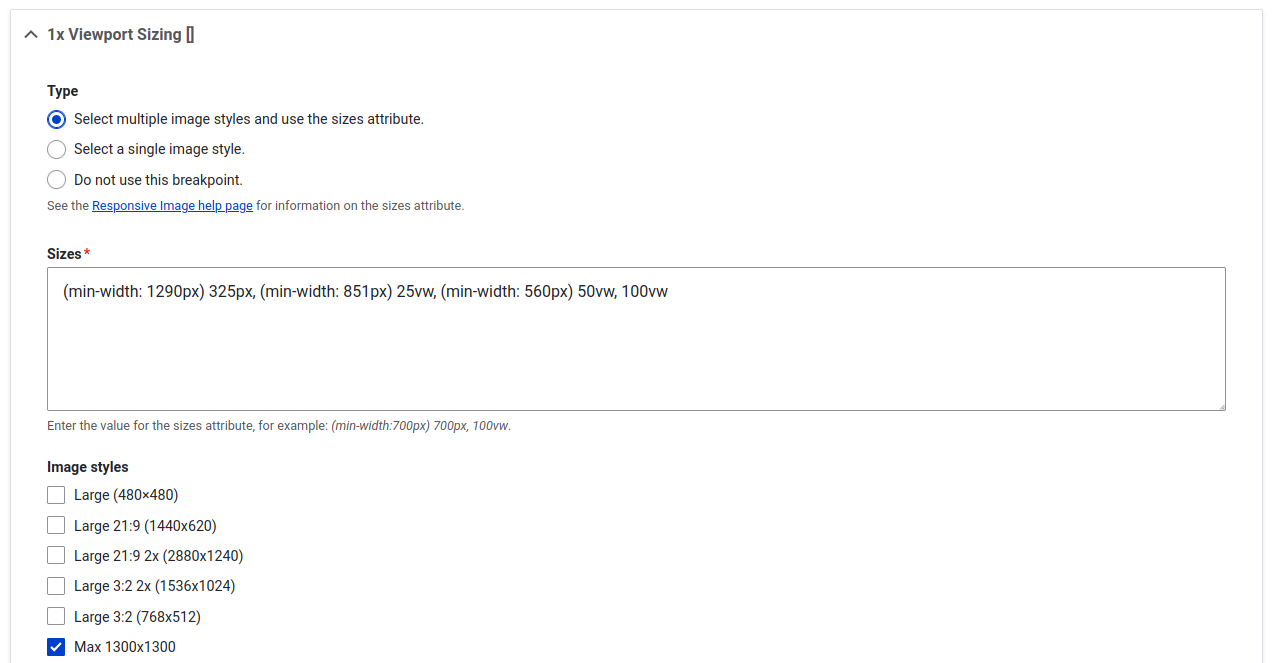
Breakpoints Module
- Responsive tables: by assigning different priorities to table columns, it is possible to show only essential ones on mobile, ensuring better readability. On desktop, all columns are displayed.
Advantage 10: Drupal is Cloud Native ready
Over the years, significant work has been done to make Drupal a modern platform ready for Cloud Native development approaches and adherent to the principles of the 12-Factor methodology.
This approach allows overcoming the limitations of monolithic architecture and making Drupal a first class citizen in the Cloud Native ecosystem through the use of modern technologies such as Docker containers and Kubernetes for orchestration. It also enables the configuration of Continuous Integration and Continuous Delivery pipelines and the automation of many manual processes such as QA and automated testing.
Conclusion
As we have seen, Drupal offers many features designed to meet enterprise needs: from security to performance, without forgetting flexibility. Drupal is a reliable and versatile CMS, which also brings all the advantages of Open Source platforms.
Used and appreciated by an ever-growing number of organizations worldwide (to name a few: Pinterest, Twitter, eBay, Verizon, P&G), it has also been chosen by Italian companies such as ilgiornale.it, FiscoOggi, and Zambon, which also selected it for its product websites.