





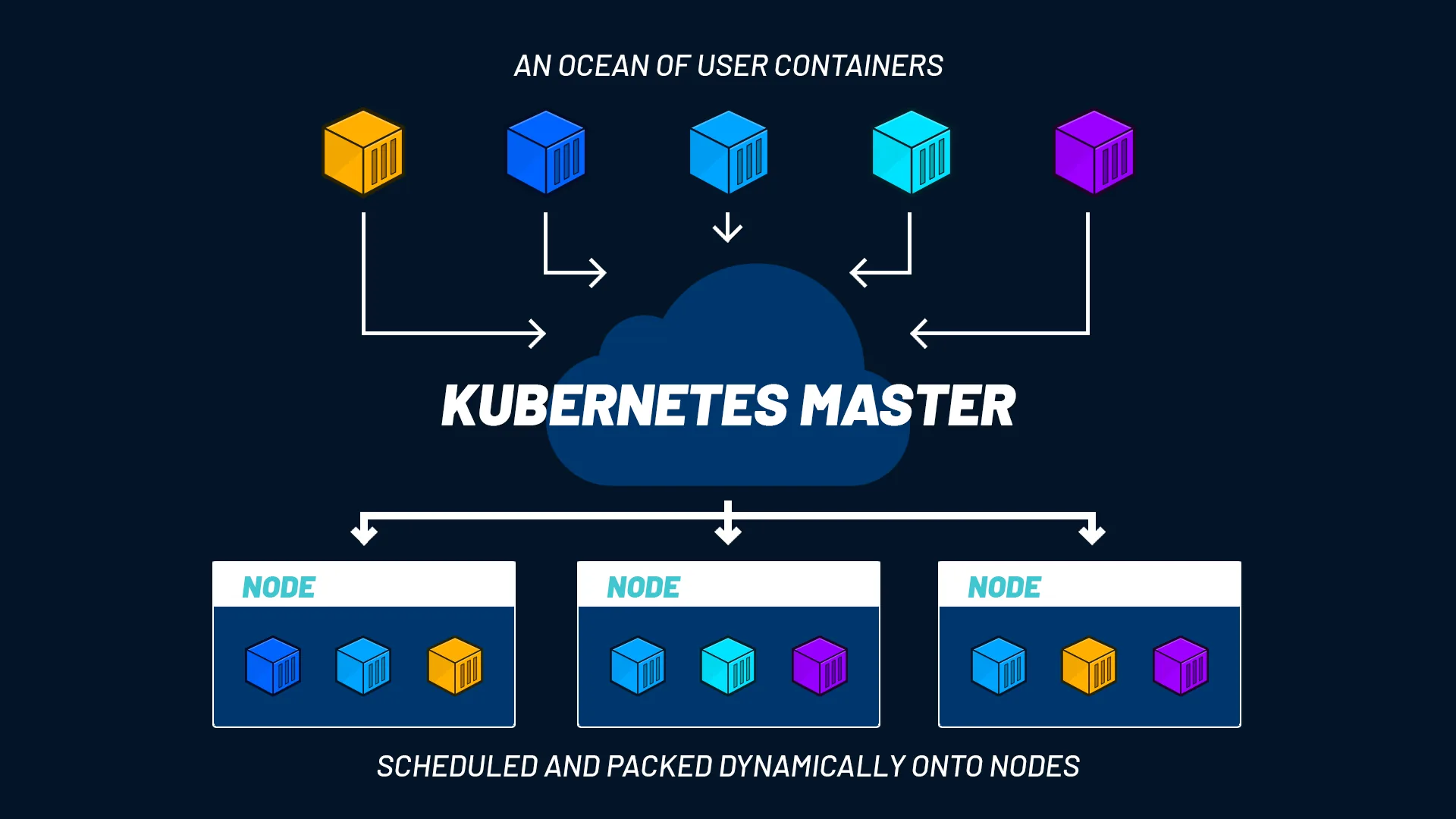
How to make applications more performant and scalable? Cloud Native logic cannot do without containers and their orchestration, also known as container orchestration: here is how it works and what the advantages of Kubernetes are.
To understand the concept of container orchestration, we must start from a definition of the latter.
Containers are a form of operating system-level virtualization that packages code and its dependencies. They have become one of the most adopted and mature virtualization solutions, particularly in Cloud Native environments.
We can consider them as much lighter virtual machines, independent of the underlying infrastructure. For applications inside the container, all machine resources are available; the operating system, however, only shows them the allocated resources and possibly other applications running in other containers.
With this “deception,” it is possible to easily create multiple containers that run one or more programs, each of which has a subset of the computer’s overall resources available. Applications can run separately or simultaneously and interact with each other or not.
Since each container contains a single software, or more often a microservice, it is easy to find oneself operating hundreds of containers in a short time, perhaps even on different clouds.
This makes it impossible to manage them manually and requires forms of automation for the entire container lifecycle. The solution is a process called orchestration, which allows for simplifying operations, increasing solution resilience, improving overall security, and thus achieving business goals.
READ ALSO: Application containerization: what you need to know
How do we move from virtualization to container orchestration?
The transition from virtualization to container orchestration represents a fundamental evolution for IT infrastructures. While traditional virtualization divides hardware resources by creating heavy virtual machines, orchestration automates the lifecycle of lightweight and independent containers, ensuring dynamic scalability, resilience, and optimized resource use in cloud environments.
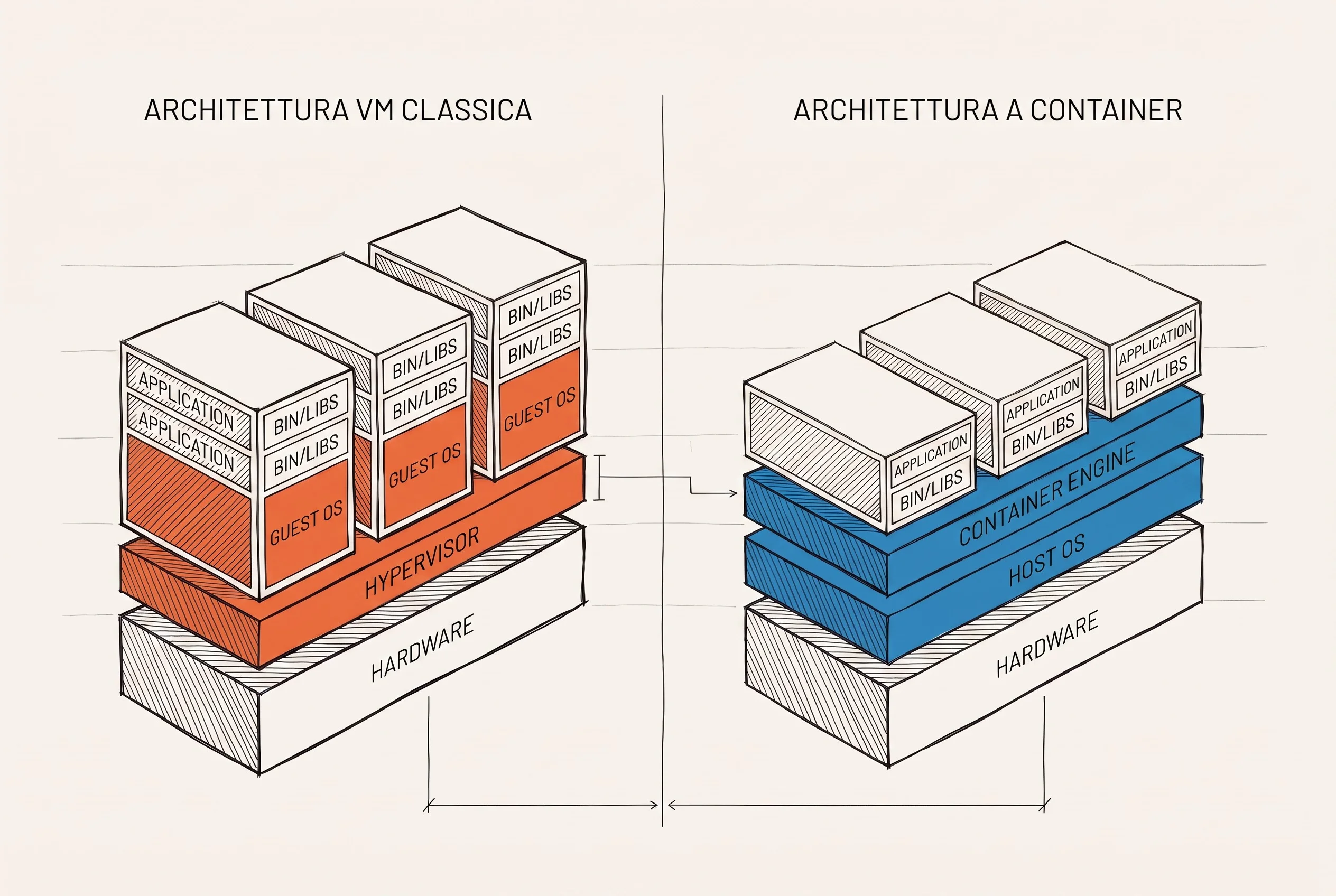
Virtualization is not a recent achievement in computing. In fact, mainframes in the 1960s already used virtualization as a method to logically divide system resources between different applications. The same very powerful mainframe could run multiple instances of one or more operating systems to run different applications as if they were running on physically different computers, thus consolidating costs and some of the management complexities of multiple systems. Multiple pseudo-guest machines worked inside a single host machine.
More modern forms of software and hardware virtualization can support a complete virtual environment. This approach is very useful for consolidating smaller servers into a single higher-class hardware, reducing costs and complexity.
Virtual machines also facilitate management, security, and replicability of installations. Furthermore, they significantly reduce the difficulty of transferring an installation from one site to another or in disaster recovery scenarios.
However, virtual machines also have numerous limits in terms of both complexity and energy consumption and types of possible workloads. And these limits are amplified in the cloud, especially in the public cloud.
For this reason, solutions were born that isolate each single software in a container. The container enables the construction of clusters characterized by ease of deployment, security, reliability, scalability, and automation.1
Containers accelerate software development because they allow for writing code consistently: from the local environment to the public cloud, programmers work continuously and without differences. Finally, being lightweight and easily shut down, containers allow for optimizing resource use.
It is clear that managing such an environment is complex and becomes increasingly so as the number of containers and running applications increases. There is also another important distinction to be made. Unlike a traditional environment, where the stability of programs and installations is measured by their overall uptime duration, the greatest utility of containers lies in the dynamic management of rapidly changing workloads. Containers are more useful the faster (and more automatically) they can be instantiated and then terminated.
What is container orchestration for and why is it done?
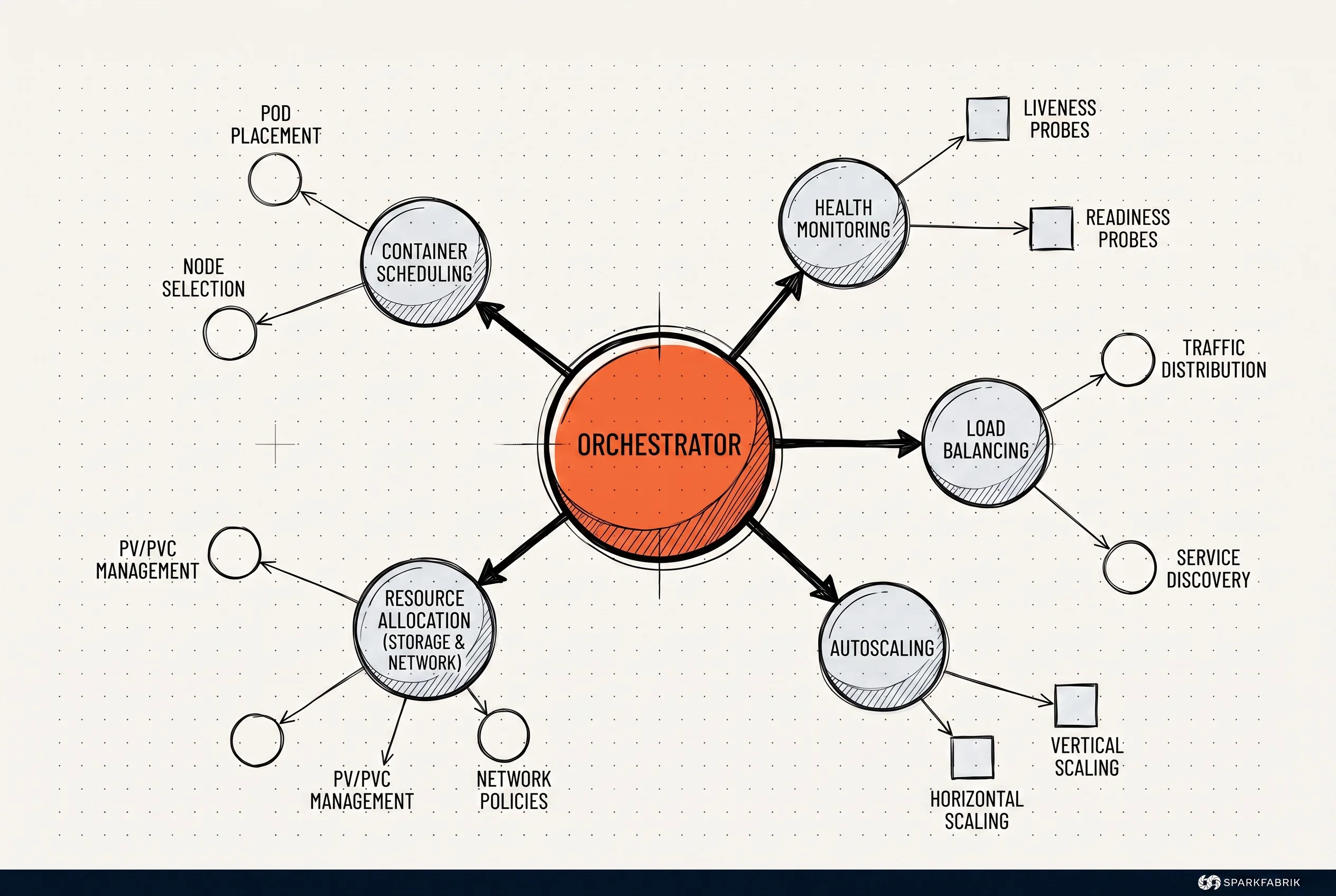
The orchestration process uses software tools to automate and manage the configuration, coordination, and lifecycle of containers. The purpose of orchestration is to be able to manage a service-oriented or microservices architecture that allows for combining business goals with the available technology: applications, data, and infrastructure.
In any environment where containers are used, an orchestration method is always applicable that allows for simplifying both software distribution work and the management of all aspects of the service, including storage, networking, and security.
If we look from a different perspective, orchestration manages the container lifecycle. This has important implications for work teams using a DevOps approach and CI/CD workflows. Orchestration and containers, in short, are two of the most important elements for creating Cloud Native applications.
What are the tools for container orchestration?
Container orchestration tools are platforms designed to automate the deployment, management, scalability, and networking of containerized workloads. These systems constantly monitor application status, balance traffic, and ensure high availability, drastically reducing the operational load on infrastructure teams.
Various tools exist to perform orchestration. The most famous and de facto standard is certainly Kubernetes2 (or K8s), but the landscape of alternatives is constantly evolving and has changed significantly in recent years. Docker Swarm3, integrated into the Docker4 containerization platform, natively offers high availability features through manager node redundancy, but its use has progressively decreased: today it remains a pragmatic choice especially for development environments or small clusters. Apache Mesos5, long cited as a contender, is now a legacy project: the Apache Software Foundation officially retired it in August 2025.
The true modern alternatives for enterprise container orchestration today are HashiCorp Nomad and the proprietary orchestration engines of cloud providers, such as AWS ECS.
These orchestrators have the ability to manage:
container configuration and scheduling;
their availability;
resource assignment;
provisioning and deployment mechanisms;
scalability (which also means rebalancing loads on the infrastructure and possible container removal);
their monitoring.
Furthermore, they can manage the configuration of software contained in individual containers and the management (and protection) of interactions between containers.
Kubernetes has a series of additional features that make it particularly suitable for managing cloud-native software hosting. In particular, horizontal scalability (Horizontal Pod Autoscaler6) across host clusters on public, private, or hybrid clouds is very important because it allows for workload portability and simplification of their balancing.
What are the advantages of Kubernetes for companies?
Created by Google as an open-source project for internal container orchestration at Googleplex, since 2015 Kubernetes has been handed over to the Cloud Native Computing Foundation, born within the Linux Foundation. This strategic choice places Kubernetes in a vital and reactive development environment, but above all, one capable of directing the growth of Cloud Native technologies and defining the open technological standards of the coming years.
Kubernetes optimizes the use of IT resources with consequent advantages in terms of time and costs. Development, release, and distribution become simpler and faster thanks to this orchestrator, while dynamic resource allocation allows for reducing waste and costs. Automatic scale-down in fact avoids the use of unnecessary resources. Not only that: in case of traffic peaks, autoscaling increases availability and therefore improves the service.
Furthermore, Kubernetes proves to be an indispensable tool for getting the most benefit from multi or hybrid cloud solutions since it guarantees application operation in any public and private environment, without functional or performance losses.
Finally, containerized infrastructures managed with Kubernetes also offer a very high reliability rate.
FURTHER READING: All the advantages of Kubernetes
Managed Kubernetes and serverless containers: when managing the cluster is no longer worth it
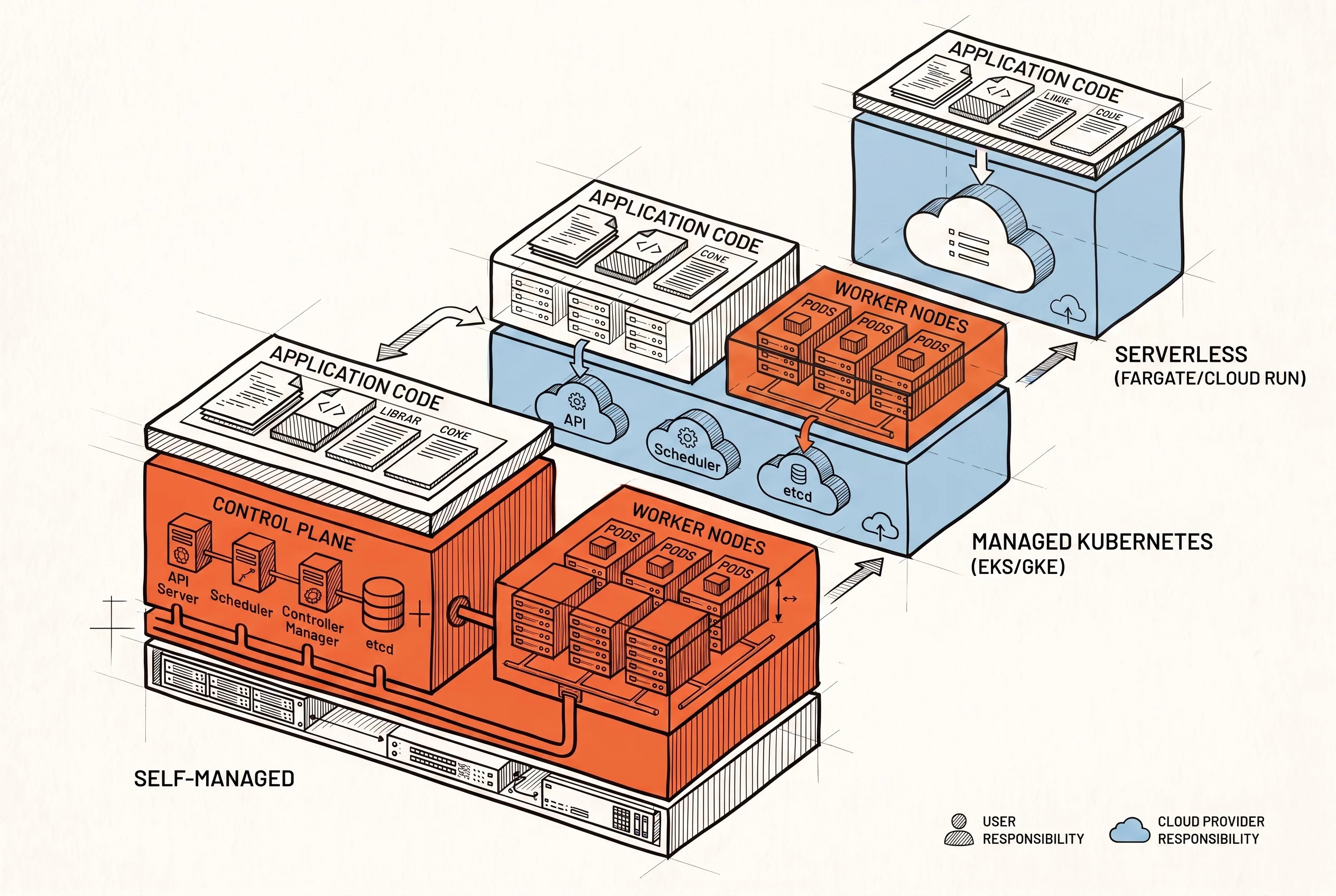
Manually installing and maintaining a Kubernetes cluster, independently managing the central control plane (control plane), the configuration database (etcd), and individual nodes, today makes sense in a limited number of scenarios: air-gapped environments, digital sovereignty requirements that prevent the use of public cloud, specialized on-premise hardware, or specific regulatory constraints. For the rest, the operational norm is now the use of managed services or serverless container solutions, which eliminate much of the operational load without giving up the Kubernetes model.
A managed Kubernetes service, such as Amazon EKS, Google GKE, or Azure AKS, transfers responsibility for the control plane to the cloud provider: central components (such as API server, scheduler, and etcd datastore) are managed, updated, and made highly available by the provider, while the team focuses on workloads and application configurations. However, a share of management remains with the user, particularly for server groups (node pools), security updates of operational machines (worker patching), and network and security policies. From our experience on migration projects, it is precisely this “gray area” that determines the real operational cost: two teams with the same managed cluster can have very different loads depending on how they automate node upgrades and autoscaling.
| Solution | Control plane | Nodes/compute | Typical use case |
|---|---|---|---|
| Self-managed Kubernetes | Team’s responsibility | Team’s responsibility | Air-gapped, data sovereignty, dedicated hardware |
| Amazon EKS / Google GKE / Azure AKS | Managed by provider | Node pools managed by team (or autopilot) | Production workloads with control over networking and security |
| GKE Autopilot / EKS Fargate profile | Managed by provider | Abstracted and managed by provider | Teams that want Kubernetes without managing nodes |
| AWS Fargate / Google Cloud Run | Not exposed | Abstracted (pay-per-use) | Stateless services, event-driven, scaling to zero |
Serverless container solutions push abstraction even further. With AWS Fargate or Google Cloud Run, you manage neither control planes nor nodes: you define the container image, CPU and memory limits, and scaling rules, and the platform allocates capacity on demand, down to scale-to-zero when there is no traffic. This model is particularly effective for services that do not store data locally (stateless), variable traffic APIs, and event-driven workloads, where paying only for actual execution time reduces costs compared to an always-on cluster.
The choice is not binary. In various projects, as we explored when analyzing cases of companies using Kubernetes successfully, we have adopted hybrid architectures. For example, in the media and e-commerce sector, we kept the core of microservices on a GKE or EKS cluster to have full control over networking, advanced communication management (service mesh), and deep monitoring (observability), moving peripheral or unpredictable peak workloads to Cloud Run.
In our experience, this configuration has allowed for significantly reducing infrastructure costs. The criterion we apply is pragmatic: the added value of managing a cluster must exceed its operational cost. If the team spends more time maintaining the Kubernetes infrastructure than producing application value, a managed service or a serverless runtime tends to be, in most cases we have encountered, the most convenient option, even at the cost of less configuration flexibility. It remains an evaluation to be placed in the specific context, because regulatory constraints, performance requirements, or customization needs can shift the balance.
Want to evaluate which architectural approach is best for your use case? Discover our Kubernetes consultancy service to design a tailor-made infrastructure.
How does the GitOps paradigm integrate into orchestration?
Managing the state of a Kubernetes cluster through imperative commands (manually executed instructions, scripts scattered among individual operators’ machines) is a practice that quickly generates so-called configuration drift, a drift where the real and operational state of the cluster progressively moves away from the one originally designed. The GitOps paradigm solves this problem at its root, promoting a Git repository as the single source of truth for infrastructure and application configuration.
The principle is simple but powerful: the entire desired state of the cluster is described declaratively (specifying the desired final result, through configuration files such as YAML manifests, Helm charts, or Kustomize definitions) and saved traceably on Git. It is no longer an operator forcing changes toward the cluster; instead, an agent installed in the cluster itself monitors the repository and takes care of reconciliation, i.e., continuously aligning the real state of the system with the declared one. Every change therefore passes through a shared review process (pull request), with all the resulting advantages: code control, complete traceability of operations, and the possibility of immediately undoing an error.
In this model, the two reference tools of the Cloud Native ecosystem, both CNCF projects, fit in:
Argo CD7: adopts a model where the agent “pulls” changes (pull-based) and offers a visual interface that shows in real-time the alignment between Git and the cluster, graphically highlighting any misalignments. It is particularly appreciated for managing multiple clusters simultaneously and for integration with gradual releases.
Flux8: built around native Kubernetes control mechanisms, it stands out for a modular approach and excellent support for Helm packages9 and container image update automation.
The resulting operational flow clearly separates the integration phase (CI), which produces and tests software components (artifacts), from the distribution phase (CD), which becomes the exclusive responsibility of the GitOps agent. In practice, the developer sends the code to the application repository, triggering the automated procedure (CI pipeline) that compiles and tests the image and then saves it in the container registry (Container Registry). Subsequently, the system updates the descriptive files (manifests) in the configuration repository. At this point, the GitOps agent (such as Argo CD or Flux) continuously monitors the repository and takes care of automatic reconciliation, applying the desired state to the Kubernetes cluster and constantly verifying that there are no deviations.
From our experience on Cloud Native projects, the concrete value of GitOps lies not only in automation but in the fact that the cluster becomes self-healing with respect to untracked changes: if someone manually alters a resource, the agent detects the divergence and restores the state declared in Git. This transforms orchestration from an operational activity into an engineering practice governed by the same rigor we apply to application code.
If you want to implement these practices in your organization, discover our DevOps automation services to optimize release flows.
In summary: why choose orchestration and Kubernetes?
Containers are a form of virtualization that allows for building, packaging, and deploying applications. The presence of all the application code and everything needed to make it work inside the container allows for moving workloads easily between different types of servers.
The complexity resulting from the division into containers requires advanced orchestration processes. Kubernetes confirms itself as the market standard, guaranteeing scalability, reliability, and performance in a Cloud Native logic. However, governing these ecosystems requires specialized skills and a strategic approach.
If your company needs support to modernize infrastructure, optimize cloud costs, or delegate operational management of clusters, explore our Managed Services and our DevOps automation services and transform your technological challenges into a competitive advantage.

Notes and sources
Virtual machines and containers, advantages and differences. (source: https://www.sentinelone.com/it/cybersecurity-101/cloud-security/containerization-vs-virtualization/) ↩︎
Kubernetes, Kubernetes is an open-source container orchestration system for automating software deployment, scaling, and management. (source: https://en.wikipedia.org/wiki/Kubernetes) ↩︎
Docker Swarm, Docker Swarm is a native container orchestration feature built into Docker Engine, enabling users to deploy and manage a cluster of Docker nodes as a single virtual system. (source: https://docs.docker.com/engine/swarm/) ↩︎
Docker, Docker is an open-source platform that enables developers to build, deploy, run, update, and manage containerized applications. (source: https://www.ibm.com/think/topics/docker) ↩︎
Apache Mesos, Apache Mesos was an open-source cluster manager and distributed systems kernel that abstracted compute resources. It was retired by the Apache Software Foundation in August 2025. (source: https://attic.apache.org/projects/mesos.html) ↩︎
Horizontal Pod Autoscaler, A Kubernetes API resource and controller that automatically scales workload resources, such as Deployments, to match demand based on observed metrics. (source: https://docs.okd.io/4.16/nodes/pods/nodes-pods-autoscaling.html) ↩︎
Argo CD, Argo CD is a declarative, GitOps continuous delivery tool for Kubernetes that automates application deployment and lifecycle management. (source: https://argoproj.github.io/cd/) ↩︎
Flux, Flux is a CNCF graduated continuous delivery tool for Kubernetes. It implements GitOps by automatically reconciling the cluster’s actual state with the desired state defined in a Git repository. (source: https://www.cncf.io/projects/flux/) ↩︎
Helm, Helm is an open-source package manager for Kubernetes that simplifies application deployment by bundling Kubernetes manifests into reusable packages called Helm charts. (source: https://github.com/helm/helm) ↩︎