


We often talk about "digital transformation", in our talks and with our clients. Describing it is difficult, because it is not just the use of a set of tools, but a methodological and organizational approach.
In this series of articles, we will outline its boundaries and clarify why it is important and, above all, why it matters now.
Let’s start with a premise: today every company is also a software company. Software is ubiquitous, it accompanies our daily activities and constitutes the primary channel through which users interact with companies. It is the ground on which we compete to remain relevant in the market. Amazon, Uber, Airbnb, Netflix, while operating in very different sectors, are first and foremost companies that produce software.
“Digital business” is often associated with companies like those mentioned above, which have introduced innovation and technology and managed to break established traditions and balances, forging new business models, new paradigms, and establishing themselves as leaders in their respective industries. But what is happening today is that every business must follow this path to remain relevant, and applications are the cornerstone of a business strategy that places digital at the center of every process.
Machine learning, blockchain, chatbot, wearable and Internet of Things are some of the buzzwords that characterize the current discussion around digital business, but these tools are merely elements within a much broader framework. **These technologies develop and thrive in a context of corporate culture dedicated to organizational agility, where the business responds to the speed of changing demand with a rapid and flexible model of product development and release.
So what is Cloud Native and how does it fit into this scenario?
Cloud Native is first and foremost a methodological approach (or a series of approaches, as we will see later) that aims to answer the question “How can I ensure that my business reacts quickly to the ever-changing demands of the market?”.
Formally, the definition of Cloud Native, given by the CNCF — Cloud Native Computing Foundation, is as follows:
Cloud native technologies empower organizations to build and run scalable applications in modern, dynamic environments such as public, private, and hybrid clouds. Containers, service meshes, microservices, immutable infrastructure, and declarative APIs exemplify this approach.
These techniques enable loosely coupled systems that are resilient, manageable, and observable. Combined with robust automation, they allow engineers to make high-impact changes frequently and predictably with minimal toil.
The concept of Cloud Native does not therefore only indicate the ability of an application to run on a private or public cloud. It is also a methodological approach, born from companies’ ever-growing dependence on software and the need to make it available and adapt it quickly to respond more effectively to market changes. An approach that translates in practice into a series of cultural changes and best practices that enable developers to build, maintain and scale modern applications quickly and securely.
The evolution toward a development and release methodology for a Cloud Native application is a multidimensional process that touches corporate culture, processes, architectures and technology. It is a transformation that does not have to be instantaneous, especially considering already established businesses that do not have the material ability to implement radical changes, but it can and should be seen as a gradual shift.
Between Cloud Native applications and technologies such as containers, container orchestrators, microservices, declarative APIs and Agile methods there is a close correlation, because **they are tools that serve the necessary changes in infrastructures, architectures, technologies and business processes.
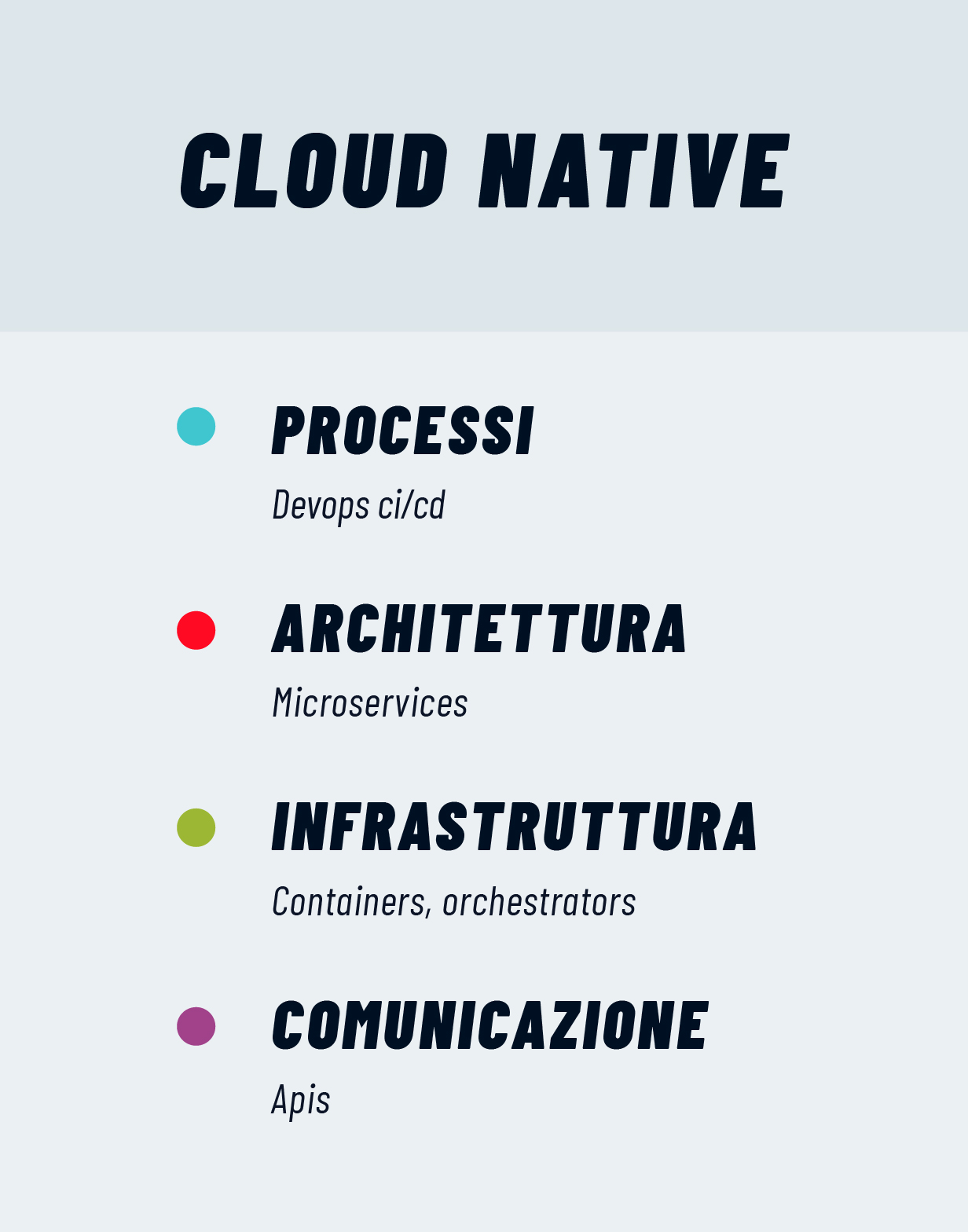
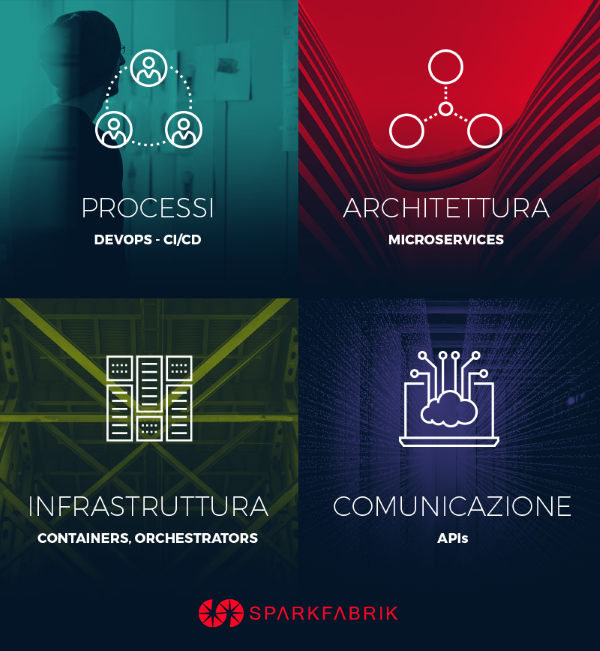
The four areas where the cloud native approach intervenes
**Let’s take a look at what these changes are.
PROCESSES
Evolving toward DevOps culture and practices is the first step on the road to developing Cloud Native applications. Continuous Integration / Delivery (CI / CD) and adherence to Agile methods are responses to the need for rapid market adaptation and represent the first substantial change in corporate culture and organization. The shift in focus from product longevity and stability to release speed requires the company to be structured for short and continuous release cycles, leading to the organization of development into multidisciplinary and collaborative teams.
ARCHITECTURE
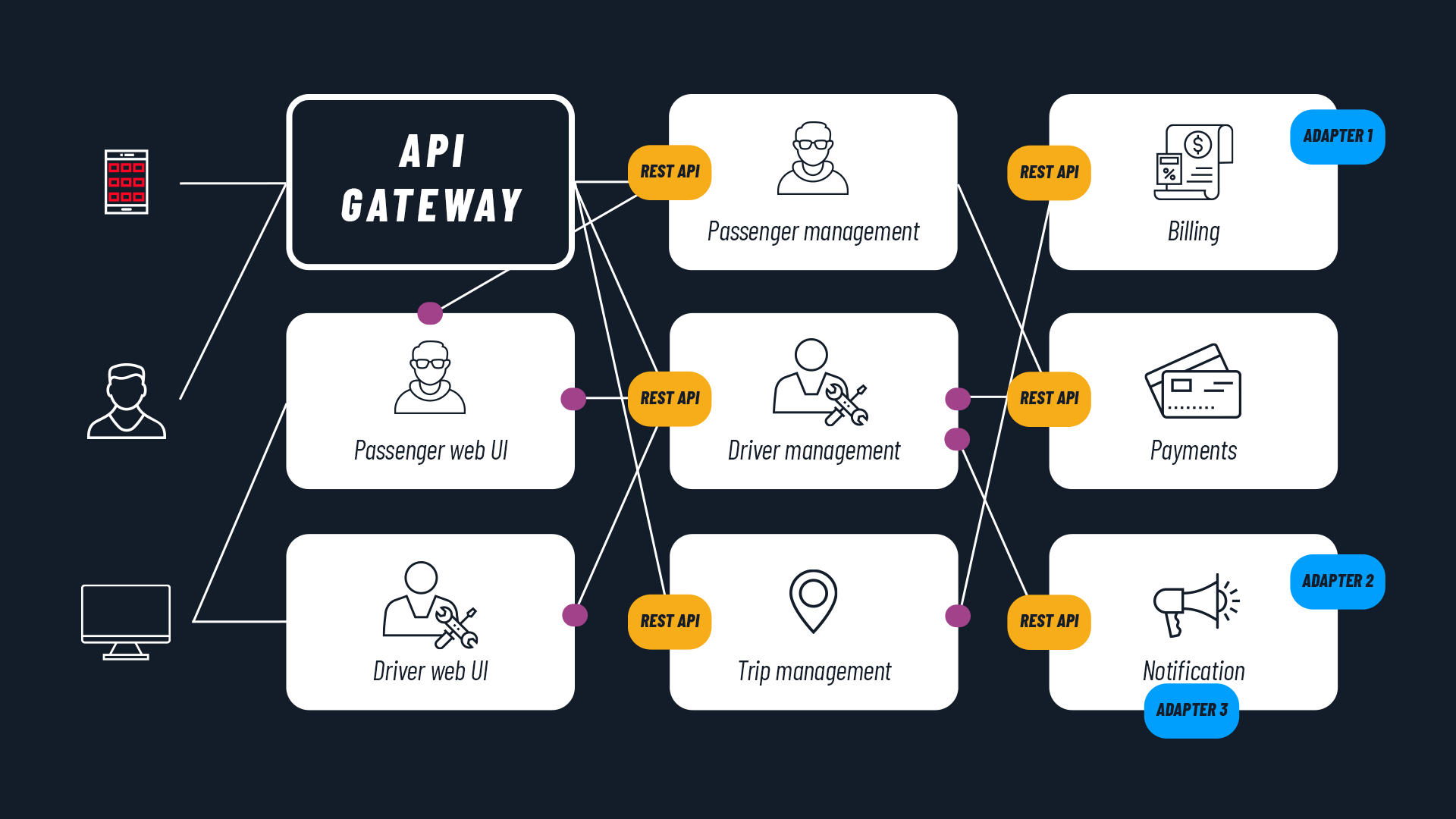
The introduction of multidisciplinary DevOps teams opens the door to Microservices. Microservices are an architectural style that approaches the development of a single app as a suite of modular and independent services, which can be easily and continuously developed, maintained and scaled individually without compromising the stability of the entire application. The advantages of this architectural style are evident (we will discuss them extensively in upcoming articles) and we can mention:
- independence of development teams
- isolation and resilience of individual components/services
- scalability and automation of the lifecycle (CI/CD)
INFRASTRUCTURE
Perhaps the most important step on this journey is the introduction of containers and their orchestration. Containers pair perfectly with a microservices-based architecture, guaranteeing portability across various environments and infrastructures, and ensuring that applications are isolated and secure. They are the answer to the need for horizontal scalability of modern applications, providing a tool that makes available disposable instances of the same component that can be deployed or removed quickly based on actual instantaneous demand.
COMMUNICATION
The use of modular and self-contained services makes it possible to base all communication between the various components of the application on lightweight, technology-agnostic APIs. This constitutes a further step toward reducing deployment complexity and allows an additional level of developer independence, as they can choose the right technology for the job they need to do without worrying about its integration with the rest of the application.
In the upcoming articles, we will venture into the details, delving deeper into the theoretical aspects and demonstrating how to put these principles into practice using the open-source tools available to us.
We will continue the discussion on methodologies and best practices, explaining why the twelve-factor methodology represents one of the most solid and credible approaches.